Woodlands.co.uk

Blog - November 2026

Holm, Holegn or Holly by any other name.

Holm, Holegn or Holly by any other name.

by The blog at woodlands.co.uk, 19 November, 2026, 0 comments

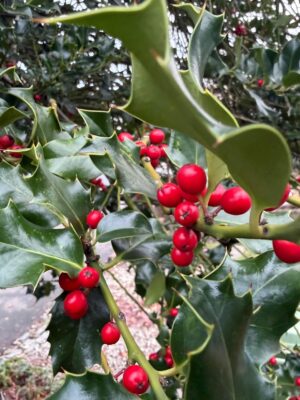
Holly is not a ’typical’ woodland tree, it is an evergreen tree but not a conifer.  Also, holly trees are either either male or female; that is, holly is dioecious.  Lastly, holly leaves usually have spines and a shiny appearance due to their thick, waxy cuticle.  The word ‘Holly” comes from the Old English “holen” or “holegn”.  It was also known as ‘holm’, ‘holme’, or ‘hollin’. These names are useful when examining old maps and ancient texts to determine the historical distribution of holly woodland across the U.K.  It is certainly the case that the holly woodland was more widespread, for example, there was Needwood Forest in Staffordshire.  Needwood was an ancient midlands forest but following the Enclosure Act of 1803, large numbers of trees were felled.  Professor David Mabberley notes in his ‘Plant Book’ that some 150,000 holly trees were taken from Needwood to provide wood for the bobbins of the cotton mills of Lancashire. Bagot's Wood is the largest remaining piece of Needwood Forest, found near to Abbots Bromley. One of the more unusual holly woods is found at the Stiperstones in Shropshire.  Here, some of the holly trees are pollarded and thought to be over two hundred years old, possibly more as judged by their circumference.  Some of the holly trees have other species growing out of them,  such as Rowan.  They are sometimes referred to as ‘cuckoo trees’. Holly was much more common in the past, and was a source of fodder. The leaves are palatable to livestock, despite their spines.  It is the only evergreen tree (found in deciduous forest or woodland) that does not contain chemicals that are toxic to sheep or cattle.  Yew, one of our native conifers, is very toxic. For many centuries, it was common to provide holly for livestock during the winter months, when other foodstuffs [such as hay or grains] was in short supply.  Without the holly, livestock might have to be slaughtered leading to problems in subsequent years.  Using holly as fodder was more common in areas like Cumbria, the Welsh Borders and the Pennines. The leaves contain a bitter tasting alkaloid - ilicin. This bitter taste deters many leaf eating insects. Indeed, compared to oak, the holly is rarely subject to sustained attack by insects. However, its leaves can harbour the holly leaf miner and the larvae of the Holly Blue butterfly (Celastrina argiolus).  The leaf miner can leave pale, twisting trails in holly leaves, as it feeds upon the tissues of the leaf.  The larvae are protected to some degree by the tough cuticle of the leaf. Holly exhibits heterophylly, that is you can find different types of leaves on the same tree.  Lower branches and young trees produce prickly, spiky leaves which deter browsing mammals, like deer.  However, higher up in the canopy and out of reach of animals, the leaves have a smooth outline and few, if any spines.  The prickly leaves and interlocking branches provide a relatively predator-proof home for nesting birds, such as the Mistle Thrushes.  The berries are a food source for birds such as redwings and fieldfares.   Holly woods have a distinct ecology due to the plant’s evergreen nature.  Stands of holly can form a dense canopy so that the amount of light reaching the woodland floor is limited so that many of the ‘usual’ woodland plants cannot gain a foothold.  However, the canopy can create the right conditions for mosses, liverworts and lichens.   In the past, Holly was used for hedging as it was relatively impenetrable and durable. The downside of using holly was its relatively slow growth compared to hawthorn.  The wood of Holly has been used in cabinet making, wood engraving and veneering. The leaves, berries and twigs have been used to decorate homes and holy places for centuries. The foliage and berries tends to last quite well in garlands and wreaths, and other displays. An early reference to the use of Holly at Christmas time can be found in Stowe's 'Survey of London' (1598) to quote 'every man's house, ….. the corners of streets were decorated with holme' (where holme is one of the old names for holly). * The British Agricultural History Society website http://www.bahs.org.uk/ has information and articles on Holly, for example 'Holly as a Fodder in England' by Martin Spray, 1981; 'Holly as a Winter Feed' by Jeffrey Radley, 1961.]
Early flowers need a helping 'hand'

Early flowers need a helping ‘hand’

by The blog at woodlands.co.uk, 14 November, 2026, 0 comments

It is well known that some birds pollinate flowers. These birds are mostly found in tropical and subtropical regions and typically they ‘target’ large, brightly coloured flowers rich in nectar.  Perhaps the best known of these avian pollinators are the hummingbirds, which can hover in the air, whilst feeding on the nectar using their long tongues. Until recently, not much was known about birds acting as pollinators in more northern latitudes.  However, recently biologists were using mist nets to catch and record the birds present at Wicken Fen (in Cambridgeshire).  This is the  UK's oldest National Trust nature reserve and it is a remnant of the ancient fenland that once covered parts of East Anglia.  Whilst ringing and recording the birds, they also swabbed them for pollen grains. They found that nearly 90% of the birds were carrying pollen, such as wrens, blue tits, and bullfinches. The pollen they carried often came from four species : Goat willow Blackthorn Hawthorn Buckthorn This raised the question “were these birds acting as pollinators?”  So a simple experiment was devised.  They bagged the flowers of several woody shrubs.  The mesh of the bags was big enough to allow insects to enter but would exclude birds from probing the flowers.  They found that the  quantity of fruit set (berries formed) in the blackthorns, hawthorns and buckthorns was reduced, so it was very likely that the birds were helping pollinate the flowers and therefore contributing to fruit set. These particular species of shrub flower relatively early in Spring, often when the temperature is below ‘the bumblebee operating temperature’ (circa 13oC).  Without the activity of the birds, pollination would be reduced as these flowers do not self pollinate.   Though this study was limited to one specific area, it seems probable that a number of our flowers and birds are at least partially dependent on each other. Full details of this study can be found here : https://besjournals.onlinelibrary.wiley.com/doi/10.1111/1365-2745.70361
Which oak is which?

Which oak is which?

by The blog at woodlands.co.uk, 6 November, 2026, 0 comments

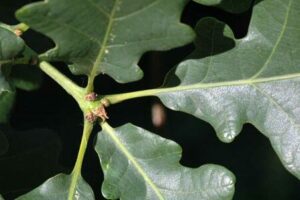
The oak is recognised as being a typically English tree.  But there are several types of oak tree to be found in the U.K. The two native species are : The pedunculate oak - Quercus robur The sessile oak - Quercus petraea   There also three non native or introduced species. Turkey Oak - (Quercus cerris).  This tree was Introduced in the 18th century.  It is a fast-growing tree, that has deeply lobed leaves.  Its acorns are easily recognised as they have ‘hairy’ cups. The bark is also somewhat different.  It is  a dark grey-brown colour, often with deep fissures and prominent orange ‘streaks’ often to be seen near the base of the trunk. Holm Oak - (Quercus ilex).  This was probably introduced from the Mediterranean region perhaps five hundred years ago. Interestingly, it is an evergreen tree.  The leaves are somewhat ‘leathery’ and not dissimilar to holly leaves when first formed  As they mature they have an oval and smooth outline. They may be found in coastal areas as they are salt tolerant. Red Oak - (Quercus rubra).   This is a North American tree that was often planted in parks and stately gardens, as its large leaves turn an impressive scarlet colour in autumn.  But how to distinguish between the two native oaks?  Firstly, the pedunculate oak is more likely to be found in nutrient rich, damp soils in Southern England.  The sessile oak is more likely to be found on well drained, upland soils.  It does not like to ‘get its feet wet’.  If geography does not give a clue, does the tree have acorns?  The acorn of the pedunculate oak has long stalks, called peduncles. The sessile oak by comparison has acorns that sit directly on their twig - no stalks. Turning to the leaves, things now change around.  The leaves of the sessile oak have stalks (petioles), whereas the pedunculate oak either has no stalks or very short ones.  Another feature that separates the two trees is that the pedunculate leaf has two small ear-like lobes where the leaf joins the twig, whereas the leaf of the sessile oak gradually taper into the stalk (aka, the peduncle).  The overall appearance of the trees may differ with the pedunculate oak usually having a large, spreading canopy, whereas that of the sessile oak is more upright / narrow.