Woodlands.co.uk

Blog - acorns

Woodland Oaks.

Woodland Oaks.

by The blog at woodlands.co.uk, 10 July, 2026, 1 comments

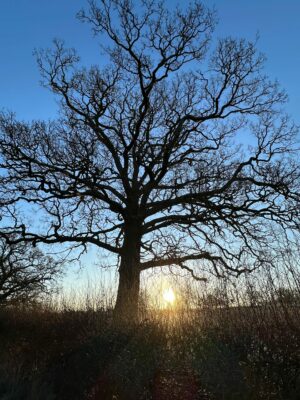
The oak is a keystone species.  Just as building an arch, the stability of the arch is gained from the positioning of the central stone - the keystone, so in many woodlands oak trees are what holds the woodland together; offering both stability and diversity.  There are two types of oak : The pedunculate oak, which ‘likes’ richer and somewhat heavier soils.  It can be distinguished from the sessile oak as Its acorns grow on long stalks [called peduncles]. The sessile oak, which can grow and survive on poorer and somewhat acidic soils, so can be found in upland areas.  Its acorns sit more or less directly on a twig. Both these oak trees contribute to many woodlands across the UK, and have done so for thousands of years.  Some have great age and are veteran trees. Their life can be between 300 and 800 years.    An oak woodland often represents the climax community in lowland Britain, which has considerable stability.  Because of their long lifespan and great biomass, they also represent significant stores of carbon.  Their extensive canopy also moderates the temperature and humidity of the woodland beneath, allowing for the growth of shade tolerate species such as hazel and holly. The trees also support an amazing diversity of life,  some two thousand species are known to find a ‘home’ in oak trees.  Feeding on the leaves or flowers are hundreds of species of insects - notably moths and butterflies.  The leaves provide food for many species of caterpillars, which in turn are a food source for birds, like the tits and warblers.  The branches of the trees provide nesting and roosting sites for many bird species.  The acorns of the oaks are a rich source of nutrients and energy not only for squirrels, but also mice, deer and other mammals.  Birds, like the jay, also take them.  Jays and squirrels create ‘caches of acorns’, that is they bury them as a store for later.  However, many are forgotten so they effectively distribute the acorns over a wider area and ‘plant’ future oak trees. The bark of the oak is rough and corrugated offering specialised niches for lichens and mosses.  When an oak dies , it is then home to a variety of fungi and beetles, which feed upon the rotting wood (saproxylic beetles).   The roots of an oak penetrate deep into the soil, which helps improve drainage, and the roots establish mycorrhizal connections with soil fungi.  These connections are symbiotic in nature, in that both partners benefit from the association.   The tree gets mineral nutrients from the fungi, and, in return, diverts some of its carbohydrate material to the fungi.  The breakdown of the oak leaves in autumn returns vital nutrients to the soil and provides food to a variety of decomposer organisms, from bacteria to earthworms.  Thus, oaks are a vital part of many woodland food chains.   Sadly, our oaks face a number of threats.  In elizabethan times, the main threat was that of being cut down and used in ship building.  At the height of Nelson’s navy in the late eighteenth century / early nineteenth century it took some 4,000 oak trees, to build a single 100-gun ship, and the navy had some 300 ships!  More recently, there have been problems with acute oak decline and infestation by the oak processionary moth.  The caterpillars of this moth feed on oak trees and large populations can strip an oak tree bare.  This leaves the tree vulnerable to other pests, and stresses such as drought.    Incidentally, contact with the hairs of the older caterpillars of this moth can cause itching, skin rashes and eye irritations, plus sore throats and breathing difficulties in us and other animals.   
beech nut

Mists, Mast and mellow fruitfulness

by The blog at woodlands.co.uk, 26 September, 2025, 0 comments

Autumn is here, whether you follow the definition of meteorological autumn, which starts on the first of September or the astronomical autumn which starts at the autumn equinox.  The equinox is when day and night length are equal, after that time the days get shorter. Or it might be that you are noting the signs of the seasons changing.  The BBC, the Woodland Trust and Nature’s Calendar chart the advance of autumn by recording events in the life of key species, for example blackberry, hawthorn, swifts, conkers, ivy and oak.  The information collected helps build a picture of how climate change is affecting the time of flowering, fruiting  etc. of many species. The blog has already commented on the early flowering of the blackberries but now woodlands are starting to transform into a mosaic of reds, yellows, and oranges as the leaves prepare to be shed and the woodland floor becomes a fungal jungle, (as Jasper has described). Hawthorn, Blackthorn and other bushes are laden with berries, conkers and acorns will be strewn across woodland floors. Squirrels eat hazelnuts (and hide some of them as a winter food store).  This banquet of fruits and seeds may be a response to the long, hot and very dry summer we have just experienced.  Trees and shrubs have been stressed by the heat and drought. Some have responded by mobilising their reserves / efforts into producing more fruits and seeds, to ensure that they pass on their genes to the next generation.   [caption id="attachment_24651" align="aligncenter" width="600"] Sloes on Blackthorn[/caption] If it seems like you have been noticing more acorns on the trees than normal that could be down to a "mast year”. Mast years occur roughly every five to ten years and refer to years when certain species of trees Like oak & beech) and shrubs produce a larger than normal crop of berries, nuts and fruit.  This boost in production means far more is produced than can be eaten  by the usual herbivores, squirrels, dormice etc, thus ensuring at least some of the mast goes on to grow new plants.  However, this ‘over-production’ can come at a cost to the tree, using vital resources so that growth in the subsequent year may be reduced.  Quite what causes trees and shrubs to ‘go mad’ and overproduce is not known but some theories are explored in a previous blog, though the weather in Spring is an important factor. [caption id="attachment_42689" align="aligncenter" width="675"] Collecting acorns.[/caption]
The times they are achanging

The times they are achanging

by The blog at woodlands.co.uk, 1 September, 2025, 4 comments

This morning,  the Today programme (Radio 4) featured an interview with Kevin Martin ( Head of Tree Collections at Kew) and Chris Packham (environmental compaigner).  They were explaining the ongoing effects of this summer’s hot and dry weather.  Mr Martin said that the trees at Kew were “ tired, they have had a stressful summer”.  The result is that many trees are entering their dormant stage, moving materials from aerial regions to the roots - much earlier than usual.  The colour changes in leaves and leaf drop do not usually occur until well into October but this year such changes are already  proceeding apace.  Kew has been able to put some mitigations in place, for example, the watering of young trees which have yet to establish extensive roots systems. This is not true for trees across the UK, where young saplings in particular may have been affected by the dry weather and successive heat waves, [plus increased browsing by the extensive deer population]. Chris Packham spoke of “climate breakdown” and “environmental chaos”, noting that an oak tree near him was ‘festooned with acorns’, but they were only the size of peas.  Normally acorns would fall later in the year as food for wood pigeons,jays, squirrels and badgers.  Jays help ‘plant’ oak trees by distributing acorns.  He said that whilst local hawthorns were red with berries, which would normally be food for winter thrushes later in the year, the berries would now be dried up / shrivelled when the birds arrived to search for them.  Though lots of hedgerow fruit [e.g. sloes, rose hips, blackberries] is being produced, it is being produced at the wrong time.  He also commented on the scarcity of mole hills as moles are forced to burrow deeper in the soil in search of earthworms etc. As the seasons change, some plants and animals adapt. For example,  blackcaps from Northern Germany fly to the UK rather than Spain to overwinter.  During a relatively short period, their wing length has changed, actually shortened - a case of evolution in action.  However, many species are struggling.   The  wet summer of 2024 was particularly difficult for butterflies, as evidenced by the data collected by the Big Butterfly Count. Nature's timings are now ‘out of sync’, plants and animals are further impacted by extreme weather events, flooding, high winds and extreme temperatures. [caption id="attachment_24651" align="aligncenter" width="600"] Sloes on Blackthorn.[/caption] https://www.metoffice.gov.uk/about-us/news-and-media/media-centre/weather-and-climate-news/2025/double-record-breaker-spring-2025-is-warmest-and-sunniest-on-uk-record  
Tree planting vs Natural Regeneration? And a film

Tree planting vs Natural Regeneration? And a film

by The blog at woodlands.co.uk, 13 January, 2025, 1 comments

Woodlands TV has just released another film, which discusses the pros and cons of tree planting in an area, as opposed to allowing natural regeneration.  Many years ago, Kenneth Mellanby [Director of a Research Station near Huntingdon] thought that it would be interesting to watch what happened to a barley field if it was left to its own devices.  The 4 acre field was ploughed for a final time in 1961 and then ‘abandoned’. The field sat next to an area of ancient woodland - Monks Wood. The changes in the field were monitored in succeeding years and eventually becoming known as the Monks Wood Wilderness Project.   In the first 10 to 15 years, a thorny scrubland developed with hawthorn and bramble.  Birds were attracted by their fruits and berries.  The birds dispersed the seeds of the fruits across the plot, and also brought in seeds from other areas (such as the adjacent woodland).  The bramble and hawthorn scrub afforded protection from the wind and herbivores [rabbits, deer etc] for young, delicate tree seedlings.  Wind blown seeds arrived in the area, such as ash and field maple.  Other tree seeds were deposited by birds, Oak began to grow.  Acorns were probably carried in by Jays, who bury them as a winter food store.  An acorn is a rich food source - containing fat, carbohydrates, proteins and micronutrients.  A single jay can scatter many hundreds of acorns each year.  They store more than they need, so some will germinate and grow on to saplings.  Whilst many different birds spread tree and shrub seeds, jays have been known to carry acorns significant distances and probably contributed to the northward spread of the Oak as the glaciers of the last Ice Age retreated. A mature oak tree can provide food and / or a home for many species of animals, plants and fungi. The former barley field has been monitored over the decades, and by 2014 it had become an oak woodland.  This despite the usual depredations of Rabbits, Hares, Muntjac Deer and Roe Deer which have been present at various times over the years.  So given time, former agricultural land can revert (rewind) to mixed deciduous woodland with a diverse collection of plants and animals.  For further details of Monks Wood - visit https://www.naturewalkswithcarol.com/monks-wood-nature-reserve.html The woodlands TV film features ecologist Connor McKinnie who highlights key factors to consider when planning woodland creation, such as tree protection methods, planting pattern, and species. This is the second film with Connor, exploring aspects of rewilding.  The first film is presented below : [embed]https://youtu.be/HZNX9hTzQaU?si=-Ivv4aziPzi4a3cA[/embed] The latest film may be viewed on YouTube by following this link : https://youtu.be/Qx7uiOlGjFY

Next Page »