Woodlands.co.uk

Blog - ancient trees

Woodlands web updates 21

Woodlands web updates 21

by The blog at woodlands.co.uk, 19 January, 2023, 0 comments

Ancient Trees A recent report has emphasised the importance of protecting and preserving ancient trees.  Ancient (veteran) oaks can live in excess of a thousand years, as can Yews.  The Bristlecones of California and Nevada may live for some five thousand years ! Such trees represent a massive carbon store; the carbon dioxide from the atmosphere being locked away for a millennium or five!  Not only are such trees a significant carbon store but they also offer a home or food for many other species - fungi, epiphytes such lichens & mosses, plus larval and adult stages of insects, birds and mammals.  As such they localised centres of diversity that contribute to ecosystem stability.  Not only are these trees ‘hotspots’ for species diversity but they are also centres of mycorrhizal activity and connectivity.  Mycorrhizae represent the symbiosis between fungi and plant. Plants ‘register’ wounding. When we are hurt, our nerves register the pain through the movement of sodium and potassium ions along the nerves.  When a plant is wounded, calcium ions are known to move in response, travelling from cell to cell, and leaf to leaf.  However, it is now known (through research at the John Innes Centre in Norwich) that this is not the first response of the plant to physical injury.  When cells are wounded they release glutamate, a form of glutamic acid.  This travels along the cell was and activates channels in the cell membranes that allow the movement of the calcium ions.   A bumblebee pathogen. One of parasites of bumblebees is Crithidia bombi.  It is a protozoan (single celled animal) that reproduces in the gut of the bumble bee. When infected with this parasite the foraging behaviour of the bee is impaired, as is its ability to learn.   A colony will suffer from increased worker mortality.  Now research has shown that floral structure may influence the transmission of this parasite from bee to bee.  The length and shape of the petals seems to be a critical factor.  If the bees ‘crawls’ in a ‘tube’ of petals, then it may leave behind some faeces.  If the bee is infected with the parasite, then it will be present in the faeces.  If the flower is then listed by another bee then it runs the risk of coming in contact with and being infected with the parasite.  Plants that have flowers with shorter petals / corollas are less likely to have faeces deposited within them, and therefore less likely to pass on the parasite to the visiting bumblebees.
woodland web updates - 21

woodland web updates – 21

by The blog at woodlands.co.uk, 5 December, 2022, 0 comments

Ancient Trees A recent report has emphasised the importance of protecting and preserving ancient trees.  Ancient (or veteran) oaks can live in excess of a thousand years, as can Yews.  The Bristlecones of California and Nevada may live for some five thousand years ! Such trees represent a massive carbon store.  The carbon dioxide from the atmosphere being locked away for a millennium or five!  Not only are such trees a significant carbon store but they also offer a home or food for many other species - fungi, epiphytes such lichens & mosses, plus larval and adult stages of insects, and a variety of birds and mammals.  As such the are localised centres of diversity that contribute to ecosystem stability.  Not only are these trees ‘hotspots’ for species diversity but they are also centres of mycorrhizal activity and connectivity.  Mycorrhizae represent a symbiosis between fungi and plant. Plants ‘register’ wounding. When we are hurt, our nerves register the pain through the movement of sodium and potassium ions along the nerves.  When a plant is wounded, calcium ions are known to move in response, travelling from cell to cell, and leaf to leaf.  However, it is now known (through research at the John Innes Centre in Norwich) that this is not the first response of the plant to physical injury.  When cells are wounded they release glutamate, a form of glutamic acid (an amino acid).  This travels along the cell wall and activates channels in the cell membranes that then allow the movement of the calcium ions. A bumblebee pathogen. One of parasites of bumblebees is Crithidia bombi.  It is a protozoan (single celled animal) that reproduces in the gut of the bumble bee. When infected with this parasite the foraging behaviour of the bee is impaired, as is its ability to learn.   A colony may also suffer from increased worker mortality.  Now research has shown that floral structure may influence the transmission of this parasite from bee to bee.  The length and shape of the petals seems to be a critical factor.  If the bees ‘crawls’ in a ‘tube’ of petals, then it may leave behind some faeces.  If the bee is infected with the parasite, then it will be present in the faeces.  If the flower is then visited by another bee then it runs the risk of coming in contact with the faeces and being infected with the parasite.  Plants that have flowers with shorter petals / corollas are less likely to have faeces deposited within them, and therefore less likely to pass on the parasite to the visiting bumblebees.
Veteran trees and an ancient swedish oak

Veteran trees and an ancient swedish oak

by The blog at woodlands.co.uk, 8 August, 2022, 0 comments

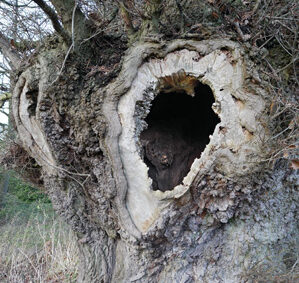
Veteran trees may be defined by a number of features: age size; condition; history; position. Neither age nor size in themselves define veteran status. These features have to be viewed in relation to typical values for each tree species.  Thus, a one hundred year old birch or willow might be ‘deemed’ a veteran but a one hundred year old oak or yew would be a youngster.  To be termed a veteran, a tree should show some of the following features the trunk should be large (for the species) decay holes in parts of the trunk the trunk may show signs of damage and/or bark loss dead wood in the canopy fungal fruiting bodies often present (from heart rot fungi) epiphytes, such as mosses and lichens are present the tree supports a rich variety of different species the shape or position of the tree is of interest the tree may have cultural or historical interest, some  were used as gallows! Some veterans achieve their status through the management of the tree, such as pollarding or coppicing.  There are thousands of ancient trees in the UK and the Ancient Tree Inventory not only offers a way of finding ancient trees across the country but also you can add details of trees). Veteran trees can be found in many countries, though the may go under different names. In Australia, veteran or ancient trees are often connected with the social, cultural, and legal practices of the aboriginal peoples.  In Italy, an Albero Monumentale (‘a monumental tree’) is defined under National Law [number 10, 14th January 2013]. In Sweden, the oldest oak (Quercus robur) is the Rumskulla Oak , also known as the Kvill Oak. It is found in Kalmar County, Småland.  The name Rumskulla derives from its older form Romfarakulla ( = Rome + travel + hill); the area was a resting place for pilgrims that  to made the journey to Rome. It is one of the largest trees in Scandinavia, being some 14 metres (46 feet) high and with a trunk circumference of 13 metres (43 feet). Its girth is still increasing.  In the severe winter of 1708-09, the crown was was damaged and much lost. The tree is over a thousand years old and was first described in 1772.  The tree is now supported by iron bands and wire.  Like many veterans, its centre is hollowed out and it is covered with mosses.   There are many holes, cracks and crevices.   The Rumskulla Oak is registered as a national natural object of interest, with the Swedish Heritage Board. Thanks to Fredrika for the photos.
veteran tree

Veteran trees and veteranisation.

by The blog at woodlands.co.uk, 12 February, 2022, 0 comments

A thousand years ago, significant areas of the country were devoted to wood pasture, that was grazed by livestock.  As time passed, much of this became royal hunting forest - a mixture of woodland, coppice, open land and farms.  As the woodlands were managed (through traditional techniques such as coppicing and pollarding), many of the trees were able to grow to maturity.  They became veteran trees.  Trees such as beech reach maturity after some 200 years, oaks take 400 years and yew 900+.   Such veteran trees can be seen in areas like the Savernake (south of Marlborough) and Sherwood Forests. Saverrnake has veterans like the Big Belly Oak, and Sherwood has the Major Oak.  Sadly, since the nineteenth century many veteran trees and ancient woodlands have been lost due to the expansion of agriculture, housing development and road & rail creation.  Veterans have also been lost from hedgerows, many of which were grubbed out to enlarge fields to allow for increasing mechanisation. As oaks and beeches age so they change, they expand, trunks hollow, cracks and holes appear, heart rot develops and dead wood appears.  Each tree offers a myriad of micro-habitats.  Bracket fungi feed on the dead heart wood, as do stag beetle larvae.   Mosses and lichens live on the bark, attached to crevices that channel the rain down the trunk, bats, woodpeckers and nuthatches inhabit holes. Other birds (like redstarts) nest in the branches and twigs.  The decaying leaf litter beneath the tree offers sustenance to a variety of beetles, and fungi (e.g. oakbug milkcap).  English oaks are associated with more than two thousand species, and more than two hundred are directly dependent on the trees. The loss of so many veteran trees has resulted in an international project to determine if these trees can be ‘replaced’.  It involves a technique termed veteranisation. Younger trees are damaged in order to start the process of decay and ‘ageing’.  The process may include Creating woodpecker-like holes Creating nest boxes for birds / bats Breaking branches Damaging the bark / trunk - to simulate deer / animal damage Inoculation with fungi It is being trialed at some 20 different sites in Norway, Sweden and England.  The project started in 2012 and will run for some 25 years.  It is hoped that such ‘techniques’ could be used to accelerate the formation of veteran trees status with its associated biodiversity. Thanks to Angus for tree jpgs. For further information : https://naturebftb.co.uk/wp-content/uploads/2021/09/Introduction-to-Ancients-of-the-Future-Jamie-Robins.pdf https://www.gov.uk/countryside-stewardship-grants/creation-of-dead-wood-habitat-on-trees-te13 https://www.woodlandtrust.org.uk/media/1798/wood-wise-ancient-trees.pdf  (opens PDF)

Next Page »