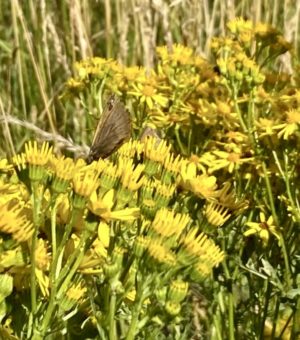
The common ragwort
by The blog at woodlands.co.uk, 7 July, 2024, 4 comments
Ragworts are a group of daisy-like flowers. The flowers are actually composites, that is, they are made up of many smaller flowers held together in a structure called a capitulum. The family of daisy-like flowers is known as the Asteraceae (previously called the Compositae). There are several different species of ragworts, for example :
Common Ragwort (Jacobaea vulgaris, previously Senecio jacobaea)
Oxford Ragwort (Senecio squalidus)
Hoary Ragwort (Senecio erucifolis)
Marsh Ragwort (Senecio aquaticus)
Silver Ragwort (Senecio cineraria)
Perhaps, the Common Ragwort and the Oxford Ragwort have attracted the most attention in recent times. The story of the Oxford Ragwort is interesting. The plant is actually native to Sicily, growing on volcanic ash and scree. It was grown in the Oxford Botanic garden around 1690. After some years, it ‘escaped’ and could be seen growing around Oxford. Later, with the advent of the railways, it was able to spread along the railway tracks and then across the country. The genetics of this plant and related species have been the subject of various research projects in recent years, and has resulted in the ‘reclassification’ of some ragwort species.
However, it is the Common Ragwort (Jacobaea vulgaris, previously Senecio jacobaea) that has been the focus of much attention. This is a native, biennial plant, but can be perennial. Its seeds are spread by wind and a single plant can produce thousands. Consequently, it can become a problem on waste land or other uncultivated areas. Ragwort may be seen in coppiced woodland, particularly in the years immediately after cutting the coppice when there is lots of light and the ground flora 'comes alive'.
The plant is a good food source for a wide range of insects and it is much 'loved' by pollinators. Over a hundred insect species feed on its nectar (bees, flies, moths and butterflies). Not only is it a good source of nectar, it also provides a home and / or a food source for many invertebrate species. Some insects feed on the ragwort exclusively.
[caption id="attachment_40185" align="alignleft" width="300"] Cinnabar moth caterpillar[/caption]
One species that is particularly associated with this plant is the cinnabar moth, whose status is described as ‘common and widespread, but rapidly declining”. The caterpillars are distinctive with yellow and black stripes. They feed on the ragwort absorbing its alkaloids, which make the caterpillars distasteful to predators. Alkaloids are organic compounds produced by plants and many of them have potent medical uses - such as quinine (for malaria) or morphine (pain relief). Most alkaloids have a bitter taste. Many alkaloids are toxic (for example, atropine from the nightshade family of plants). The alkaloids present in ragwort can make it a problem when present in fields / areas grazed by horses or cattle, though it is not usually a problem in gardens. Horses do not normally eat ragwort due to its bitter tasting alkaloids but if consumed in any quantity then the alkaloids can cause liver damage (a form of cirrhosis).
[caption id="attachment_40489" align="alignleft" width="300"] Tweet from Prof Goulson[/caption]
Ragwort poisoning is relatively uncommon and may arise through feeding with hay that contains dried ragwort. In U.K., the common ragwort is classed as an injurious weed under the provisions of the Weeds Act 1959, and there is the Ragwort Control Act 2003. The latter provides for a code of practice relating to ragwort. Removing common ragwort from an area is not without its problems. Sometimes, other species are ‘identified’ as ragwort and sprayed with weedkiller.
Friends of the Earth have produced a ‘briefing’, which notes that
Ragwort has been blamed for animal deaths which are unproven
Scare stories have been based on poor or irrelevant statistics, and biased surveys
Ragwort has been falsely labelled as a threat to human health / the countryside
As a result, unnecessary measures have been used to control ragwort (in nature reserves or areas like the New Forest, and indeed roadside verges).
The briefing, entitled “Ragwort: problem plant or scapegoat?” which can be accessed here offers a number of solutions to the ‘ragwort problem’
Further information about controlling ragwort is available on WoodlandsTV - see below:
[embed]https://youtu.be/esfLW0nIvNo?si=DQ2Uokq7U1pAJYMZ[/embed]