Woodlands.co.uk

Blog - bark damage

The trouble with squirrels

The trouble with squirrels

by The blog at woodlands.co.uk, 17 November, 2025, 4 comments

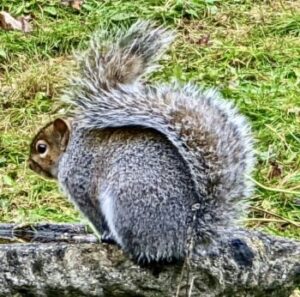
 The red squirrel is a native species, it has been present in the British Isles since the retreat of the glaciers of the last ice age -so around for some 10,000 years.  The grey squirrel on the other hand has only been here since the mid nineteenth century, when it was introduced from America.  Though relatively small numbers were introduced at stately homes, it did incredibly well and they spread out from their original sites, colonising woodlands and spreading across the country.  As the grey squirrel spread so the red squirrel retreated and its numbers declined. Recent population estimates suggest that the grey squirrel population may now be as high as three million, whereas the red squirrel numbers are probably less than 300,000. The grey squirrel is to be regarded as a pest.  Why ? (a).   They strip bark from trees.   This is the main type of damage type of damage. The squirrels remove  bark to access the sap tissues underneath. [caption id="attachment_42793" align="aligncenter" width="675"] Squirrel damage[/caption] (b).   They cause the death of trees.  The damage to the bark and the underlying tissue can affect the flow of water and nutrients from soil to leaves.  It can also allow for the entry of pathogens (parasitic bacteria and fungi). (c).   Their activities have an impact on the quality of timber that can be harvested. (d).   They are associated with biodiversity loss, not only do they complete with and displace the native red squirrel, their presence can affect other woodland species such as songbirds (eat their eggs) and dormice. (e).   Grey squirrels pass on the squirrel pox virus to red squirrels.  Once infected the red squirrels tend to die of dehydration and starvation. [(f).   The grey squirrels that visit my garden dig up bulbs, like crocus, tulips and hyacinths.  They also make raids on soft fruits.] [caption id="attachment_42794" align="aligncenter" width="675"] Older damage by squirrels[/caption] There are measures to stop or limit grey squirrels from breeding.   One ‘extreme’ measure is shooting or trapping followed by euthanasia.  Another measure is the introduction of Pine Martens, they seem to control the numbers of grey squirrels whereas red squirrels have co-existed with Pine Martens in areas like north Scotland for many years.   However, the Governments Animal and Plant agency is developing a contraceptive.  This is a vaccine based product which causes the squirrel’s immune system to render both males and females infertile.   The vaccine induces the formation of antibodies against the animals own reproductive hormones. The idea is to fed it to the grey squirrels through feeding hoppers that grey squirrels can access but not red squirrels or other animals. The bait will need to be palatable and attractive to the squirrels. Should this prove successful, it will be a non-lethal way of reducing the numbers of the grey squirrel without shooting or trapping.   For detailed information on the squirrel contraceptive project, visit https://aphascience.blog.gov.uk/2024/09/30/reducing-grey-squirrel-overpopulation/ Similarly, lots of information on squirrel damage here : https://www.observatree.org.uk/media/1425/identifying-squirrel-damage.pdf  
Grey squirrel damage.

Grey squirrel damage.

by The blog at woodlands.co.uk, 22 July, 2024, 0 comments

Much has been written about the explosion of the UK deer population in recent times, and the damage to woodlands through their browsing activities.  However, the grey squirrelis associated with tree damage.  The grey squirrel is not just the 'cheeky chap' who steals the bird food in the garden, it is a serious pest.    The grey squirrel is a non-native species.  It was introduced in the 19th century.  The squirrels have spread across the country and have displaced the native red squirrel from many areas (either through competition or disease).  The grey squirrel's bark stripping activity now poses a threat to the sustainable management of woodlands. Gnawing of the bark means that they can get to the sweet, sap filled tissue (phloem) just beneath the bark. This tissue is responsible for the movement of sugars and other organic molecules around the plant (known as translocation). If the gnawing extends around the stem then the tree is ‘ringed’ [i.e a complete circle of bark and underlying tissue is removed]  then the tree us likely to die.  The squirrels tend to take bark from the main stem (and branches). The bark stripping may : Lead to the loss of particular tree species (for example, beech) Lead to the loss of insect / spider and fungal species associated with the loss of tree species, i.e. a loss of biodiversity allow fungal infection of the tree Reduce carbon capture Reduce the economic value of timber Act as a disincentive to creating new woodland for timber In order to reduce squirrel damage, it is important to Start inspecting for damage in late February as damage typically occurs in early Spring.  Examine the base of trees for damage. Look for ‘tester patches’ made by squirrels (to which they may well return later). Check young, broadleaf trees as they are particularly favoured by the squirrels.  Oak and beech are quite vulnerable to damage (see image of damaged beech trunk below). Recent research* at Bangor University has investigated the microbiome of the squirrel in relation to its bark stripping activity.  The microbiome of the gut refers to the various micro-organisms found with the intestines.  Analysis of bacterial DNA found in the colon of great (and red) squirrels revealed that grey squirrels had 'oxalobacter' bacteria in their colons.  These bacteria are able to 'release / access' calcium from the tree bark to the squirrels.  Calcium is an important nutrient in terms of bone building and is also involved in muscle contraction. had  a more diverse bacterial population in the colon. These findings may help explain why the grey squirrel 'outcompetes' the red squirrel.  Their more diverse gut microbiome may mean that they can access a greater range of resources. For example, grey squirrels can digest acorns, which red squirrels cannot;  this is possibly associated with tannin content of acorns. In order to reduce damage in a woodland, the number of grey squirrels may need to be managed.  This can be done though trapping or shooting.  Trapping is a legally acceptable and effective way of controlling grey squirrels in most situations. Grey squirrels can be trapped throughout the year though March to September is a good time as food is less abundant. Through autumn, berries, nuts and seeds [natural foods] are available so trapping is less successful.  Details of the various types of traps and their use / placement may be found at: https://greysquirrelcontrol.co.uk/trapping-method.php https://www.britishredsquirrel.org/wp-content/uploads/2016/07/Grey-Squirrel-Best-Practice.pdf https://basc.org.uk/pest-and-predator-control/grey-squirrel-control-with-live-capture-traps/ https://www.britishredsquirrel.org/wp-content/uploads/2016/09/Trapping-Protocol.pdf  https://bpca.org.uk/a-z-of-pest-advice/squirrel-control-how-to-get-rid-of-squirrels-bpca-a-z-of-pests-/188983 To go down the ‘shoot to kill’ route then there are a number of rules and regulations to observe.  Details may be found in the link below : http://www.britishredsquirrel.org/grey-squirrels/grey-control/ It is hoped that eventually a form of oral contraception will be developed, which will offer a non-lethal and humane means of population control. Full details of this research work may be found here
Deer control - shoot to kill and cull, or are there other solutions?

Deer control – shoot to kill and cull, or are there other solutions?

by Angus, 30 August, 2023, 9 comments

Deer are eating out the bottom of our woodlands and wildlife is suffering.  Although the size of the national deer population is not known for sure it is probably at its highest for a thousand years. There may be as many as two million deer in the UK’s countryside. There are several types, such as the two native species, being the Red deer (Cervus elaphus) and the Roe deer (Capreolus capreolus) - which is the most populous of the larger deer being, perhaps, 500,000 animals. Then there are the ones the Normans introduced, the Fallow deer (Dama dama) with a population of at least 150,000. On top of that there are three species of deer which have been introduced from the Far East including the Sika deer (Cervus nippon).  The other two from China are very different - there are relatively small numbers of the Chinese Water deer (Hydropotes inermis), whereas there are probably hundreds of thousands of the small and mostly nocturnal Muntjac (Muntiacus reevesi). They are all hungry and they all love woodlands. Most people believe the deer population needs to be controlled, or even reduced in number, but the range of species makes that harder to do. If you reduce the population of one type of deer the others will expand their numbers. Culling, or shooting, is certainly helping but stalkers are usually only interested in the larger species with enough meat to make it worthwhile and this leaves the muntjac space to thrive. Here is a film we made of a Scottish deer stalker explaining her job and how her stalking helps with environmental management: [embed]https://www.youtube.com/watch?v=ISh2sN-Ljy8&ab_channel=WoodlandsTV[/embed] Megan: “99% of stalking is looking through the binoculars.” Other ways of controlling the deer population are fencing them out but that is expensive and unlikely to work in the large open areas of the British countryside such as the moors and the uplands. Another potential method of control is introducing predators such as lynx or other larger hunting species. This meets some resistance from the public and the unintended consequences are that the predators might well go after different species altogether and occasionally humans. Most work is going on with contraceptive solutions so that the birth rate is reduced and less killing or culling is needed. This is also being researched for controlling populations of wild boars and grey squirrels to keep their numbers in check. It means getting the drugs to the target species and usually to the females which is often done through their foodstuffs, using food hoppers which are designed to be only accessible to that species. Other approaches include sterilization through injections and the Deer Initiative partnership has done a lot of work on examining different methods of biological control of deer numbers: https://www.thedeerinitiative.co.uk/pdf/contraception-and-wild-deer-control.pdf It’s not easy.  Even if one of these methods works, it will require an enormous effort to cut deer populations particularly of the smaller and more evasive species such as the muntjac. What do you think should be done? Meanwhile , deer are dangerous to motor cars.  The British Deer society estimates that annually there are between 40,000 and 70,000 accidents involving deer and this leads to about 700 human injuries, and far more deer fatalities!. So, in short, an overpopulation of deer is a large and growing problem: they damage the flora in woodlands, they eat young saplings, they compete with other mammals for space, they eat farmers’ crops, they carry ticks and they cause road accidents. The challenge of controlling the deer population is very real.
Parts of a tree (1): The Bark.

Parts of a tree (1): The Bark.

by The blog at woodlands.co.uk, 25 May, 2023, 0 comments

Bark exists to protect a tree from ‘attack’ by the elements, pests, ‘predators’ (animals who would eat it) and disease causing organisms.  There is no easy definition of what constitutes bark,   a slightly technical definition might be ‘the tissues that lie outside the vascular cambium'.  The vascular cambium is a layer of dividing cells that gives rise to xylem tissue and phloem tissue.  The cells nearer the centre form the xylem, those towards the outside form the phloem.    The inner part of the bark contains various types of living cells, for example, glands that produce latex (as in natural rubber), oils and resins.  Moving outwards, there lies the rhytidome or outer bark, an amalgam of living and dead material - notably cork cells.  The cork cells fill with a waxy material - Suberin. Eventually, these cells die and form much of the bulk of the bark.  The nature of bark is immensely variable. Wind, fire and frost can seriously damage or kill trees but bark helps  to protect them.   Trees are eminently combustible as is evidenced by the recent forest fires in Australia and California. However, some trees have a very thick bark that can protect them against fire.  The cork oak has a bark that can be up to 30 cm thick, it is so thick that it can be harvested periodically without killing the trees.  Cork oak is grown extensively in the mediterranean region. Giant Redwoods too are noted for having an extremely thick bark. Their bark is very fibrous and can be up to three feet thick, it offers protection against fire (and rock fall which is also a hazard in their home habitat). In contrast to cork oak and redwoods, some trees like the eucalypts have a bark that is rich in oils and very flammable.  The bark also ‘peels’, strips are shed onto the forest floor. There are many species of Eucalyptus and several different types of bark are recognised.  [caption id="attachment_35352" align="alignleft" width="300"] Woodland recovering from a fire[/caption] If and when this oil rich bark builds up on the forest floor, it will contribute significantly to the intensity and ferocity of any fire. Indeed, it has been likened to adding petrol to a fire ’3 centimetres of leaf litter can cause a conflagration equivalent to one fuelled by a centimetre of refined gasoline’.  The leaves are also rich in oil so the crowns of the trees can also contribute to / exacerbate any fire.  The peeling or exfoliation of bark is not restricted to Eucalypts, it can be seen in trees much closer to home - such as the birch.  Its bark can be removed in long strips and has been used in covering a canoe or roofing material. Whilst bark can protect against fire, it can also deter animals - large or small from inflicting damage.  For example, there is an African species of Acacia known as knobthorn that has a bark covered with thorn-like structures.  These 'thorns' deter elephants from eating the bark.  Elephants can consume a lot of vegetation in a day and tree bark is much favoured.  A variety of animals may feed on bark material, for example deer, squirrels, and beavers, but the list could also include orang-utans, rhinos, bush babies and porcupines. North American porcupines use their large front teeth to eat bark and stems. Bushbabies generally feed on insects during the wet seasons, but during drought / dry periods - they feed on the resins / gum that flows from the trees in their woodlands. In the UK, a lot of bark damage is done by deer, especially during the winter months when other food sources are limited.  In the summer months, male deer rub their heads / antlers against the trunks of trees - inflicting damage.  Such activity can prevent regeneration in natural woodlands.  Tree guards may be needed to allow young trees to establish themselves (or fencing to create a ‘deer free’ zone).  Guards also protect against rabbit damage.  Grey squirrels can also cause damage to trees as they gnaw stems to reach the ‘sweet’, sap-filled tissues just below the bark, this activity is usually seen in late Spring and early Summer. [caption id="attachment_5312" align="alignleft" width="300"] xylem vessels[/caption] Whilst bark is broadly protective, it can also offer a home to certain pests.  Bark beetles lay their eggs below the bark so that when the larvae hatch, they can feed on the nutrient rich tissue of the cambium and phloem.  Bark beetles have been responsible for the loss of millions of trees in the United States and Canada.  The scale of the loss is much greater than in the past, when cycles of beetle infestation and fire created a mosaic across the countryside of young and old trees.  Ageing stands of trees coupled with warmer winters (which have helped the overwintering stage of the insect)  have contributed to the spread of bark beetles.  The beetles breed and feed beneath the bark, damaging the phloem and cambium tissue.  Consequently, the tree's transport systems begin to fail and the beetles may also introduce disease-causing fungi and bacteria. To a certain extent, trees are able to repair damage to their bark but the response is varied according to the nature of the damage and the tree involved. Some trees can produce ‘callus tissue’ that heals over the ‘wound’, leaving a scar. Some trees, such as the pines, produce resins and antimicrobial compounds in response to injury.  This sticky resin may trap insect invaders as is witnessed by those trapped in time capsules of amber.   Apart from bark beetles, other animals and plants live in or on bark in a variety of associations, some parasitic as is the case with fungi (like the polypores), whilst lichens and mosses are epiphytes.  They use the bark as a substrate on which to live, grabbing nutrients and water from rainwater as it trickles down.   The many uses of bark tissue can be left for another woodlands post. [caption id="attachment_39940" align="aligncenter" width="620"] Section through bark[/caption]