Woodlands.co.uk

Blog - blackberries

Blackberry time?

Blackberry time?

by The blog at woodlands.co.uk, 15 September, 2025, 0 comments

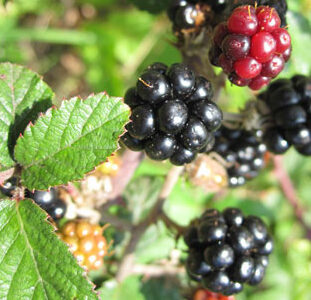
Blackberries are one of the best-known fruits in the rose family. They’re often collected in the wild from hedgerows and woodlands.  September and October are usually the peak months for blackberry forays, but this year blackberries [with the exceptional warmth of the Spring and summer months], they have been ripening early.  Some ripe fruits were spotted back in June!  The fruits start off green, but as they mature they become red and finally black from stem to tip. The bramble has a perennial root system with biennial stems. In the first year, the stems (sometimes called canes) grow vegetatively, but in their second year they produce flowers and fruit.   Then they die back but the dried stems together with their prickles / thorns can persists for some time.  It is a good idea to wear some protective gloves when rummaging for these fruits. The leaves of the bramble are compound, with 3 - 5 - 7 leaflets which have serrated edges.  Its flowers are white to a subtle shade of pink.  They have 5 petals and first appear in early Spring.  They are attractive to pollinators such as bumblebees. Blackberries are a nutritious fruit, rich in Vitamin C but also contain other nutrients, e.g. Vitamin K and manganese.  A cup full of blackberries can provide 7 grammes of dietary fibre.   The colourings of the fruits (anthocyanins and flavonoids) are a source of antioxidants. Blackberries are a food source for wildlife food, many birds, foxes, and many small mammals (for example the dormouse) feed on the berries.  However, this earlier appearance of autumnal fruits may cause problems.  For example, some birds feed upon insects in the Spring and summer months but by autumn they move over to seeds and fruits, like blackberries. But what if the fruits have come and gone, and there are just the shrivelled remains of once juicy fruits.  There could be a 'food gap', this would be especially series for animals trying to prepare for the relatively barren days of winter.  Deer may feed on bramble leaves. If large amounts of bramble are allowed to grow in a woodland, it can affect the microclimate of the ground  layers.  This influences the growth and development of other plants. Whilst brambles can offer protection from browsing by deer and / or rabbits of young tree saplings, they can also suppress the development of light loving species.  A thicket of brambles can also offer a home to some birds, like the nightingale. Further reading - see here
The times they are achanging

The times they are achanging

by The blog at woodlands.co.uk, 1 September, 2025, 4 comments

This morning,  the Today programme (Radio 4) featured an interview with Kevin Martin ( Head of Tree Collections at Kew) and Chris Packham (environmental compaigner).  They were explaining the ongoing effects of this summer’s hot and dry weather.  Mr Martin said that the trees at Kew were “ tired, they have had a stressful summer”.  The result is that many trees are entering their dormant stage, moving materials from aerial regions to the roots - much earlier than usual.  The colour changes in leaves and leaf drop do not usually occur until well into October but this year such changes are already  proceeding apace.  Kew has been able to put some mitigations in place, for example, the watering of young trees which have yet to establish extensive roots systems. This is not true for trees across the UK, where young saplings in particular may have been affected by the dry weather and successive heat waves, [plus increased browsing by the extensive deer population]. Chris Packham spoke of “climate breakdown” and “environmental chaos”, noting that an oak tree near him was ‘festooned with acorns’, but they were only the size of peas.  Normally acorns would fall later in the year as food for wood pigeons,jays, squirrels and badgers.  Jays help ‘plant’ oak trees by distributing acorns.  He said that whilst local hawthorns were red with berries, which would normally be food for winter thrushes later in the year, the berries would now be dried up / shrivelled when the birds arrived to search for them.  Though lots of hedgerow fruit [e.g. sloes, rose hips, blackberries] is being produced, it is being produced at the wrong time.  He also commented on the scarcity of mole hills as moles are forced to burrow deeper in the soil in search of earthworms etc. As the seasons change, some plants and animals adapt. For example,  blackcaps from Northern Germany fly to the UK rather than Spain to overwinter.  During a relatively short period, their wing length has changed, actually shortened - a case of evolution in action.  However, many species are struggling.   The  wet summer of 2024 was particularly difficult for butterflies, as evidenced by the data collected by the Big Butterfly Count. Nature's timings are now ‘out of sync’, plants and animals are further impacted by extreme weather events, flooding, high winds and extreme temperatures. [caption id="attachment_24651" align="aligncenter" width="600"] Sloes on Blackthorn.[/caption] https://www.metoffice.gov.uk/about-us/news-and-media/media-centre/weather-and-climate-news/2025/double-record-breaker-spring-2025-is-warmest-and-sunniest-on-uk-record  
Autumnal changes

Autumnal changes

by The blog at woodlands.co.uk, 14 October, 2022, 0 comments

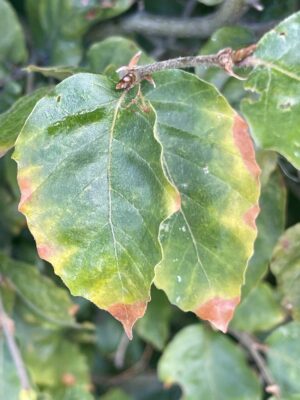
In 1820, John Keats famous poem “To Autumn’ was published.  Its opening line often serves to describe autumn as ‘The season of mists and mellow fruitfulness’.  Indeed, Autumn has arrived here.  Woodlands have been transformed into a 'tableau' of red, yellows, and oranges as the leaves are shed and the woodland floor has become a veritable fungal jungle, (as Jasper has described).  Hawthorn and other bushes are laden with berries, conkers and acorns are generously strewn across woodland floors, squirrels are eating hazelnuts (and hiding them as a winter food store).  But this cornucopia of fruits and seeds may be in response to the long, hot and very dry summer we have experienced.  Trees and shrubs have been stressed by the heat and drought. Some have responded by mobilising their reserves / efforts into producing more fruits and seeds, to ensure that they pass on their genes to the next generation.   Different trees are responding in other ways. Some are ‘holding on’ to their leaves for longer, whilst others (like some birches and rowans) have already shed theirs - in order to limit the damage from wilting and water loss during the intense heat and drought of summer.  [caption id="attachment_39130" align="aligncenter" width="675"] Autumnal colour[/caption] Blackberries appeared early this Summer and few are to be seen this Autumn, some animals (like the dormouse) will search in vain. [caption id="attachment_39026" align="aligncenter" width="675"] Black Bryony berries (photo by Art Symons)[/caption] Will this Autumn be long and mild? It may extend into the traditional winter months. There is also the threat of extreme weather events (like Storm Arwen that brought severe winds across the UK last November).  Whilst we might welcome mild weather (with the high price of gas and electricity), it could be mean an increase in bacterial and fungal infections, not only of plants but also affecting overwintering insects - tucked up in cocoons and pupal cases. Prolonged cold periods, coupled with frosts limit the spread of such infections.  The cold of winter is also the traditional signal for animals like hedgehogs to hibernate.  If they are still active in winter when food is scarce, then they will lose condition and possibly starve to death.  Milder weather in Autumn and Winter also affects the migratory behaviour of birds, some birds may choose to overwinter here.  Some seeds need to experience cold temperatures before they will germinate in the following Spring. Climate change and severe weather events are here to stay until there is a coordinated and concerted effort to reduce greenhouse emissions on a global scale.  On a local scale, our gardens (which represent some 400,000 hectares of land) can make a contribution by encouraging wildlife / pollinators and promoting biodiversity.  Gardens can also help to some extent with extreme rainfall.  During heavy rain, water runs off hard surfaces and into the drains, these may also deal with sewage.  When the drains are overwhelmed by storm water, sewage is discharged into our rivers (and the sea).   Gardens can help by  reducing hard landscaping, so that rain can soak into the soil instead of running off into the drains making use of water butts.  They capture water, so it does not enter the drainage system.  It is also there to use when the garden needs water (and there is a hose pipe ban) mulching the soil with a layer of plant material. It is an effective method of conserving water in the soil and it reduces surface runoff, increasing the infiltration / penetration of water into the soil.  It helps keep the soil moist in times of drought, and helps reduce run off during heavy rainfall.  Particularly important when planting young trees / shrubs. [caption id="attachment_38957" align="aligncenter" width="675"] a light mulch (in Art's garden)[/caption]  

Next Page »