Woodlands.co.uk

Blog - blackberry

beech nut

Mists, Mast and mellow fruitfulness

by The blog at woodlands.co.uk, 26 September, 2025, 0 comments

Autumn is here, whether you follow the definition of meteorological autumn, which starts on the first of September or the astronomical autumn which starts at the autumn equinox.  The equinox is when day and night length are equal, after that time the days get shorter. Or it might be that you are noting the signs of the seasons changing.  The BBC, the Woodland Trust and Nature’s Calendar chart the advance of autumn by recording events in the life of key species, for example blackberry, hawthorn, swifts, conkers, ivy and oak.  The information collected helps build a picture of how climate change is affecting the time of flowering, fruiting  etc. of many species. The blog has already commented on the early flowering of the blackberries but now woodlands are starting to transform into a mosaic of reds, yellows, and oranges as the leaves prepare to be shed and the woodland floor becomes a fungal jungle, (as Jasper has described). Hawthorn, Blackthorn and other bushes are laden with berries, conkers and acorns will be strewn across woodland floors. Squirrels eat hazelnuts (and hide some of them as a winter food store).  This banquet of fruits and seeds may be a response to the long, hot and very dry summer we have just experienced.  Trees and shrubs have been stressed by the heat and drought. Some have responded by mobilising their reserves / efforts into producing more fruits and seeds, to ensure that they pass on their genes to the next generation.   [caption id="attachment_24651" align="aligncenter" width="600"] Sloes on Blackthorn[/caption] If it seems like you have been noticing more acorns on the trees than normal that could be down to a "mast year”. Mast years occur roughly every five to ten years and refer to years when certain species of trees Like oak & beech) and shrubs produce a larger than normal crop of berries, nuts and fruit.  This boost in production means far more is produced than can be eaten  by the usual herbivores, squirrels, dormice etc, thus ensuring at least some of the mast goes on to grow new plants.  However, this ‘over-production’ can come at a cost to the tree, using vital resources so that growth in the subsequent year may be reduced.  Quite what causes trees and shrubs to ‘go mad’ and overproduce is not known but some theories are explored in a previous blog, though the weather in Spring is an important factor. [caption id="attachment_42689" align="aligncenter" width="675"] Collecting acorns.[/caption]
Blackberry time?

Blackberry time?

by The blog at woodlands.co.uk, 15 September, 2025, 0 comments

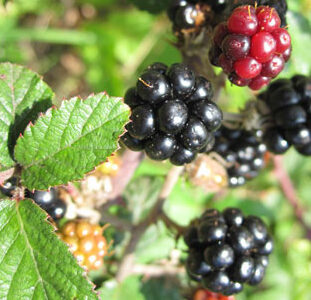
Blackberries are one of the best-known fruits in the rose family. They’re often collected in the wild from hedgerows and woodlands.  September and October are usually the peak months for blackberry forays, but this year blackberries [with the exceptional warmth of the Spring and summer months], they have been ripening early.  Some ripe fruits were spotted back in June!  The fruits start off green, but as they mature they become red and finally black from stem to tip. The bramble has a perennial root system with biennial stems. In the first year, the stems (sometimes called canes) grow vegetatively, but in their second year they produce flowers and fruit.   Then they die back but the dried stems together with their prickles / thorns can persists for some time.  It is a good idea to wear some protective gloves when rummaging for these fruits. The leaves of the bramble are compound, with 3 - 5 - 7 leaflets which have serrated edges.  Its flowers are white to a subtle shade of pink.  They have 5 petals and first appear in early Spring.  They are attractive to pollinators such as bumblebees. Blackberries are a nutritious fruit, rich in Vitamin C but also contain other nutrients, e.g. Vitamin K and manganese.  A cup full of blackberries can provide 7 grammes of dietary fibre.   The colourings of the fruits (anthocyanins and flavonoids) are a source of antioxidants. Blackberries are a food source for wildlife food, many birds, foxes, and many small mammals (for example the dormouse) feed on the berries.  However, this earlier appearance of autumnal fruits may cause problems.  For example, some birds feed upon insects in the Spring and summer months but by autumn they move over to seeds and fruits, like blackberries. But what if the fruits have come and gone, and there are just the shrivelled remains of once juicy fruits.  There could be a 'food gap', this would be especially series for animals trying to prepare for the relatively barren days of winter.  Deer may feed on bramble leaves. If large amounts of bramble are allowed to grow in a woodland, it can affect the microclimate of the ground  layers.  This influences the growth and development of other plants. Whilst brambles can offer protection from browsing by deer and / or rabbits of young tree saplings, they can also suppress the development of light loving species.  A thicket of brambles can also offer a home to some birds, like the nightingale. Further reading - see here