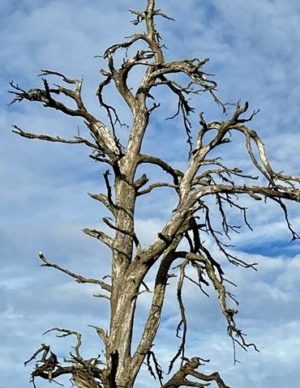
Wild life and deadwood.
by The blog at woodlands.co.uk, 28 April, 2023, 0 comments
For biodiversity to flourish, a wide variety of microhabitats is needed. With many micro-habitats, more species are able to thrive. It may seem counter-intuitive but deadwood offers opportunities for a diverse range of species. Within a woodland, there are various types of deadwood, providing shelter and food for many organisms.
Perhaps one of the most obvious examples of deadwood is standing but dead trees. If the dead tree was a veteran, then it will provide a variety of micro-habitats. Holes and crevices may be used by bats and birds, the decaying wood will be colonised by bacteria and fungi, bracket fungi may erupt - whilst the bark will continue to offer a substrate for mosses and lichens. As the wood decays, the material becomes a home for saproxylic beetles. Stag beetle larvae feed on decaying wood underground, whilst the adults rely on fat reserves built up during their larval stage. Adults can ‘drink' oozing sap and the juice of soft, rotting fruit. In the UK, some 650 beetle species are associated with deadwood [visit Dr Ross Piper’s website for full details of these insects]. As with many insects, many saproxylic beetles are threatened with extinction - due to the decline in the number of veteran / ancient trees. Saproxylic beetles, apart from being important in the recycling of materials, are also food for birds and mammals.
A previous blog has extolled the virtue of dead hedges. Dead hedges are simply piles of branches and twigs arranged to create a barrier / hedge. They represent a way of disposing of material that arises from thinning or clearing operations in woodlands. This ‘waste material’ of saplings and side branches are sometimes referred to as “arisings" by tree surgeons, or "lop and top” by foresters. Using this material in this way is good for wildlife, particularly for small mammals and birds - as it gives them somewhere to shelter from the wind and rain, and protection from predators. It's also good for insects. As the material rots and decomposes, it adds humus / nutrients to the underlying soil.
Larger pieces of wood from the felling of trees can be arranged to form a stack or pile, by simply laying branches and logs on top of one another Such a stack wil rot and decay over time, but will provide a home to a variety of wildlife.
So, deadwood in its various forms, is an important part of woodland ecosystems. It has a role in delivering biodiversity, but it also provides ‘ecosystem services’, such as soil formation and nutrient cycling. Deadwood contributes to the detrital food chain, which is driven by fungi, bacteria and detritivores.
Below : All that remains of a historic tree - the Wilberforce Oak. It was here at Holwood House (Keston , near Hayes, Bromley) in 1788 that William Wilberforce resolved to address the task of abolishing the slave trade. It took some twenty years for his vision to be realised.
[Thanks to Ruth for images of the Wilberforce Oak]
https://en.wikipedia.org/wiki/Holwood_House