Woodlands.co.uk

Blog - bramble

The importance of hedgerows.

The importance of hedgerows.

by The blog at woodlands.co.uk, 17 April, 2026, 0 comments

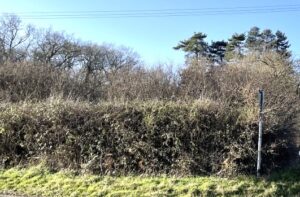
Woodlands and hedgerows are important features of our countryside.  Just as woodlands vary across the country, so do hedgerows.  A hedgerow usually includes a number of tree and shrub species, but may also include walls, banks, fencing and gates.  They may have been planted recently or may be ancient, dating back to the time of the enclosures. It has been estimated that there are over half a million kilometres of hedgerow across England, and the majority are actively managed.  In a managed hedgerow, the trees and shrubs have their form and shape altered.   The trees and shrubs that form the basics of a hedgerow include hawthorn, hazel, oak, holly, blackthorn, ash and yew. These may form the main body of the hedge but there are many other plants that contribute to its structure, such as bramble, honeysuckle and ivy, many wild flowers plus mosses, bryophytes, fungi and lichens.  [In urban settings, species like  privet, yew, box and holly may form the basis of the hedge / hedgerow.] [caption id="attachment_42838" align="aligncenter" width="675"] Beech hedge in garden[/caption] Consequently, hedges come in a variety of shapes and sizes and can include many different species. Rural hedges are often a mix of shrub and tree species, such as hawthorn, blackthorn, hazel, ash and oak. They were / are often planted to form boundaries around fields in managed agricultural landscapes.  Historically, many hedgerows were planted to keep livestock, such as sheep, cattle, pigs, chickens in specific areas. Other hedgerows were planted to define boundaries as in ‘who owned which bit of land’.  Hedgerows often surround fields.   The word ‘field’ comes from Old English ‘feld’, meaning 'an area of felled trees  or open country'.  Hedgerows are important as they offer habitats / niches for a variety of plants and animals. Not only do they provide ‘food and lodgings’ for many animals, they also act as biological corridors, supporting plant and animal connectivity across our landscape.  The flowers, fruits, berries and nuts are an important source of food for many invertebrates, birds and mammals. [caption id="attachment_24651" align="aligncenter" width="600"] Sloes on Blackthorn[/caption] Animals such the harvest mouse, the hedgehog and the vole may be found nesting in a hedgerow, and it offers food and / or homes for blue tits, and yellowhammers. They also support important insect pollinators, butterflies, hover flies, moths, bumblebees and bees. These insects may help with the pollination of crops in adjacent fields planted with oilseed rape, legumes or fruit trees. Other insects, such as ladybirds can help with crop yields by predating upon crop pests, such as green fly and blackfly (these aphids may spread viral diseases on crops such as sugar beet).  Sadly, hedgerows declined significantly in the last century, due mainly to intensification of agriculture. Fortunately, the destruction / loss has slowed since the 1990’s, though neglect and damage are significant threats even today.  Good management may involve planting of trees or shrubs to fill gaps, coppicing, laying a hedge or ‘considered’ cutting back.  However, there is no standardisation of the management of hedgerows and they can be harmed by excessive cutting back or flailing.   The effects of heavy pruning and cutting back during the nesting season can be disastrous. Whilst mechanical flailing of a hedgerow is fast and effective,  the regrowth is generally slower and its effects can be particularly bad for birds. [They may abandon their nests and / or  their eggs or chicks may be destroyed.] The pruning / flailing may also affect insect populations of the hedgerow (and / or other other food sources) on which the birds and other animals depend.  Another threat can be the use of agricultural chemicals [pesticides and herbicides] next to the hedgerow. [caption id="attachment_42843" align="aligncenter" width="675"] A managed hedge[/caption] For further and detailed information on hedgerows, visit : https://hedgelink.org.uk/guidance/importance-of-hedgerows/  
beech nut

Mists, Mast and mellow fruitfulness

by The blog at woodlands.co.uk, 26 September, 2025, 0 comments

Autumn is here, whether you follow the definition of meteorological autumn, which starts on the first of September or the astronomical autumn which starts at the autumn equinox.  The equinox is when day and night length are equal, after that time the days get shorter. Or it might be that you are noting the signs of the seasons changing.  The BBC, the Woodland Trust and Nature’s Calendar chart the advance of autumn by recording events in the life of key species, for example blackberry, hawthorn, swifts, conkers, ivy and oak.  The information collected helps build a picture of how climate change is affecting the time of flowering, fruiting  etc. of many species. The blog has already commented on the early flowering of the blackberries but now woodlands are starting to transform into a mosaic of reds, yellows, and oranges as the leaves prepare to be shed and the woodland floor becomes a fungal jungle, (as Jasper has described). Hawthorn, Blackthorn and other bushes are laden with berries, conkers and acorns will be strewn across woodland floors. Squirrels eat hazelnuts (and hide some of them as a winter food store).  This banquet of fruits and seeds may be a response to the long, hot and very dry summer we have just experienced.  Trees and shrubs have been stressed by the heat and drought. Some have responded by mobilising their reserves / efforts into producing more fruits and seeds, to ensure that they pass on their genes to the next generation.   [caption id="attachment_24651" align="aligncenter" width="600"] Sloes on Blackthorn[/caption] If it seems like you have been noticing more acorns on the trees than normal that could be down to a "mast year”. Mast years occur roughly every five to ten years and refer to years when certain species of trees Like oak & beech) and shrubs produce a larger than normal crop of berries, nuts and fruit.  This boost in production means far more is produced than can be eaten  by the usual herbivores, squirrels, dormice etc, thus ensuring at least some of the mast goes on to grow new plants.  However, this ‘over-production’ can come at a cost to the tree, using vital resources so that growth in the subsequent year may be reduced.  Quite what causes trees and shrubs to ‘go mad’ and overproduce is not known but some theories are explored in a previous blog, though the weather in Spring is an important factor. [caption id="attachment_42689" align="aligncenter" width="675"] Collecting acorns.[/caption]
Blackberry time?

Blackberry time?

by The blog at woodlands.co.uk, 15 September, 2025, 0 comments

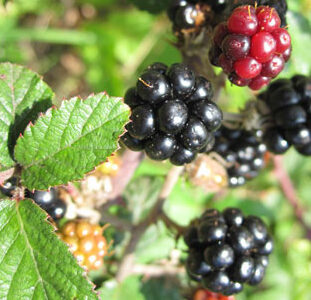
Blackberries are one of the best-known fruits in the rose family. They’re often collected in the wild from hedgerows and woodlands.  September and October are usually the peak months for blackberry forays, but this year blackberries [with the exceptional warmth of the Spring and summer months], they have been ripening early.  Some ripe fruits were spotted back in June!  The fruits start off green, but as they mature they become red and finally black from stem to tip. The bramble has a perennial root system with biennial stems. In the first year, the stems (sometimes called canes) grow vegetatively, but in their second year they produce flowers and fruit.   Then they die back but the dried stems together with their prickles / thorns can persists for some time.  It is a good idea to wear some protective gloves when rummaging for these fruits. The leaves of the bramble are compound, with 3 - 5 - 7 leaflets which have serrated edges.  Its flowers are white to a subtle shade of pink.  They have 5 petals and first appear in early Spring.  They are attractive to pollinators such as bumblebees. Blackberries are a nutritious fruit, rich in Vitamin C but also contain other nutrients, e.g. Vitamin K and manganese.  A cup full of blackberries can provide 7 grammes of dietary fibre.   The colourings of the fruits (anthocyanins and flavonoids) are a source of antioxidants. Blackberries are a food source for wildlife food, many birds, foxes, and many small mammals (for example the dormouse) feed on the berries.  However, this earlier appearance of autumnal fruits may cause problems.  For example, some birds feed upon insects in the Spring and summer months but by autumn they move over to seeds and fruits, like blackberries. But what if the fruits have come and gone, and there are just the shrivelled remains of once juicy fruits.  There could be a 'food gap', this would be especially series for animals trying to prepare for the relatively barren days of winter.  Deer may feed on bramble leaves. If large amounts of bramble are allowed to grow in a woodland, it can affect the microclimate of the ground  layers.  This influences the growth and development of other plants. Whilst brambles can offer protection from browsing by deer and / or rabbits of young tree saplings, they can also suppress the development of light loving species.  A thicket of brambles can also offer a home to some birds, like the nightingale. Further reading - see here
Tree planting vs Natural Regeneration? And a film

Tree planting vs Natural Regeneration? And a film

by The blog at woodlands.co.uk, 13 January, 2025, 1 comments

Woodlands TV has just released another film, which discusses the pros and cons of tree planting in an area, as opposed to allowing natural regeneration.  Many years ago, Kenneth Mellanby [Director of a Research Station near Huntingdon] thought that it would be interesting to watch what happened to a barley field if it was left to its own devices.  The 4 acre field was ploughed for a final time in 1961 and then ‘abandoned’. The field sat next to an area of ancient woodland - Monks Wood. The changes in the field were monitored in succeeding years and eventually becoming known as the Monks Wood Wilderness Project.   In the first 10 to 15 years, a thorny scrubland developed with hawthorn and bramble.  Birds were attracted by their fruits and berries.  The birds dispersed the seeds of the fruits across the plot, and also brought in seeds from other areas (such as the adjacent woodland).  The bramble and hawthorn scrub afforded protection from the wind and herbivores [rabbits, deer etc] for young, delicate tree seedlings.  Wind blown seeds arrived in the area, such as ash and field maple.  Other tree seeds were deposited by birds, Oak began to grow.  Acorns were probably carried in by Jays, who bury them as a winter food store.  An acorn is a rich food source - containing fat, carbohydrates, proteins and micronutrients.  A single jay can scatter many hundreds of acorns each year.  They store more than they need, so some will germinate and grow on to saplings.  Whilst many different birds spread tree and shrub seeds, jays have been known to carry acorns significant distances and probably contributed to the northward spread of the Oak as the glaciers of the last Ice Age retreated. A mature oak tree can provide food and / or a home for many species of animals, plants and fungi. The former barley field has been monitored over the decades, and by 2014 it had become an oak woodland.  This despite the usual depredations of Rabbits, Hares, Muntjac Deer and Roe Deer which have been present at various times over the years.  So given time, former agricultural land can revert (rewind) to mixed deciduous woodland with a diverse collection of plants and animals.  For further details of Monks Wood - visit https://www.naturewalkswithcarol.com/monks-wood-nature-reserve.html The woodlands TV film features ecologist Connor McKinnie who highlights key factors to consider when planning woodland creation, such as tree protection methods, planting pattern, and species. This is the second film with Connor, exploring aspects of rewilding.  The first film is presented below : [embed]https://youtu.be/HZNX9hTzQaU?si=-Ivv4aziPzi4a3cA[/embed] The latest film may be viewed on YouTube by following this link : https://youtu.be/Qx7uiOlGjFY

Next Page »