Woodlands web updates : 27
by The blog at woodlands.co.uk, 16 November, 2023, 0 comments
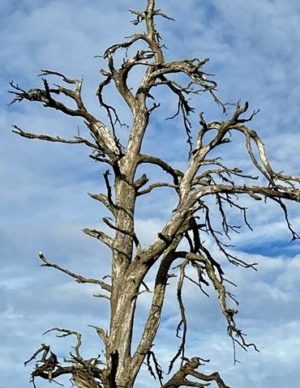
Tree survival and drought.
Researchers at the University of California have been working on a method that helps predict whether forests / woodlands can survive periods of drought. As climate change is altering patterns of snow and rainfall, so periods of drought are likely to become more common.
Forests are important in terms of carbon sequestration, that is, they take up carbon dioxide from the air and convert it into sugars, starches etc that are stored in the leaves, branches, stems and roots. However, in order to assimilate and convert carbon dioxide (in photosynthesis), trees (indeed all plants) need a supply of water. When water is limited, trees need to make use of their reserve materials. Just as we make use of body reserves of fat and glycogen when food / diet in inadequate.
However, reserves can only sustain a tree for a finite period of time. If drought persists, the tree reaches a ’tipping point’ and it will die. The researchers studied a forest in the Sierra Nevada that experienced a period of drought between 2012 and 2015. During this period, millions of trees died. The team recorded rainfall, soil moisture and temperature in the forest AND the amount of carbon dioxide that the trees absorbed, and their reserve materials. They found that the trees were able to maintain function / health after the onset of the drought but with the passing of time, the trees exhausted their reserves and were unable to use / convert carbon dioxide into food. They had reached the tipping point and died. The methodology of this study was called CARDAMON (carbon data assimilation with a model of carbon assimilation); it is hoped that it can be used to evolve strategies to enhance forest and woodland resilience in the face of climate change.
Pollinators.
[caption id="attachment_35902" align="aligncenter" width="675"] hoverfly[/caption]
University researchers from the UK and Finland have been trying to determine the most effective pollinators of crop plants, like strawberries (and other fruits). Plentiful and effective pollinators are needed to ensure a good harvest of the fruits.
The researchers studied the pollinators at three strawberry farms through the (long) growing season for the fruit. They adopted two approaches :
They caught the insects that visited the strawberry flowers and analysed the pollen they carried in detail (pollen load and type).
They also counted the number of flower visits by the different insects, (a quick way to identify key local pollinators).
Many insects were identified, including :-
European drone fly : Eristalis arbustorum
Honeybee : Apis mellifera
Levels drone fly : Eristalis abusivus
Buff tailed bumblebee : Bombus terrestris
White tailed bumblebee : Bombus lucorum
Common drone fly : Eristalis tenax
Red tailed bumblebee : Bombus lapidarius
Early bumblebee : Bombus pratorum
Bent-shinned Morellia : Morellia aenescens
Hoverflies are true flies, that is, they belong to the order Diptera or true flies, as they have a pair of wings and a pair of halteres (balancing / orienteering organs used when in flight). Several of the flies in the genus Eristalsis are known as Drone Flies (due to their resemblance to honey bee drones). The larvae of Eristalis species are commonly found in putrid / stagnant water and sometimes referred to as “rat-tailed maggots”.
It was noted that pollinators also made use of the wild plants to supplement their diets, as strawberries alone cannot meet the nutritional needs of pollinators. ‘Elsanta’ strawberries have a relatively low sucrose and protein content in both their nectar and pollen.
The precise order of importance of pollinators varied between farms. Bee (Apis and Bombus) species and hoverfly (Eristalis) emerged as key pollinators. The European drone fly was the most important pollinator at two of the three farms studied, evidence that hoverflies can be effective pollinators. One farm had commercial hives of the honey bee but they were less significant than the activities of of the hoverflies and bumblebees. The abundance of a particular insect, coupled with its active period were / are important determinants of pollinator importance.
Sawdust and plastics - a possible use?.
Plastics represent a relatively new, but persistent and major form of pollution (on land, in the sea, indeed everywhere). Whilst many plastic objects are instantly visible in the form of discarded bottles, fast food containers, many plastic pollutants are in the form of very small particles of plastics - nano and microplastics. The concern is that we and other organisms are taking these microscopic particles into our bodies from our food / drinking water.
However, it is possible that plant materials may offer some ‘solutions’. Water that contains micro and nano plastics can be filtered through sawdust that has been treated with tannic acid. Tannic acid is large molecule, its molecular formula is C72H52O46 . Tannic Acid is found in certain plant galls (swelling of trees caused by parasitic wasps) and in the twigs of certain trees, such as Chestnut and Oak. The wood sawdust contains fibres of cellulose, combined with hemicelluloses and lignin. Water can flow through this material by capillary action.
This plant-based filtration (known as bioCap) of plastic-laden water is capable of dealing with a wide range of nanoplastics (PVC, PET, polyethylene etc), and tests with mice suggest that the filtered water may be sufficiently free of plastic to pose little risk.