Woodlands.co.uk

Blog - carder bees

Carder bees - important pollinators.

Carder bees – important pollinators.

by The blog at woodlands.co.uk, 18 May, 2026, 0 comments

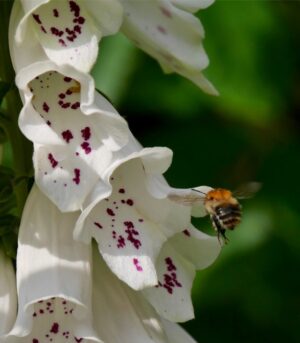
There are some 270 species of bee to be found in the UK.  Most of these bees are solitary bees. Solitary bees do not form colonies like the honey bee, with a queen and workers. Twenty four are types of bumblebee,  although two of these bumblebees may be extinct in the UK.  Included in the bumblebee category are the carder bees. Their name relates to their ability to ‘knit’ together plant materials / fibres to form a nest*.  The six species of carder bees in the UK are listed below : The common carder bee The brown banded carder bee The moss carder bee The red shanked carder bee The ruderal carder bee The shrill carder bee The common carder bee (Bombus pascuorum) is quite widespread and is found in gardens, the edges of woodland, and farmland throughout the country.  It is a social insect, forming colonies with worker bees.  Their yearly cycle is not dissimilar to that of bumblebees.  In spring, queen carder bees emerge from hibernation and establish new colonies. These develop throughout the spring and summer, adding workers.  By late summer, new queens and males are formed, and in autumn the old queen and workers die.  The new queens overwinter and emerge in the following spring. [caption id="attachment_43305" align="aligncenter" width="675"] Common carder bee[/caption] Carder bees tend to build their nests on or near the soil surface, using moss, dried grass or similar plant material.  The shrill carder bee favours flower-rich grassland areas to build its nest.  As so many of these diverse grasslands have disappeared over the last century, it explains the rarity of this particular bee.   Carder worker bees are a ginger / warm brown colour. Carder bees are noted for their ‘long tongues’, i.e. their mouthparts have a long proboscis [feeding tube].  This allows them to reach the nectar inside flowers with a long, tubular shape (such as foxgloves, honeysuckle and clover).  It also means that they are not in direct competition with ‘shorter tongued’ bees, who can only access open flowers.    Whilst visiting flowers, they act as pollinators of both wild flowers and farmland crops. As pollinators, they help promote the transfer of pollen from plant to plant, promoting outbreeding which in turn helps maintain variation with a species. The bees actively forage from spring into autumn and can thrive in our extensively modified landscape, so they are key pollinators in both rural and urban areas. * Originally, the term a carder referred to person who combs out and cleans fibres of wool / cotton before spinning.
dandelion

Wild flower pollen and bees

by The blog at woodlands.co.uk, 20 April, 2024, 1 comments

The period since WW2 has seen urban areas and, indeed farms, expand across the UK. The number of places where wildlife can thrive has been eroded.  Gardens and lawns have been changed to provide parking for cars, lawns are mowed and ‘weed-killered’, or worst still replaced with artificial grass so there is not a weed in sight.  Fortunately there are now initiatives like No Mow May that promote the growing of wild flowers in lawns and public spaces, like roadsides and verges.  Many common weeds are simply wildflowers by another name. Wild flowers / weeds (like dandelions, ragworts, clovers) are a lifeline for bees and bumblebees - who are facing so many threats [pesticides, habitat loss, invasive species] so adequate food is important. The flowers of these wild flowers / weeds offer food for a wide range of endangered bees, and at times when other resources are limited.  Dandelions, for example, offer an abundant source of nectar and pollen for bees & bumblebees when other options are limited - especially in urban settings. They produce their flowers (and therefore nectar and pollen) from early Spring right through to the onset of Winter. Recent studies have shown that the diet of bees has changed over the years.   In the past, the bees were able to forage and collect pollen and nectar from a wide variety of plants but with the loss of ‘natural’ wild areas their diet is now often dominated by brambles, clover and dandelions.  In the case of dandelions, their simple, open flowers makes for ease of collection.  They are visited by honey bees, bumblebees and carder bees.   Some studies have indicated that dandelion pollen, whilst it is rich in the amino acid proline,  has low levels or lacks certain amino acids (such as valine and isoleucine).  Bees need the same ten essential amino acids as us.  Without a supply of these particular amino acids, the development and growth of bees is impaired, as is their disease resistance and ability to raise the brood.  So, it is important to find ways to offer our pollinators a range of plants / pollen to provide all their essential nutrients. interesting related papers Food for Pollinators: Quantifying the Nectar and Pollen Resources of Urban Flower Meadows: https://journals.plos.org/plosone/article?id=10.1371/journal.pone.0158117 Shifts in honeybee foraging reveal historical changes in floral resources: https://www.nature.com/articles/s42003-020-01562-4