Woodlands.co.uk

Blog - caterpillars

Searching for Woodland Soundscapes 

Searching for Woodland Soundscapes 

by Sam Corbett, 26 September, 2026, 0 comments

Pink Floyd’s Grantchester Meadows features some unusual instrumentation: the rolling whistles of a skylark, a honking goose, a buzzing insect. Recordings of blackbirds feature prominently in Kate Bush’s Aerial Tal, not to mention, of course, in the Beatles’ Blackbird, and field recordings of farmyard animals, rushing rivers and harsh winds have been used by other musicians over the years. Now, however, soundscape artists are blurring the division between music and the natural world further, with many taking to Britain's woodlands in search of their natural notes and melodies. For some, it’s not only a meditative experience, but a way of enhancing their perception of the natural world. “Listening, if you give it time, can be transformative to one’s sense of place,” sound artist Jez Riley French told Sound UK. “You have to give up control in a way. At least give up the idea that you know what a forest sounds like.” The quantity and variety of different sounds to be discovered in even a small patch of British woodland can be almost endless for the committed listener. Here are some you might not have noticed before: Caterpillar Business You may, on a June day, notice the sound of raindrops pattering on the forest floor, then look up to discover there’s not a cloud in the sky. When large numbers of caterpillars feed on the canopies of oak trees during early summer, a sound not unlike rainfall can be heard. This is actually the sound of frass (caterpillar droppings) landing on the forest floor. The Inner Workings of Trees This one requires a bit of specialist kit, but is worth the effort. By attaching a contact microphone to the trunk of a tree, you can record the whispering movement of water through the tree’s xylem and the crackling sound of the sap rising up the trunk during spring, as well as the tiny pops and cracks of the growing and shifting wood fibres. Wasps Taking a Bite Did you know wasps have a penchant for wood? Carefully approach a dry log or a bit of old fencepost on a summer’s day and you may hear a social or paper wasp hard at work. These wasps scrape away wood fibres, chew them into a pulp, and take them back to their nests to build new walls. The sound is a faint scrabbling, like fingernails on a tabletop. Gorse Bombshells  Some compare it to gunshots, though the more temperate say the sound is closer to popcorn. As the sun heats the seed pods of a gorse plant during summer, the pressure inside them gradually builds and eventually, they burst, launching their seeds into the air, and letting off a loud pop. When dozens are going off at once on a hot day, the sounds combine into a satisfying crackle. How to Have a Go Though a clutch of soundscape artists have made their passion into a profession by creating albums of natural sound or providing accompaniment to exhibitions, most use field recording as a relaxing weekend hobby, and an excuse to spend time in the woods. The price and complexity of recording setups can range depending on the user’s commitment.  Hobbyists might want to invest in an omnidirectional microphone, such as a Lom mikroUsi, a Clippy EM272, or a Sennheiser MKH 8020, in order to capture the entire forest atmosphere at once. Contact microphones that capture those gurgling tree sounds, or hydrophones for recording activity below the surface of ponds and brooks, can also be worthy investments for the truly dedicated.  But for those just starting out, a basic plug-in microphone or even a phone recording can provide a fine place to start. Often it is the act of paying acute attention to the woodland around you, rather than the recording itself, which is most valuable. “The key is to be aware of your individual role in the collective quietness,” French explained. “Allow time for the sounds to take us beyond our usual, short attention spans.” Thanks to David Alty for the wasp image.
Oaks playing clever

Oaks playing clever

by The blog at woodlands.co.uk, 11 September, 2026, 0 comments

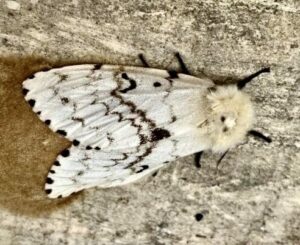
Once upon a time, the gypsy moth lived only in the Fenlands of eastern England, where its caterpillars fed upon bog myrtle and creeping willow.   As the Fens continued to be drained and agriculture expanded, this native population died out in the early part of the C20th.  However, many years later, a colony of the European form of the moth was found in Epping Forest. This form of the moth is polyphagous, that is, its caterpillars can feed on a variety of plant leaves. They have a particular penchant for the leaves of oak and poplar.  Since its ‘introduction’, this form of the moth has spread to many parts of south-east England. The caterpillars of this moth can denude a tree of its leaves if the infestation is heavy.  Repeated attacks combined with drought can result in the death of trees. The trees do have a defence mechanism which is to increase tannin production, which makes the leaves much more bitter.  But this comes at a cost to a tree, namely an increase in metabolism and energy expenditure to make these materials. [caption id="attachment_43799" align="aligncenter" width="675"] Gypsy moth caterpillar. [Thanks to Bernell MacDonald & Pixabay][/caption] Research has indicated that oak trees have ‘solved’ the problem in a different way.  If a tree has been subject to a significant attack by these caterpillars/moths, then in the succeeding year it delays the opening of its leaves by a few days.  The effect of this is that when the caterpillars emerge, the leaves that they depend upon are still ‘sealed away’ in their buds. So, the caterpillars have little or nothing to eat.  The effect of this is to reduce the damage to the tree by over 50%! The research work was carried out over a large area in Northern Bavaria and made extensive use of radar satellites.  The satellites were able to identify which trees had been stripped bare and how they reacted in the following year.  Further details of this work can be accessed here: https://www.nature.com/articles/s41559-026-03071-9
Watching insects on the move

Watching insects on the move

by The blog at woodlands.co.uk, 5 December, 2025, 0 comments

Scientists from the Meteorological Office use radar data to track approaching storms and changing weather patterns.   The radar works by sending out pulses of microwaves, these bounce off rain drops and other particles in the air.  The time that it takes for this signal to return, plus its intensity gives information about the approaching weather. Early radar [during the Second World War] also picked the movement of ‘angels’. These ‘angels’ were later recognised as the movement of birds, bats and insects.  Scientists then had to develop techniques to remove this ‘biological scatter / material’, so that they could accurately predict storms etc. By removing this ‘biological component’ of the signal, a lot of biological information about the movement of birds, bats and insects was being ‘discarded’.   Now, scientists from the University of Leeds have ‘repurposed’ the radar data (from many radar stations, which scan the skies many times each day & night) but this time they remove the data relating to the weather.  This leaves information about the insects moving at a height of some 500 / 700 metres above the ground.  The results showed that some 11.2 trillion insects are moving during the day, and that this reduces to some five trillion at night.   Some of these insects are actively flying, but some are being carried by the wind  / thermals.  Furthermore, there were more insects above areas such as woodlands, grasslands and even urban areas.  However, the numbers were lower over intensively farmed areas, where plant biodiversity was reduced as compared to woodland or natural grassland.  The numbers were also lower where artificial lighting was high.   Other work by the CEH, Newcastle University and Butterfly Conservation, has involved surveys of grassland and hedgerows in southern England (Thames Valley) some of which were lit by streetlamp, others were unlit. The areas that were exposed to night time lights had roughly half the number of caterpillars as compared to the unlit areas.   In another study, LED lighting was set up in fields, and caterpillars' numbers in these illuminated fields were reduced.  The lighting may :- [caption id="attachment_40185" align="alignleft" width="300"] Cinnabar moth caterpillar.[/caption]   Deter nocturnal moths from egg laying. Make the night flying moths ‘easier targets’ for predators (such as bats). Affect the feeding habits of moth caterpillars. Whilst it would seem that night time light affects insects and the feeding behaviour of caterpillars,  quite how and why is yet to be determined.
Moths - secret pollinators?

Moths – secret pollinators?

by The blog at woodlands.co.uk, 24 November, 2025, 0 comments

Honeybees, bumblebees and butterflies are always cited as being important for flower pollination. Indeed, without them many of our food crops would ‘fail’.  But what about moths?  Well, recent research has found that they too are efficient pollinators.  A recent study compared the role of nocturnal and day time pollinators.  Much scientific research has focused on daytime pollinators, like honey bees and bumblebees, but little is known about the night time pollinators.  So a study was devised, which focused on the day and night visitors to bramble flowers. Bramble may be a bit prickly to us but for bees and other insects it is important source of nectar and pollen, from early spring through to autumn.  The study was carried out out in the summer moths (when night is only one third of the daily cycle).  Trail cameras were used to record visitors to the bramble flowers over three days, also special bags were used to cover the flowers for different times in order to determine the effectiveness of the different pollinators on pollination and fruit formation.  One group of the bramble flowers was covered up for the three days.  A second group was bagged up for the day time.   The final set was covered only at night.  The number of pollinator visits was recorded as was the resulting pollination and fruit formation.   At night, moths were the only insect visitors of the pale pink / white flowers of the bramble, and they also proved to be very effective pollinators. It is not clear why moths were more effective, perhaps the time they spend visiting a flower is a critical factor.  They do spend more time rummaging in a flower than day time insects [hoverflies, butterflies, bees etc].     There are only some sixty species of butterfly in the UK but over two thousand species of moth.  But like butterflies, moths are vulnerable with many of our larger moths in decline.  The challenges that they face as the same as those that threaten many insects namely: Pesticides Habitat loss Climate change But moths face an additional challenge - artificial light at night. This interferes with the feeding behaviour of their larvae / caterpillars, it also affects the feeding and breeding of the adults.   Thus, moths are not only important pollinators but a vital component to the biodiversity of an ecosystem.  They also are a food source bats and birds. Moths can be helped by: By allowing a patch of brambles and / or wild flowers in your garden Persuading the council to allow wild flowers to grow and flourish on roadside verges, ‘spare’ plots of land etc. Asking the local council to reduce night time lighting where it safe to do so.   At home, limiting the use of outdoor lights at night, draw curtains and blinds to limit light spill to the exterior. As insects are in decline generally, (see the  woodlands.co.uk splatometer blog) it is important to help our pollinators - ensuring that they still ‘have a home’ at the end of the day.  
The stinging nettle, a woodland and urban plant.

The stinging nettle, a woodland and urban plant.

by The blog at woodlands.co.uk, 15 July, 2024, 1 comments

Stinging nettles grow in a wide range of natural habitats, river banks, swamps, meadows, wastelands, floodplains, disturbed areas and gardens. They are are particularly effective colonisers of disturbed, bare or ‘waste’ ground. They flourish in nitrogen-rich soils.  Their seeds can lie dormant in the soil for some five years (and can even survive soaking in salty water), plus they spread using their underground rhizomes. Nettles may not be the most friendly plants to us, as their leaves and stems are ‘armed’ with special ‘hairs’. The hair-like structures are termed trichomes and each trichome has a hollow tube-like structure. At the bottom of the tube is a swollen base, which is filled with a number of chemicals, (including histamine, serotonin, formic acid and acetylcholine). The tip of the tube is easily broken, leaving a sharp point that can penetrate the skin and deliver the ‘biochemical cocktail’. [caption id="attachment_7154" align="aligncenter" width="600"] Trichomes - loaded with their chemical 'cocktail'[/caption] [NB: there is a video on YouTube that shows this mechanism here.] This collection of chemicals gives the characteristic rash/inflammation of a nettle sting.  Nettles may be found near to dock leaves which, if crushed and rubbed where you have been stung by the nettle, may take away some of the pain. More detailed information on the chemistry of the 'chemicals' in the nettles can be found here.  The hairs / trichomes probably evolved as a defence mechanism to limit grazing by sheep, deer or rabbits. Despite their ‘weaponised hairs’, nettles are in fact very good for wildlife, particularly in urban / sub-urban areas.   This is also true in areas under intensive farming practices.  The spread of farming, urban sprawl, habitat fragmentation and pollution have all contributed to the loss of natural habitats (for plants and animals), and that’s without mentioning climate change. Stinging nettles are the food plant for the caterpillars of comma, painted lady, peacock, red admiral and small tortoiseshell butterflies. The presence of nettles in our gardens and urban areas has allowed these butterflies in. And it’s not just butterflies that rely on nettles. For example,  ladybirds often lay eggs on nettle leaves. This insect might be termed a “gardener’s friend” as it has a voracious appetite for aphids - greenflies and blackflies that suck the sap from plants, ravage the vegetables in our gardens / allotments, Some aphids spread plant viruses, for example, virus yellows on sugar beet. Having nettles in our gardens and near farms give ladybirds and other insects somewhere to shelter, ready to feast when the aphid population rises. Aphid populations can rise very quickly as females give birth to live young, without fertilisation. Nettles can be used to make tea, soup, flavour beer, wrap cheese (Cornish yarg) or make cloth.  Using nettle fibres to make fabric / clothing is a very old practice, dating back to the Bronze Age.  Nettles can also be used to dye fabric [caption id="attachment_34107" align="aligncenter" width="650"] stinging nettle[/caption]
Butterfly updates

Butterfly updates

by The blog at woodlands.co.uk, 25 March, 2024, 2 comments

Solar farms have sprung up across the country with hundreds or thousands of solar panels, linked together in fields.  Now, researchers in the States have shown that sowing grasses and wild flowers in-between the panels on solar farms resulted in: A significant increase in the number of beneficial insects (bees in particular benefitted) An increase in insect diversity beneficial 'spillover effects' on adjacent farmland. The solar farms under study were sown with specially designed seed mixes. See also the previous woodlands  blog on solar panels and wildlife The seeding of solar farms would seem to offer support to : Renewable Energy Generation: Biodiversity Pollination services Habitat restoration: in fields that may have been damaged by intensive agriculture and / or development. They can also act as a refuge for native plants and wildlife. Erosion control: the root systems of native plant species (which penetrate to different depths) help prevent soil erosion. Reduced maintenance costs: as less mowing / weed control needed. The cabbage white butterfly is generally regarded as the enemy by the keen vegetable gardener.  If you are growing brassicas - cabbages, cauliflowers, brussels sprouts, broccoli, kale or pak choi, it is likely that you will have these butterflies as summer visitors.  The butterfly is white with black spots on the wings.  Males have a single spot on each of the forewings, whereas the females have paired spots. The butterflies are attracted to the plants as they produce the chemical - glucobrassicin. The butterflies can sense the glucobrassicin through the hairs on their front legs (they have three pairs of legs, a pair on each segment of the thorax). This chemical, glucobrassin, stimulates them to lay their eggs on the leaves of cabbage and other brassicas.  A female can lay up to 800 yellow eggs. These eggs may hatch and the green / black caterpillars emerge.  These caterpillars can double their mass in a day through their voracious feeding.  The adults are attracted to the glucobrassicin in the brassicas just as the caterpillars ‘enjoy’ the chemical - SINIGRIN.   When leaf tissue is damaged, the sinigrin is broken down into a mustard oil, responsible for the pungent taste of Cruciferous vegetables. There are a number of strategies that may help keep the butterfliess away from your crops, and reduce the damage by the caterpillars. Cover the plants with an insect proof mesh Offer ‘sacrificial brassicas’ away from the main crop Use companion / mixed planting, so that beneficial insects have 'hiding places' and it is more difficult for the female cabbage whites to find the brassicas.  Also, by mixing up the planting with herbs and other veg, it makes it a bit more difficult for the caterpillars to move from cabbage to cabbage etc. If you do need to use an insecticide, consider using the products derived from Bacillus thuringiensis.
Light in the darkness

Light in the darkness

by The blog at woodlands.co.uk, 8 February, 2022, 0 comments

Compared to past centuries, we live in a bright, highly illuminated world where even our nights are bright.  Apart from the lights in our homes and offices, there are thousands of street lights. In many places, the natural 'night time' environment is no more.  This 'artificial light' pollution  has increased significantly in recent times (as indicated by research led by the University of Exeter).    Street lights, especially the newer LED ones, may be affecting various night flying insects.   It is a fact that insect populations in general are under threat from  The loss of woodlands, forests, heathlands and meadows (often to agriculture) The intensive use of pesticides Climate change / extreme weather events Pollution of rivers / lakes (eg. Nitrate / phosphate pollution leading to eutrophication). Now the intensive use of artificial light is thought to be affecting night flying insects, such as moths. Moth populations are in decline, for example, the Buff Arches population, has declined in number by 62% since the 1970s. However, the effects are not limited to moths but also birds, bats and wildlife that feed upon them (or their caterpillars). The UK Centre for Ecology and Hydrology suggests that streets bathed in light may:- Deter nocturnal moths from egg laying. Make the night flying moths ‘easier targets’ for predators (such as bats). Affect the feeding habits of moth caterpillars. A number of investigations have been initiated by CEH, Newcastle University and Butterfly Conservation. The work involved surveys of grassland and hedgerows in southern England (Thames Valley) some lit by streetlamp, others unlit.  The areas that were exposed to night time lights had roughly half the number of caterpillars as compared to the unlit areas; (the hedgerows reduction was 47%, and 33% in grass margins).  In another investigation, LED lighting was set up in fields, caterpillars numbers in such fields were reduced.  It would seem that night time light affects the feeding behaviour of caterpillars. Quite how and why is to be determined. LED lights are being using more and more, as they are brighter, cheaper to run and more energy efficient. LEDs emit more blue light than older forms of lighting. It is likely that the impacts of light pollution on night flying insects will increase. This, in turn, will effect of other species, such as hedgehogs which need many, many caterpillars to feed themselves and their young.  The loss of insects, such as bees, ants and beetles is occurring at a worrying rate, indeed faster than the loss of mammalian, avian or reptilian species.  The loss of insects has far reaching consequences for ecosystems - as they provide food for many vertebrate species and they acts as pollinating agents for many flowers and crops.   https://youtu.be/Rnsz7JtBmJw

Next Page »