DIY charcoal making – black gold
by Angus, 13 September, 2024, 3 comments
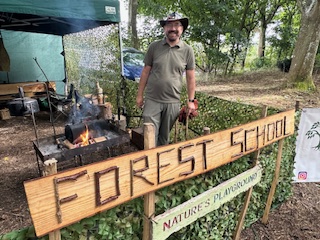
The advantage of charcoal is that it burns hotter than wood, is far lighter, and produces less smoke and steam - so it's useful for smelting iron or cooking barbecues. You can buy it ready-made, usually imported and often from unsustainable sources, or you can buy locally from people working their own woodlands. Another option is to make your own using a small charcoal maker which Paul Bradford demonstrated to me. Paul and Lisa do regular charcoal making demonstrations in Kent with their Community Interest Company (CIC), Willow Bushcraft. They use a specially made cylindrical piece of kit to show school children how charcoal is made, and as they sit around the fire they can discuss the processes required as well as the fact that charcoal making goes back to the iron-age.
This charcoal-making device was bought online for about £40 and Paul reckons he can get 30-40 burns out of the charcoal maker before the metal gives way. The processes are straightforward: he loads it with hardwood pieces typically about 1-2 inches in size and closes the end. While I was watching he used oak but charcoal can also be made from hazel, ash, birch, beech or ash. He then puts it on a fire - crucially the wood inside is heated in the absence of oxygen. Initially the moisture comes out as steam and next the wood releases flammable gases which burn off in yellow or blue flames whilst inside the charcoal is being produced. Paul says that although the instructions say it will be done in 2 hours, he finds it takes more like 3-4 hours for a burn. In any event it shouldn't be opened until it has cooled down much later, perhaps the next morning.
Paul told me about the many uses charcoal has - obviously it can be burn but it is also used for drawing, for making toothpaste and for some cosmetics. It is used in face-washes and exfoliating scrubs - the properties that really help are its ability to absorb toxins as well as its natural gritty texture. It is also used in some deodorants because of its ability to absorb moisture and neutralise odors. Historically charcoal was used to make gunpowder along with sulphur and potassium nitrate. It can also be a filter for purifying water and has medical applications such as treating poisoning and overdosing because it absorbs certain toxins. It is a special material and quite remarkable how it is naturally occuring and the method of processing is so simple.
To make 1.3 kg of charcoal in Paul's machine you need to put in about 6.5 kg of wood, which illustrates how much water by weight is contained in wood, but it also indicates how effective it is to burn charcoal to get to high temperatures - you are not wasting energy evaporating the water and the texture of charcoal allows the oxygen to get in for a hotter burn.