Woodlands.co.uk

Blog - coleoptera

A surfeit of ladybirds

A surfeit of ladybirds

by The blog at woodlands.co.uk, 4 November, 2025, 2 comments

A surge in ladybird populations took place this summer. The seven spot ladybird is native to the UK.  "Millions" of the beetles invaded beaches and even cricket matches during the various heat waves.  At seaside venues, ladybirds massed on the beaches, landed on sunbathers, and covered cars.  The last time that we experienced a similar increase in ladybirds was during the hot (and dry) summer of 1976, though there have been sporadic ‘booms’ in the intervening years.   The surge in ladybird (particularly the seven spot ladybird) numbers can be attributed to :- The warm weather in early Spring and Summer An abundance of food in the form of greenfly and blackfly (aphids).  Their numbers also increased with the warm weather, as their life cycle moves at a faster rate.   Aphids enter into a cycle where female aphids can give birth to live young, without fertilisation.  A process known as parthenogenesis. Ladybirds in gardens help control aphids on roses and other plants by feeding on them.  They are very effective predators.  Predators have key role in keeping the balance of nature. As the temperature falls, ladybirds look for places to overwinter. Native ladybirds tend to hibernate under logs, rocks, and in tree litter.  The harlequin ladybird which is an invasive asian species, may enter our homes. AS harlequin ladybirds have been introduced from warmer regions, so they seek out the warmth that houses offer.  People have found them on windows, doors and walls.  It is advisable to close windows and doors to limit their entry.  In their home range, harlequin ladybirds probably hibernate in big clusters in caves, hollow trees and other sheltered places.  Here their search for warmth tends to occur at the start of October.  Harlequin ladybirds are mainly to be found in the South-East though they have been spreading northwards. They have been implicated in the decline of native species.  Interestingly, they harbour a sexually transmitted disease but not the sort that can affect us. It is a fungus [the Laboulbeniales fungus] that forms scales on the wing cases (elytra), which cover and protect their wings, or it appears as a yellow, finger-like outgrowths of the body. The fungus feeds off vital internal fluids. It is passed on through contact during mating or when the harlequin ladybirds huddle together whilst hibernating. [caption id="attachment_42748" align="aligncenter" width="675"] Larva of ladybird[/caption]  
Flowering plants and pollinators

Flowering plants and pollinators

by The blog at woodlands.co.uk, 3 July, 2023, 0 comments

Plants have existed for hundreds of millions of year - as algae, mosses, liverworts, ferns but flowering plants only appeared about 140 million years ago. The exact timing of their appearance is a matter of some debate (see article) They have been a massive evolutionary success, there are perhaps 300,000 to 400,000 species world wide.  They reproduce using pollen.  This is used to fertilise the ovules and produce viable seeds.  Most plants rely on insects to transfer this pollen to the ovules, indeed over 80% of flowering plants have relied on insects for this service.  To this end, flowering plants (Angiosperms) have evolved a number of inducements to attract insects : colour, scent and nectar. When we think of pollinators, we generally tend to think of bees, bumblebees, hover flies.  But when flowering plants first evolved, fossil evidence suggests that many of these flowers were quite small so it is probably that the first pollinators were also quite small, and hence able to access these small flowers.  The first pollinators were probably small flies, midges or beetles (more than 77,000 beetle species are estimated to visit flowers).  Quite when bees (and their pollen collecting activities) evolved is not known.   A recent analysis of the "family tree" of the families of flowering plants indicates when different plant families evolved and when various forms of pollination emerged.  Insect pollination is / was clearly the most common method of pollination,  and was probably the first means of pollination.  This analysis also indicated that other means of pollination (involving small mammals, birds, bats) have evolved several times, as has wind pollination.  Wind pollination seems to have evolved more often in open habitats and at higher altitudes , whereas animal pollination is associated with closed canopy tropical forests. The pollen of insect pollinated flowers is significantly different to that of wind pollinated species.  Flowers that are insect pollinated tend to produce pollen that is heavy, 'sticky' and protein-rich.   Pollen is an important constituent of the diet of many insects.  Wind pollinated species by contrast produce large quantities of pollen, the grains being light and small.
Supporting ladybirds.

Supporting ladybirds.

by The blog at woodlands.co.uk, 16 November, 2022, 0 comments

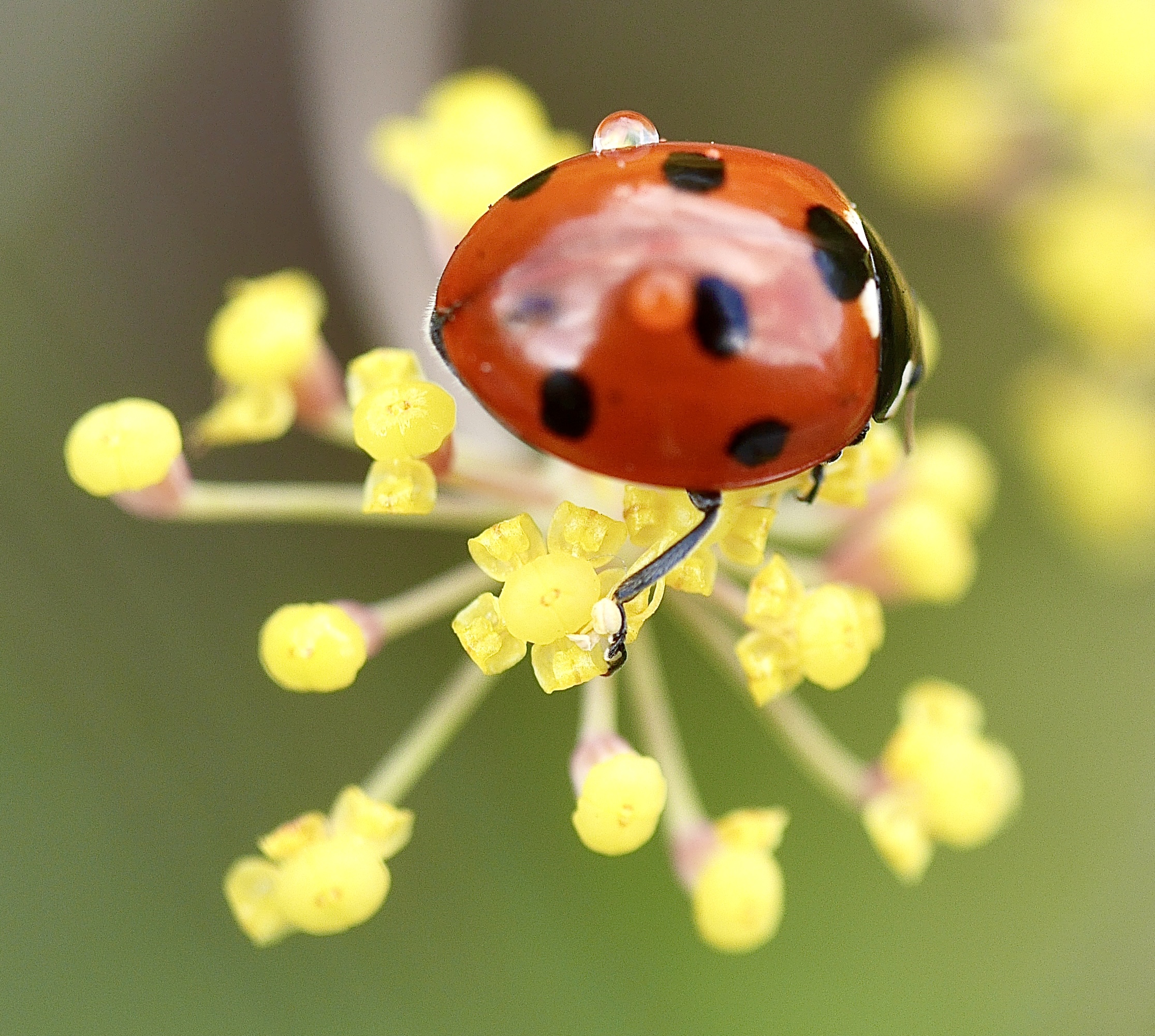
Ladybirds are to be encouraged (with the exception of the harlequin ladybird) as they help control pests such as aphids (greenfly and blackfly). Aphids ‘drain’ nutrient rich sap from host plants and also spread viruses with their piercing mouthparts. Some ladybirds add to their diet with nectar and as they sip nectar from flowers, they may also carry pollen from one flower to another.  Like many other insects, species of native british ladybirds have declined in recent years, many outcompeted by the harlequin ladybird (which is an introduced species from Asia.  Harlequins also harbour a fungus which can infect native ladybirds). [caption id="attachment_39002" align="aligncenter" width="675"] a ladybird 'stalking' aphids[/caption] Ladybirds are coccinellid beetles.  They belong to the order – Coleoptera – and are characterised by having forewings modified to form hard wing covers (ELYTRA) and they have biting mouthparts (as compared to butterflies and moths, which have a proboscis*).  Their wing covers are brightly coloured, and they serve as a warning to predators of their bitter taste. Ladybrds can also exude a pungent fluid to ward off ants, birds and people. Recent work at Cornell University (and the Lost Ladybug Project) has suggested ways in which ladybirds might be encouraged in the garden.   Strategies that might encourage ladybirds include : Growing plants that have hairs on their surfaces that offer some protection from predators,  Plants that 'offer' food such as nectar , or prey (aphids).  For example, aphids are often to be found on roses which frequently are home to aphids. Plants that give visual (or chemical) cues. More ladybirds were observed on the plants from the Umbellifer,  Daisy and Rose families  They seem to be drawn particularly to yellow flowers. [caption id="attachment_30742" align="aligncenter" width="600"] Aphids on yellow - beware![/caption]   * though some species such as the Humming-bird Hawk-moth have a 'tongue' which it uses to sip nectar
