Woodlands.co.uk

Blog - cuticle

A place to live - leaves.

A place to live – leaves.

by The blog at woodlands.co.uk, 24 September, 2026, 0 comments

Generally speaking, leaves are quite small, but collectively they present a massive surface area to the environment.  The total surface of leaves is significantly greater than the surface area of the Earth.  Leaves are the organs of photosynthesis, not only do they make the basic chemicals for the plant, but they replenish the oxygen in the atmosphere. Generally speaking, a leaf has two surfaces.  One surface (the adaxial) is presented to the sun, the other (the abaxial surface) is shielded from the light to some extent.  Both surfaces are covered with a waxy layer (the cuticle), which helps restrict water loss. The underside of the leaf has many tiny pores, the stomates, which can open and close to allow the exchange of gases and water vapour.  The lower surface may be covered in minute 'hairs'.  These create an unstirred layer, so that air next to leaf has a high water content and thus water loss through the stomates is reduced.  The veins of a leaf contain xylem tissue which delivers water and mineral salts, and phloem which transports sugars and other organic compounds from the leaf. [caption id="attachment_43706" align="alignleft" width="300"] adaxial surface[/caption] [caption id="attachment_43705" align="alignright" width="300"] abaxial surface[/caption]   The upper  surface and lower surface  of a foxglove leaf.  Whilst the veins can be seen on the top surface, they are ridged and covered in hairs on the lower surface. [caption id="attachment_13486" align="alignleft" width="240"] galls on sycamore[/caption]   Once a leaf has grown then its size, shape and the veins remain constant, but during the course of the year other things can and will change.  For example, in autumn the coloured pigments in the leaf break down and many compounds are transported out of the leaf as it undergoes senescence. The leaf may be subjected to attack, caterpillars and leaf miners may eat its tissues.  Certain wasps may lay eggs within the leaf so that a gall develops.  Greenfly use their piercing mouthparts to access sugars and other compounds from the phloem.  Bacteria may infect the leaf either through wounds inflicted on the leaf, or by penetrating the stomates. To some micro-organisms, a leaf is ‘home’; it is a habitat.  Rather like it is now common to talk about our gut microbiome or  the microbiome of the skin, so each leaf has a microbiome. Recently, microbiologists from China and Germany have studied the microbiome of oak leaves.  Specifically, they examined the microbiome of the leaves of the pedunculate oak.  They examined how the organisms present changed during the course of a growing season.  They found that the upper and lower sides of the leaves had different communities of micro-organisms.  Both surfaces  shared the same sorts of bacteria, but they varied in the amounts / proportions of the bacteria on the two surfaces.  Furthermore the differences between the upper and lower surfaces changed as the seasons changed.  The diversity of organisms on the lower surface of the leaf fell as the year progressed.  Some of the bacterial DNA on the lower surface was that of bacteria which could be found on / in aphids and whitefly.  Some of the bacteria found were associated with fermentation of sugars.   The study did not investigate fungal species on the leaves, but it does indicate that there are complex microbial communities present on leaves, and that the two surfaces offer different ‘opportunities’ for micro-organisms.  Similarly, it has been established that there is a root microbiome. The root microbiome is a complex community of bacteria, fungi, archaea, and viruses living in and around plant roots. This microbiome helps the plant take in nutrients, fight diseases, and cope with environmental stress. [caption id="attachment_43724" align="alignright" width="350"] Hornbeam - abaxial surface[/caption]   [caption id="attachment_43723" align="alignleft" width="350"] Hornbeam - adaxial surface[/caption]
Coming into leaf

Coming into leaf

by The blog at woodlands.co.uk, 25 April, 2025, 0 comments

The grey—brown skeletal branches of trees are being cloaked in fresh green leaves as they unfurl from the buds that protected them through the winter months.  Their bright green colour is due to large amounts of chlorophyll.  The chlorophylls are pigments that can absorb many of the wavelengths of visible light, but not green.  Green wavelengths are reflected back into the environment, which is why our eyes perceive both young and mature leaves as green. Each leaf is made up of a variety of cells and tissues.  The top and bottom of the leaf are covered with a layer of cells  termed the epidermis.  It consists of many interlocking cells (rather like jigsaw pieces), sometimes called pavement cells.  Their function is to protect the underlying cells and also produce the waxy, waterproofing layer — the cuticle.   The lower epidermis is ‘pierced’ by the stomates.  These are the ‘breathing pores’ of the leaf, allowing the exchange of gases and water vapour.   The epidermis may also bear trichomes.  These are small ‘hair—like’ projections.  If there are many of them they can give the leaf a white or silvery appearance, helping to trap moist air near to the leaf surface to reduce water loss.  They  may also help to reflect sunlight, so that the leaf does not get too hot and on cold days can serve to protect the leaf from frost damage. Some trichomes have a protective function in that they may physically restrict the feeding of insects and other herbivores, and some contain a cocktail of toxic chemicals [e.g. nettles]. Under the upper epidermis and within the leaf, there is one or more layers of cells packed with chloroplasts - the palisade layer.  This is the principal site of photosynthesis within the leaf, where carbon dioxide is fixed into sugars and other vital nutrients.  The ‘by-product’ of photosynthesis is oxygen, which is not only essential for plant respiration but needed by the vast majority of animals on this planet.  It diffuses out of the leaf through the intercellular spaces of the next layer of the leaf - the mesophyll layer. The stomates allow gases in and out, but can close through the movement of their guard cells.  Stomates tend to close up at night or when the leaf experiences water stress.  Running throughout the body of the leaf is the xylem and phloem tissues, which conduct water, minerals and sugars etc around the plant. The sheer abundance of chlorophyll in many leaves masks the presence of other pigments, which only become visible when the leaf begins to senesce and the chlorophylls break down.  The leaf turns a yellow / orange colour due to the presence of carotenoid pigments.  Autumnal leaves can display a variety of colours due to other pigments such as the anthocyanins and xanthophylls.  Some leaves take protection very seriously   Curious fact : the leaf with the largest surface area is that of the Amazonian water lily, which can be 10 feet in diameter.
A leaf challenge.

A leaf challenge.

by The blog at woodlands.co.uk, 18 April, 2025, 0 comments

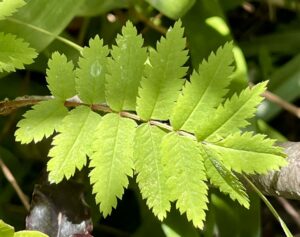
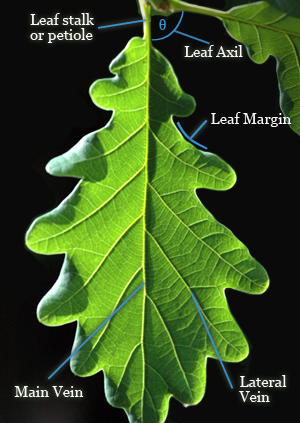
Leaves have three main parts:  The petiole, a stalk-like structure that connects the blade of the leaf to the stem of the plant. Some leaves don’t have petioles,  and are known as sessile leaves. The blade or lamina, usually the largest part of the leaf.  The edge of the leaf or the leaf margin may be described as entire, toothed, or lobed. The oak leaf, for example, is clearly lobed. The blade has many veins, forming a network, carrying water and nutrients, The base, the base is the region of the blade that attaches to the petiole. A leaf is said to be simple if its blade / lamina is undivided, if the ‘teeth’ or lobes do not reach down to the main vein of the leaf.  A compound leaf has several leaflets, which join up with a single leaf stalk or petiole. When identifying tree leaves, it is always important to look for the petiole,   as a single leaflet of a compound leaf can look like a simple leaf.  More details of leaf and tree structure can be found on this link on our website. Now for a challenge.  Can you or your children find a leaf (and name the tree it came from), that Has a serrated / toothed edge Has a lobed margin Has a smooth edge / margin Is a compound, palmate leaf Is a compound, pinnate leaf Is hairy Is not green, but red or a mixture of colours Is more or less circular Is fleshy / succulent Has spines on its edges Is needle shaped Has a thick (waxy?) cuticle or is very shiny Has net venation  is marcescent (might keep you hanging around) Go forage!

Next Page »