The importance of biocrusts
by The blog at woodlands.co.uk, 4 June, 2024, 0 comments
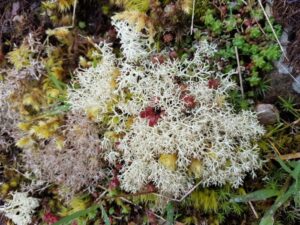
The soil in many arid ecosystems (for example, savanna, deserts, & shrublands) is often covered by a thin layer of organisms, a community of lichens, mosses, liverworts, fungi, cyanobacteria and other microbes. They form a biocrust in the very top layer of the soil. These organisms produce a variety of chemicals that glues together the soil particles. Most biocrusts start of with a single type of organism (often a lichen or cyanobacteria, they are hardy). As these grow, they change the immediate environment so that others can then colonise the area so slowly the community grows..
The resulting biocrusts are important in helping reducing soil erosion and dust production. Whilst dust can hold nutrients that will benefit plants as and when it is deposited, it can also have negative effects. Dust reduces water and air quality. Dust storms can be truly massive and terrifying, for example, the 2009 Australian Dust storm. Occasionally, in this country we experience saharan dust that his been carried hundreds of miles on the wind. If wind-blown dust lands on glaciers, snow or ice sheets then it affects the albedo. The albedo is a measure of a surface’s ability to absorb and retain energy, or putting it the other way round, the ability to reflect heat / light energy. Dark coloured objects tend to absorb more light energy than light coloured surfaces. So if snow or ice becomes coated with dust, it will absorb more heat and may melt.
Biocrusts prevent many millions of tonnes of dusts entering the atmosphere each year. It is thought that they may cover some 12% of the earth’s land surface. Soil with a biocrust needs a far stronger wind before it starts to erode. Sadly, like many other things, biocrusts are under threat due to climate change and shifting patterns of land use.
[caption id="attachment_41261" align="aligncenter" width="675"] Church wall being colonised by Lichens[/caption]
Biocrusts can also form on walls and buildings, for example, lichens and mosses colonise gravestones. Whilst biocrusts have positive effects when they form on soils, it is thought that they can have deleterious effects on stone / brick surfaces due to the various organic acids and other chemicals that the colonising organisms can produce. The production of these chemicals can degrade (weather) structures and lose their integrity / aesthetic appeal.
The Great Wall of China, which once stretched for some 8000+ kilometres, is protected by biocrusts in parts. Construction of the wall started about. 200 BCE and continued (on and off) till the 1600’s CE. Much of the wall has now been lost. Some parts of the wall were made from stone and bricks (held together by sticky rice mortar). Other sections were constructed from ‘rammed earth’, made by compressing natural materials (eg. chalk, gravel, lime) with soil. Some have regarded these sections of the wall as ‘weak points’. Recent work by Bo Xiang and colleagues found that the ‘rammed earth’ sections were often covered by a biocrust, (of lichens, mosses and cyanobacteria). This biocrust actually helps maintain the integrity of the wall by protecting it from wind and water erosion. It reduces temperature extremes and the porosity of the wall, reducing infiltration and its water holding capacity. All of these help maintain the integrity of these sections of the wall.
If biocrusts are lost, through fire, climate change or human intervention then recovery can be problematic. Organisms like cyanobacteria may recolonise a site quite quickly by organisms blowing in from nearby and undisturbed areas. Full recovery of the crust and composition generally occurs more rapidly where the soil is fine textured and moist. When the soil is coarse and dry then re-establishment of a biocrust may take hundreds or thousands of years.
Thanks to Art for lichen image on church wall.