Woodlands.co.uk

Blog - deadwood

Orchid germination

Orchid germination

by The blog at woodlands.co.uk, 17 December, 2025, 0 comments

Orchids are unusual, indeed exotic plants. After they have produced their flowers and they have been pollinated, the flower wilts and the ovary begins to swell to form a seed pod.  The time it takes for a seedpod to mature varies from species to  species, it may take eighteen months for a type of slipper orchid [Paphiopedilum].  When the capsule is mature, it splits open and its numerous, minute seeds are dispersed by the wind.  A single seed pod may contain millions of the dust-like seeds; a single seed may compared to a ‘speck of dust’.   Unlike the seeds of ‘normal’ plants, the seeds have no food reserve within them and in order to grow, they have to establish a symbiotic relationship with a specific mycorrhizal fungus.  This symbiosis is essential for the seed to germinate and grow.  The fungus enters the seed and provides the necessary nutrients for its development into a seedling. Propagating orchids from seeds is a complex process. sometimes done under sterile laboratory conditions using special culture media. In the wild, although an orchid may produce millions of seeds, only a minute fraction will successfully establish a symbiotic relationship with the correct fungal partner to grow and survive. Recent research with the orchid Cremasta variabilis has revealed some interesting facts about the germination of the seeds.  The orchid is found on the Korean Peninsula and is an insect pollinated, terrestrial orchid.  As with other orchids, its seeds are minute and are known to depend on a certain fungus to grow and develop.  In the past, most studies have focused on the fungi present in mature orchids but the team from Kobe University studied very young seedlings.  They noted that seedlings were often to be found near decaying logs, and this led them to test whether deadwood fungi are involved in early orchid development.   They buried seeds of four species of orchid in various forest locations, but they only observed germination  and seedlings near to decaying logs.  The seedlings were found to be exclusively associated with wood decaying fungi.  It may be that the orchids use other fungi to maintain the symbiosis as the deadwood dries out or is exhausted of nutrients. Some species of orchids have abandoned photosynthesis completely, and feed via fungi through their lives - a phenomenon known as mycoheterotrophy.  As woody (and rotting) debris represents a major carbon source in forests, it is a resource waiting to be exploited.  
Knox Wood - first impressions

Knox Wood – first impressions

by Alan, 19 February, 2024, 0 comments

We purchased Knox Wood in August 2023, part of Boltonmuir Wood, an old woodland site on fairly boggy ground in East Lothian. Our five acres are split 50% almost pure birch (Silver and Downy) regenerating [about 20 years old] and 50% mature Scots Pine that is well thinned over mixed natural regeneration.  All of the site has previously been used for commercial forestry so there is plenty of natural regeneration from Sitka Spruce, Douglas Fir, Western Hemlock, Silver Fir and Larch. Some oak, rowan, hawthorn and beech regeneration is also present. Roe deer use the site but are not having much impact on the trees, just ticks to be aware of.   Plenty of mosses, ferns and bracken that indicate acidic soil conditions. Our plan is to improve the site for biodiversity and use some birch for green wood working.  So far we have been taking out non-native conifer regen, leaving a few that are suitable for bird nesting and to provide a bit of evergreen shelter. A few Rhododendrons to eliminate as well, easy enough using the lever and mulch technique. We will create some standing deadwood and add to the fairly good level of deadwood from previous birch thinning that is now well rotten.  We will add a few native species, such as Aspen and maybe more Willows for weaving.   Also hoping to grow some edible fungi on site, there are wild mushrooms and I am sure plenty of people already roam around there collecting them.  As Alien Spoons, I teach green wood working so will thin out the birch for spoon carving, shrink pots, bowls and other treen.  Maybe make some besoms and other products with it as well.    [caption id="attachment_41045" align="aligncenter" width="675"] Birch regenerating[/caption]  
Wild life and deadwood.

Wild life and deadwood.

by The blog at woodlands.co.uk, 28 April, 2023, 0 comments

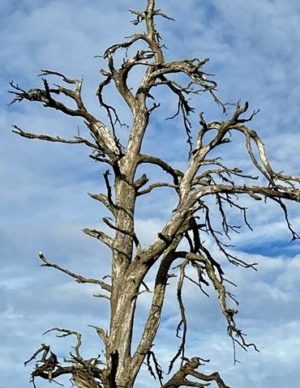
For biodiversity to flourish, a wide variety of microhabitats is needed.  With many micro-habitats, more species are able to thrive. It may seem counter-intuitive but deadwood offers opportunities for a diverse range of species. Within a woodland, there are various types of deadwood, providing shelter and food for many organisms.  Perhaps one of the most obvious examples of deadwood is standing but dead trees.  If the dead tree was a veteran, then it will provide a variety of micro-habitats.  Holes and crevices may be used by bats and birds, the decaying wood will be colonised by bacteria and fungi, bracket fungi may erupt - whilst the bark will continue to offer a substrate for mosses and lichens.  As the wood decays, the material becomes a home for saproxylic beetles. Stag beetle larvae feed on decaying wood underground,  whilst the adults rely on fat reserves built up during their larval stage. Adults can ‘drink' oozing sap  and the juice of soft, rotting fruit. In the UK, some 650 beetle species are associated with deadwood [visit Dr Ross Piper’s website for full details of these insects].  As with many insects, many saproxylic beetles are threatened with extinction - due to the decline in the number of veteran / ancient trees.  Saproxylic beetles, apart from being important in the recycling of materials, are also food for birds and mammals. A previous blog has extolled the virtue of dead hedges.  Dead hedges are simply piles of branches and twigs arranged to create a barrier / hedge. They represent  a way of disposing of material that arises from thinning or clearing operations in woodlands. This ‘waste material’ of saplings and side branches are sometimes referred to as “arisings" by tree surgeons, or "lop and top” by foresters. Using this material in this way is good for wildlife, particularly for small mammals and birds - as it gives them somewhere to shelter from the wind and rain, and protection from predators. It's also good for insects.  As the material rots and decomposes, it adds humus / nutrients to the underlying soil. Larger pieces of wood from the felling of trees can be arranged to form a stack or pile, by simply laying branches and logs on top of one another  Such a stack wil rot and decay over time, but will provide a home to a variety of wildlife. So, deadwood in its various forms, is an important part of woodland ecosystems. It has a role in delivering biodiversity, but it also provides ‘ecosystem services’, such as soil formation and nutrient cycling. Deadwood contributes to the detrital food chain, which is driven by fungi, bacteria and detritivores.   Below : All that remains of a historic tree - the Wilberforce Oak. It was here at Holwood House (Keston , near Hayes, Bromley) in 1788 that William Wilberforce resolved to address the task of abolishing the slave trade. It took some twenty years for his vision to be realised. [Thanks to Ruth for images of the Wilberforce Oak] https://en.wikipedia.org/wiki/Holwood_House
Recycling in a wood?

Recycling in a wood?

by The blog at woodlands.co.uk, 3 August, 2022, 1 comments

It may be that a dead hedge is just that, your once carefully manicured box hedge which has now been ravished by the box moth.  However, in terms of managing your woodland, a dead hedge may have a different meaning. Here, a dead hedge may be a barrier to an area of new planting, it may be a way to ‘persuade’ people to keep to a footpath, or keep away from a pond / stream.   The dead hedge will be made from the bits and pieces that have be culled in clearing and thinning operations within the wood, material that foresters sometimes refer to as ‘lop and top’ and tree surgeons call ‘arisings. It can also include material cut from brambles and climbers such as ivy, honeysuckle and Old Man’s Beard (Clematis). Using natural materials to create barriers (and indeed) a habitat in a woodland is a way of using ‘waste’ in an ecologically sound way.  It saves having to remove trimmings from the site and offers opportunities to ‘top up’ the hedge if desired.  Obviously diseased materials should not be used.   Creating a dead hedge from clippings and trimmings is a way of using natural materials, rather than plastic & other materials that do not readily decompose.  A dead hedge will be an effective barrier for a period of time but it will break down sooner or later as bacteria and fungi break down the woody remains (lignin and cellulose).  The disappearance of the hedge will take time as the branches twigs etc are largely off the ground, so relatively dry and decomposition is facilitated by warmth and wetness. After its initial ‘construction’, the hedge will become part of the woodland, it will be colonised by some plants and it will offer shelter, nesting sites for birds and small mammals, and a ‘home’ to many different invertebrates, such as woodlice, beetles, even certain species of bumblebees.  As the hedge deteriorates, that is, decomposes, so the soil will gain in humus and fertility as the nutrients from the decaying wood etc are released through the detrital food chains.   Another way of using / recycling bits from pruning, clearing etc is by Hugelkultur.   Hugel beds are basically raised beds with a difference - they are filled with rotting wood and other biomass.  They are packed with organic material, nutrients and air pockets. Such beds can be an effective way of creating a productive area for growing fruits and vegetables in your woodland.  There is a woodlands blog about hugelkultur here. Large chunks of wood e.g. sawn up tree trunks can be stacked up in small piles and will over time make an excellent home for many invertebrates but especially xylophagous (wood eating) insects, for example,  saproxylic beetles.  These are beetles that live / eat in dead wood.  In the UK, some 600+ beetle species (from 53 different) families are associated with deadwood. Some feed on the deadwood itself (often with the aid of symbiotic bacteria in their gut), others feed on the fungi that are gradually ‘dissolving’ the wood.  Ants and wasps sometimes make their nests in dead wood.   Using wood to increase the organic content of the soil is good in terms of  carbon sequestration,  improving soil fertility,  water conservation and  productivity.