Woodlands.co.uk

Blog - deer fencing

Deer in woodlands

Deer in woodlands

by The blog at woodlands.co.uk, 22 June, 2024, 3 comments

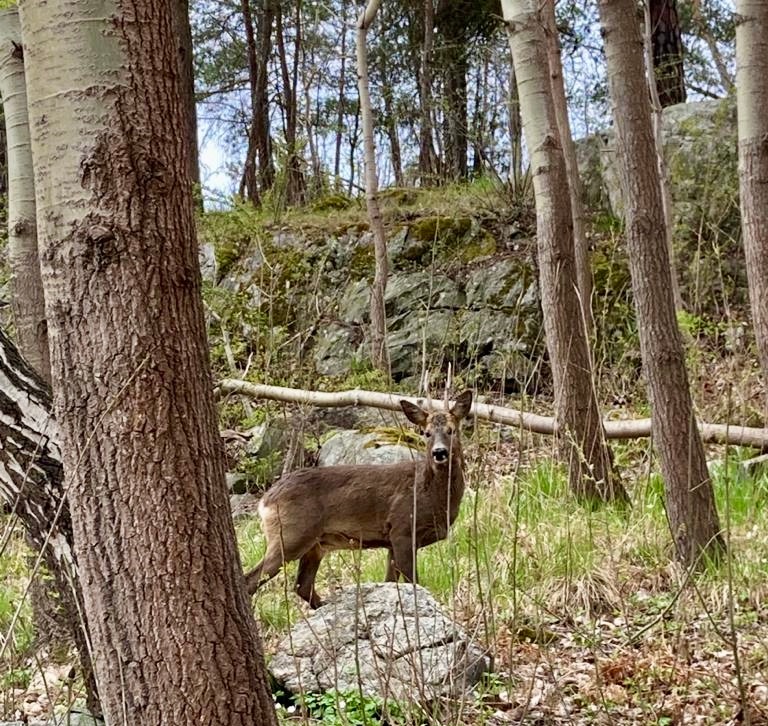
Woodland covers some 1,000 hectares of the Ashdown Forest, that is roughly 40% of its area. Much of the woodland is relatively young. However, the forest’s capacity for regeneration / renewal is being damaged by overgrazing.  Local deer populations have grown and now represent a problem. Deer browse / graze on vegetation, shoots, flower buds and foliage are stripped off plants.  Young saplings are damaged and bark is eaten, especially when food is scarce.  Consequently, tree and shrub regeneration is limited.  Other species are affected by the feeding of the deer, either through loss of niches or food.  Among those at risk are small mammals and certain butterfly species. [caption id="attachment_34368" align="aligncenter" width="650"] deer damage[/caption] Damage is found in woodlands in many parts of the country, as deer populations have increased in recent times. In the 1970s, the deer population was estimated to be around 450,000 as compared to today’s estimates of over 2 million.  The National Forest Inventory highlighted that "40 percent of British forests have ‘unfavourable’ levels herbivore damage, which limits the survival of young trees and threatens biodiversity".  Apart from deer damage, there is damage by the grey squirrel populations. Deer browsing can : Prevent natural regeneration Affect biodiversity Affect woodland resilience Reduce food availability to the herd which can lead to starvation / loss of condition Deer are also hosts to ticks.  The ticks may be infected with Borrelia burgdorferi  bacteria and transmit them to humans, resulting in Lyme disease. Deer  also contribute to collisions with motor vehicles; more than 450 deer were hit by vehicles on Hampshire roads last year .  In Scotland,  government agency figures indicate that deer vehicle collisions  [DVCs] have almost doubled between 2008 and 2020.   Sadly, people are injured or killed in DVCs, and the repair cost to vehicles runs into millions. The solution to the ‘problem’ is not clear cut. Culling [the selective killing of animals] to control deer populations is one way in which numbers can be reduced, and the damage to woodland mitigated.  However, this approach has been met with opposition by many, including animal rights organisations.  There is the argument that whilst a reduction in deer numbers might fix some problems in the short term, the subsequent increase in plant growth and food availability might lead to increased breeding by the remaining deer and numbers would then increase again.  Also, unsuccessful or inaccurate shooting leads to animal suffering, mutilation and / or a lingering death.   Some might advocate rewilding and the introduction of apex predators (such as the wolf, lynx, wild cats*) as a means of reducing numbers but that might raise other problems! Deer have been 'part and parcel' of woodlands since mediaeval times, when the forests were used for hunting. In the Ashdown Forest, the number of red deer declined during the C17th,  and poaching was a factor in their decline. Fallow deer numbers also declined. [Fallow deer were introduced to England by the Normans around 1100 AD.]  The deer population roaming the forest has increased significantly in the recent decades, and now there are the relatively recently introduced species, muntjac and sika deer.   There are six species of deer in UK woodlands – the two native species, the red deer and roe deer and fallow, muntjac, sika and chinese water deer make up the four non-native species. The problem of over grazing is not unique to the Ashdown forest. For example, deer numbers in Scotland have doubled in recent years to almost a million since 1990.   Finding sustainable (and humane) solutions to the large numbers of deer is difficult. * Wildcats were once widespread in Britain, but by the end of the 18th century, they were to be found only in the northern regions. [caption id="attachment_34415" align="aligncenter" width="700"] Remnants of birch woodland near Loch Muick are subject to browsing by red deer (especially in the winter), so temporary fences have been put in place to allow for regeneration.[/caption]
Wildlife in Scotland

Wildlife in Scotland

by The blog at woodlands.co.uk, 18 January, 2024, 0 comments

NaturScot is Scotland’s nature agency.  It monitors and reports on all aspects of the natural environment.  It has published a report on its terrestrial bird breeding species and it is a somewhat mixed report. Some of the most ‘famous’ species associated with Scotland, such as the black grouse have declined significantly during the period of study (1994 - 2019).  The grouse population has halved, and the kestrel, greenfinch and lapwing populations are also in decline.  Woodland populations of Capercaillie have also fallen.  The largest grouse in the world, the capercaillie was once widespread but suffered local extinction in the eighteenth century and was reintroduced in the C19th. It is now only found in old pine forests and mainly in the Cairngorms National Park. The Capercaillie are now red-listed and protected in the UK. [The Pine Marten which feeds in part on the eggs of game birds was almost lost in the nineteenth century, due to farmers and gamekeepers trapping them.] The fall in bird numbers has been associated with changes in climate, notably warmer and wetter weather coupled with extreme events (such as flooding and heat waves).  Whilst some species have suffered as a result of the changing weather, others seem to have prospered, including some that do not ‘traditonally’ make their way to Scotland.  The great spotted woodpecker is one such species, its numbers have increase by 500%, bullfinch and red numbers have also increased.  Gold finches and magpies are now more common on farmlands in Scotland. various measures could help offset some of these declines,.such as  the diversification of woodland (more tree species) restoration of peatlands Creation of habitats on farmland legal predator control deer exclusion to allow regeneration removal of deer fencing, (where feasible) as capercaillie and black grouse are known to fly into this and injured as a result. One example of the benefits of deer fencing is to be seen in the Glen Lyone woodlands.  Historically, this area was part of the royal hunting grounds of Cluanie and was home to capercaillies, wildcats and lynx.    Nineteenth century maps show a significant area of woodland, but by the 1990’s less than a hundred of the ancient pines were left.  The oldest pine in the area dates back to the C14th century, and many others are several centuries old.  However, the area was heavily grazed by deer, which reduces regeneration as young seedlings / saplings get eaten.  Now “Trees for Life” have erected new deer fencing, which hopefully will allow natural regeneration of pine forest in the area.  Calendonian Forest once covered much of the Highlands but now less than 2% of it survives.  Full details of this project (and a video) may be found here ; https://treesforlife.org.uk/scotlands-oldest-wild-pine-saved/
capercaillie

woodlands web updates : 28

by The blog at woodlands.co.uk, 30 November, 2023, 0 comments

On the Red List! The capercaillie is threatened.  Its numbers in Scotland have roughly halved (between 2010 and 2020).  It was once widespread, but now it is found in the pine forests of the Highlands - notably the Cairngorms National Park.  It is a red listed species. The decline in numbers is associated with poor breeding success, poor weather in early summer when the chicks are developing, another problem is predation by species such as the pine marten, foxes and crows.  The Game and Wildlife Conservation Centre (GWCT) has identified another issue that these birds face - namely collisions with deer fences.     These fences are created to keep deer out of particular areas.  However, when the capercaillie (and black grouse) impact on these fences, they are injured or killed.  Marking these fences, reduces the number of collisions but does not stop them.  Unmarked fences are still killing adult birds.  Marking of these fences or their removal would help with the survival of the capercaillie, though removal would  mean trees and shrubs would be unprotected from deer. Mosquitoes! There are some 36 different species of mosquitoes to be found in the UK, which  are generally harmless (though they bite).  But that may change.  With longer and warmer summers, the UK may become a venue for other species such as the tiger mosquito.   This insect has been found in ‘traps’ (monitored by the UK Health Security Agency) at ports and rail terminals.  This insect is known to transmit various diseases, such as dengue fever.  The mosquito was found in Italy in 1990 and it is spreading on the continent. A species of Culex has also been found in some areas of the Thames estuary - which can spread the West Nile Virus. This virus can result in flu-like symptoms.  Outbreaks have been been mainly in the warmer areas of the Mediterranean, but with climate change and the potential for very hot summers here - vigilance will be needed. Floral defences. Many flowers release a distinctive scent.  The scent serves to attract pollinators like bees and butterflies, or  it may ward off pests that would feed upon the plant.. Many of the chemicals that contribute to scents are terpenes.  Recent research has investigated how these chemicals can affect the growth and development of butterflies - using painted lady butterflies.  These butterflies feed on a wide range of plants and hence are exposed to a variety of scents / terpenes. For these experiments, the researcher (at the University of Centra Florida) used four common floral terpenes  Limonene :  which has a fresh, citrus like smell Linalool. : has a floral scent, reminiscent of lavender Cineole : has a camphor-like smell, slightly medicinal contributes to eucalyptus oil. β caryophyllene : this has a spicy / woody fragrance. Different amounts of these terpenes were fed to caterpillars of the painted lady butterfly, and the subsequent development of the caterpillars was monitored and the size of the adults recorded.  The experiment was also conducted at different temperatures.  Temperature affects scent release by flowers. Higher levels of terpenes has significant affects on the survival of the caterpillars, especially when combined with the higher temperatures.  The caterpillars took longer to enter into pupation when given high levels of terpenes, though the size of the adults that emerged from pupation was unaffected.  If longer and warmer summers become more common, the combined effects of terpenes and heat could become important determinants of development. `
Deer control - shoot to kill and cull, or are there other solutions?

Deer control – shoot to kill and cull, or are there other solutions?

by Angus, 30 August, 2023, 9 comments

Deer are eating out the bottom of our woodlands and wildlife is suffering.  Although the size of the national deer population is not known for sure it is probably at its highest for a thousand years. There may be as many as two million deer in the UK’s countryside. There are several types, such as the two native species, being the Red deer (Cervus elaphus) and the Roe deer (Capreolus capreolus) - which is the most populous of the larger deer being, perhaps, 500,000 animals. Then there are the ones the Normans introduced, the Fallow deer (Dama dama) with a population of at least 150,000. On top of that there are three species of deer which have been introduced from the Far East including the Sika deer (Cervus nippon).  The other two from China are very different - there are relatively small numbers of the Chinese Water deer (Hydropotes inermis), whereas there are probably hundreds of thousands of the small and mostly nocturnal Muntjac (Muntiacus reevesi). They are all hungry and they all love woodlands. Most people believe the deer population needs to be controlled, or even reduced in number, but the range of species makes that harder to do. If you reduce the population of one type of deer the others will expand their numbers. Culling, or shooting, is certainly helping but stalkers are usually only interested in the larger species with enough meat to make it worthwhile and this leaves the muntjac space to thrive. Here is a film we made of a Scottish deer stalker explaining her job and how her stalking helps with environmental management: [embed]https://www.youtube.com/watch?v=ISh2sN-Ljy8&ab_channel=WoodlandsTV[/embed] Megan: “99% of stalking is looking through the binoculars.” Other ways of controlling the deer population are fencing them out but that is expensive and unlikely to work in the large open areas of the British countryside such as the moors and the uplands. Another potential method of control is introducing predators such as lynx or other larger hunting species. This meets some resistance from the public and the unintended consequences are that the predators might well go after different species altogether and occasionally humans. Most work is going on with contraceptive solutions so that the birth rate is reduced and less killing or culling is needed. This is also being researched for controlling populations of wild boars and grey squirrels to keep their numbers in check. It means getting the drugs to the target species and usually to the females which is often done through their foodstuffs, using food hoppers which are designed to be only accessible to that species. Other approaches include sterilization through injections and the Deer Initiative partnership has done a lot of work on examining different methods of biological control of deer numbers: https://www.thedeerinitiative.co.uk/pdf/contraception-and-wild-deer-control.pdf It’s not easy.  Even if one of these methods works, it will require an enormous effort to cut deer populations particularly of the smaller and more evasive species such as the muntjac. What do you think should be done? Meanwhile , deer are dangerous to motor cars.  The British Deer society estimates that annually there are between 40,000 and 70,000 accidents involving deer and this leads to about 700 human injuries, and far more deer fatalities!. So, in short, an overpopulation of deer is a large and growing problem: they damage the flora in woodlands, they eat young saplings, they compete with other mammals for space, they eat farmers’ crops, they carry ticks and they cause road accidents. The challenge of controlling the deer population is very real.
Deer and Scotland’s temperate rain forest.

Deer and Scotland’s temperate rain forest.

by The blog at woodlands.co.uk, 6 July, 2023, 1 comments

Scotland’s west coast has a number of temperate rain woodlands / forests. They are quite rare. The remnants of oak, birch, ash, native pine and hazel woodlands are small and isolated from each other. They are noteworthy for the diversity and richness of the bryophytes (mosses and liverworts) and lichens; found in abundance on the trees, rocks and on the ground.   Sadly, such woodlands have been in decline for some time. In the past, this woodland covered large areas of the west coast of Scotland, but much has been lost over the last two thousand years.  These woodlands / forests now cover a small area, just under 5% of the land. Factors that have contributed to the decline and loss of this woodland include:- mismanagement,  overgrazing by sheep and  invasion by non-native species [such as Rhododendron ponticum]. According to recent study by Scottish Environment LINK, deer now represent a considerable threat to the woodlands.  Whilst deer are part of woodland ecosystems, when their numbers increase beyond a certain point then they become a significant problem.  Deer numbers are now at historic highs in Scotland/  Money has been made available to manage surging deer populations, for example, through the provision of deer fencing.  However, the report considers that such fencing is “both expensive and often ultimately ineffective”.  More needs to be done if deer damage is to be reduced and allow regeneration of the woodlands. Developing a community approach to deer stalking and management will be important, combined with the use of technologies such as thermal and drone surveying. A greater focus on the management of roe and sika deer, combined with the removal of Rhododendron ponticum will be needed if the woodlands are to flourish and expand. see also : https://www.thescottishfarmer.co.uk/news/23637346.soaring-deer-numbers-see-new-powers-land-managers/   [caption id="attachment_39688" align="aligncenter" width="675"] Rhododendron ponticum, these plants were growing near the River Tay.[/caption] visit https://www.instagram.com/woodlands.co.uk/?hl=en