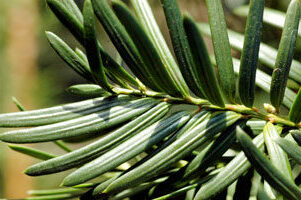
The yew, a native conifer.
by The blog at woodlands.co.uk, 17 June, 2026, 0 comments
The yew is one of our native conifers, the others are the Scots Pine and Juniper. The yew is exceptional in terms of its longevity. The life span of the tree may run into the thousands of years, but more typically a tree may live for 1500 years. Somewhat unusual features of the Yew are that
it is dioecious. That is, there are separate male and female trees. This promotes cross fertilisation, increasing genetic diversity.
when it sets seed, they are not in the typical conifer cone. They form in a fleshy red aril - a berry-like structure
The yew is a medium sized conifer, that may reach a height of some 20 metres. It has dark green needle-like leaves, which are somewhat flattened (see image). The bark has a red / brown colour, which has an increasingly flaky appearance as the tree ages. Again as the trees mature they may develop hollow trunks and splinter apart to form multiple stems. This seems to be a regenerative strategy. This is particularly apparent in the Fortingall Yew, which is indeed is a very ancient tree, possibly the same age as Stonehenge!
[caption id="attachment_43351" align="aligncenter" width="700"] Yew in a woodland setting[/caption]
The Yew is distributed across the UK but is found more often in Southern and Central England, where it is associated with well drained soils seated on chalk and limestone. It is also to be found in managed situations, ranging from church yards, large estates and parklands, to hedgerows in urban gardens. In some places, the trees are managed to form topiary.
Yew trees can thrive in woodlands settings, though its dense evergreen canopy can create deep shade at ground level. As the light intensity is reduced, this can reduce the diversity of the ground flora. However, the trees offers shelter in the winter months to various birds (such as the Chaffinch, Robin, and Wren) and mammals. Most of the tree is toxic, the only edible part is the red aril that surrounds the seeds.
The seeds contain high concentrations of taxine alkaloids, which if ingested interfere with the electrical signals in the heart. In recent years, yew trees have been planted in large numbers in China to provide material for the extraction of one of its toxic chemicals for the anti-cancer drug taxol/paclitaxel. This drug acts by interfering with the division of cancer cells. However, some birds can eat the aril and the seed, the seed then passes through the gut undigested. This aids the dispersal of the seeds over a significant area The toxicity of the tree is important in that it protects against grazing by deer etc.
Yew wood is noted for its red/brown colour and its durability. In the past, it was greatly valued in the making of long bows due to its flexibility and strength. The rich colour and grain of the wood mean that is used to make veneers and in furniture making. As the wood is hard and dense, it is favoured by woodturners to create bowls and lamp bases. The wood is also used in the making of violins and other musical instruments. Yew wood is remarkably resistant to decay / rot, which makes it particularly suitable for outdoor furniture. However, as the tree is slowing growing and often ‘twisted’ and/or knotted, it is difficult to obtain large planks of the wood in any quantity.
For many centuries, Yew has been associated with churchyards and this is where many ancient yews are to be found. In a Christian context, the yew represents eternal life and resurrection. Its evergreen nature being symbolic of eternal life. Some yews may predate the building of the churches, pagan tradition associated the tree with winter festivals and the cycle of life.
Further details of the association of Yew with religion and folklore, see https://www.whitedragon.org.uk/articles/yew.htm