Woodlands.co.uk

Blog - epidermis

Coming into leaf

Coming into leaf

by The blog at woodlands.co.uk, 25 April, 2025, 0 comments

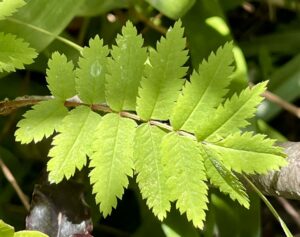
The grey—brown skeletal branches of trees are being cloaked in fresh green leaves as they unfurl from the buds that protected them through the winter months.  Their bright green colour is due to large amounts of chlorophyll.  The chlorophylls are pigments that can absorb many of the wavelengths of visible light, but not green.  Green wavelengths are reflected back into the environment, which is why our eyes perceive both young and mature leaves as green. Each leaf is made up of a variety of cells and tissues.  The top and bottom of the leaf are covered with a layer of cells  termed the epidermis.  It consists of many interlocking cells (rather like jigsaw pieces), sometimes called pavement cells.  Their function is to protect the underlying cells and also produce the waxy, waterproofing layer — the cuticle.   The lower epidermis is ‘pierced’ by the stomates.  These are the ‘breathing pores’ of the leaf, allowing the exchange of gases and water vapour.   The epidermis may also bear trichomes.  These are small ‘hair—like’ projections.  If there are many of them they can give the leaf a white or silvery appearance, helping to trap moist air near to the leaf surface to reduce water loss.  They  may also help to reflect sunlight, so that the leaf does not get too hot and on cold days can serve to protect the leaf from frost damage. Some trichomes have a protective function in that they may physically restrict the feeding of insects and other herbivores, and some contain a cocktail of toxic chemicals [e.g. nettles]. Under the upper epidermis and within the leaf, there is one or more layers of cells packed with chloroplasts - the palisade layer.  This is the principal site of photosynthesis within the leaf, where carbon dioxide is fixed into sugars and other vital nutrients.  The ‘by-product’ of photosynthesis is oxygen, which is not only essential for plant respiration but needed by the vast majority of animals on this planet.  It diffuses out of the leaf through the intercellular spaces of the next layer of the leaf - the mesophyll layer. The stomates allow gases in and out, but can close through the movement of their guard cells.  Stomates tend to close up at night or when the leaf experiences water stress.  Running throughout the body of the leaf is the xylem and phloem tissues, which conduct water, minerals and sugars etc around the plant. The sheer abundance of chlorophyll in many leaves masks the presence of other pigments, which only become visible when the leaf begins to senesce and the chlorophylls break down.  The leaf turns a yellow / orange colour due to the presence of carotenoid pigments.  Autumnal leaves can display a variety of colours due to other pigments such as the anthocyanins and xanthophylls.  Some leaves take protection very seriously   Curious fact : the leaf with the largest surface area is that of the Amazonian water lily, which can be 10 feet in diameter.
The cuticle,  a protective barrier and ‘sun screen’.

The cuticle, a protective barrier and ‘sun screen’.

by Chris, 10 July, 2022, 0 comments

Plants make use of sunlight in order to photosynthesise and grow.  However, not all wavelengths of light are useful to plants.  The red and blue wavelengths of light are absorbed by chlorophyll and used in photosynthesis.  Green light is reflected, hence we see green leaves etc.  Another component of sunlight is ultra-violet light.  Whilst UV light can help our skin manufacture vitamin D, it can also do considerable damage to the skin and cause premature ageing and skin cancers.  As this is the case, we are advised to apply sun screen to exposed skin as it helps prevent sunburn, skin cancer and premature ageing.  But what of plants?  Do they also protect themselves from UV irradiation / damage?  Some new research suggests that the plant cuticle has a role. The cuticle is usually a thin layer made up of fatty/waxy material that covers the outside (the epidermis) of the plant.  Its ‘primary’ function is a barrier to the evaporation of water from the underlying tissues.  It also prevents tissues becoming waterlogged as its ‘repels’ rain / water (see headline image) and it also resists the entry of pathogens / micro-organisms.  In most flowering plants, the cuticle tends to be thicker on the top of the leaf (aka the adaxial surface) which is exposed directly to incoming light. Though the cuticle is usually a thin layer, in plants living in arid environments, it can be quite thick to limit water loss. Since the waxy cuticle repels water (i.e. is hydrophobic), the adhesion of water to the cuticular surface is minimised so globules form.  Some plant leaves (eg. Nasturtiums and the Lotus) exhibit ultrahydrophobicity, so that they essentially become self-cleaning surfaces. Now, the rôle of the cuticle in protecting plants from UV damage is unravelling.  Research at the University of Malaga has shown the cuticle can quench UV light.  It does this though the phenolic compounds present in the cuticle.  Phenolics are rings of carbon atoms, with hydroxyl (OH) groups attached.  Examples are the cinnamic acids [e.g. p-coumaric acid]. When these molecules absorb UV light, they change shape momentarily.  On changing back to the original state, the absorbed energy is released but at a longer wavelength, which is far less damaging than UV light. As these molecules do not react this way to red and blue light, the red and blue wavelengths can pass into the leaf to be used in photosynthesis. [caption id="attachment_38494" align="aligncenter" width="700"] The leaves of some plants have quite amazing surfaces, some are hairy whilst others have protective spines.,[/caption]