Woodlands.co.uk

Blog - extreme weather

a bad day for sparrows.

a bad day for sparrows.

by The blog at woodlands.co.uk, 29 January, 2026, 0 comments

In recent decades, extreme climate events such as tropical storms, droughts, floods, wildfires, heat waves, and cold snaps have increased in both frequency and intensity. These events have the potential to reshape human populations and ecosystems across nearly all regions of the world. According to the Intergovernmental Panel on Climate Change (IPCC), such events are projected to intensify further in the coming decades. Very strong hurricanes are expected to become more common, wildfires to burn hotter and spread farther, and heat waves to last longer. Extreme events pose severe risks not only to human populations but also to biodiversity and the structural integrity of ecosystems. They can reek changes in species in a number of ways. One of the earliest studies of the biological consequences of an extreme climate event was carried out by Hermon Bumpus at Brown University.  [caption id="attachment_42667" align="aligncenter" width="675"] Brown University campus[/caption] In February 1898, an unusually severe and prolonged storm brought snow, sleet, and rain to Providence, Rhode Island. After the storm, Bumpus collected a large number of incapacitated sparrows (Passer domesticus), of which 72 survived and 64 perished. He measured a range of body characteristics in both groups. The birds varied in length from 152 mm to 167 mm, with an average of 159.5 mm. Individuals whose body length was close to this average were more likely to survive, whereas those at the extremes were more likely to die. Very long-bodied birds were particularly vulnerable. In addition to body length, [caption id="attachment_42669" align="alignleft" width="300"] Elementary lessons in zoölogy, by Needham, James G. 1896[/caption] Bumpus measured traits such as weight, femur length, humerus length, sternum length, and skull width. Interestingly, he also noted that males were more likely to survive the storm than females. Bumpus’s work represents one of the earliest investigations of natural selection in the context of an extreme climate event. Since his study, relatively few investigations have directly examined the selective pressures imposed by such events.  However,  certain lizards on the Turks and Caicos Islands have been found to have larger sticky toe pads after experiencing Hurricanes Irma and Maria, when compared to ‘pre-hurricane’ lizards.  The next generation of lizards also had larger toe pads, which suggests a heritable feature and hurricane driven selection. Nevertheless, such research suggests that extreme climate events [such as high winds, extreme temperatures, flooding] can generate 'short lived' but strong episodes of natural selection, and may drive rapid evolutionary change.   [caption id="attachment_43023" align="aligncenter" width="675"] a sparrow[/caption] Further reading : https://www.cell.com/current-biology/fulltext/S0960-9822(25)00955-8 Sparrow leg anatomy from 'Elementary lessons in zoölogy, a guide in studying animal life and structure in field and laboratory' by Needham, James G, 1898. Accessed from Archive.org  
Burrs or Burls?

Burrs or Burls?

by The blog at woodlands.co.uk, 18 February, 2025, 0 comments

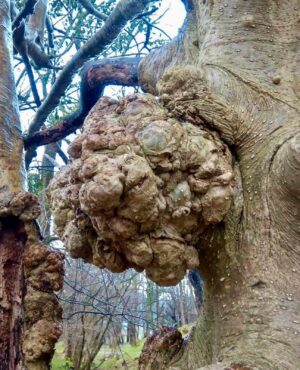
Burrs or Burls? What’s in a name. What are they?  They are woody outgrowths found on stems, branches, and often on roots.  They are  typically rounded, somewhat bulbous in form.  Burrs develop as a result of rapid and uncontrolled growth,  leading to a dense and irregular wood grain beneath the external bark of the structure. The uncontrolled and abnormal growth may result from various stressors, such as :- Physical damage eg. wounds, where branches are lost in high winds, injuries as the result of boring insects, or damage from squirrels or deer. Infections caused by bacteria, viruses, or fungi may trigger burr formation  These infections can induce  hormonal changes that affect cell division. Environmental factors such as extreme weather events or pollution can influence tree physiology and growth, as can somatic mutations. In most cases, a burr does not harm a tree, indeed they may persist for decades.  If the burr formed due to injury to the tree, then it could even be considered protective.  However, If a burr develops on a branch then it may become so heavy that the branch breaks. Burrs may be seen on a variety of trees, but some species are more prone to developing them, notably oaks, maples, walnut, and birch.  Coastal redwoods are known to produce burrs of considerable size, sometimes reaching several metres in width and even encircling the trunk of the massive trees..  Although burrs may not be visually appealing from the outside, internally the complex grain pattern means makes them highly valued for woodworking.  They are used to create bowls, furniture, musical instruments and sculptures.  It is generally unwise to cut a burr from a living tree; instead they are typically harvested from fallen or dead trees. Thanks to Steve Sangster for Burr images.
Revisiting hedgerows.

Revisiting hedgerows.

by The blog at woodlands.co.uk, 12 April, 2023, 0 comments

Some years back, the Woodlands blog posted various articles about hedgerows,  noting the loss of many - due to the increased mechanisation of farming in the mid C20th.  Now, there is greater recognition of the importance of hedgerows, and there are initiatives to promote the maintenance and expansion of hedgerows. But what is a hedgerow? Natural England offers a definition as follows : A hedgerow is defined as any boundary line of trees or shrubs over 20m long and less than 5m wide, and where any gaps between the trees or shrub species are less that 20m wide (Bickmore, 2002). Any bank, wall, ditch or tree within 2m of the centre of the hedgerow is considered to be part of the hedgerow habitat, as is the herbaceous vegetation within 2m of the centre of the hedgerow.  This differs from the definition in the  Biodiversity Action Plan, which included references to ancient hedges / species-rich hedges.  The definition now includes all hedgerows consisting of at least one native woody species of tree or shrub (mainly), but it does exclude bramble and honeysuckle as ‘woody species’.  According to one source, there are some 550,000km of hedgerow in England, with over 400,000 km being actively managed.  Hedgerows are an important semi-natural habitat in what is otherwise a managed agricultural landscape. They are found across the country but there are more in lowland regions. Hedgerows in the south east are associated with large fields and fewer trees, the proportion of trees in hedgerows increases as one goes north and west.   The nature of hedgerows varies across the country but all are important as : They provide a habitat, shelter (micro-climate provision) and resources for many different species (from plants to insects, birds and mammals). Hedgerows are particularly important as nesting sites for birds. They support animals that have key roles within the broader ecosystem, for example pollinators and predators of pests. They offer an important source of nectar that helps support wild bees - adjacent farmland can be a poor source of nectar Hedgerows are known to support threatened (red listed) species Hedgerows capture and store carbon (above and below ground) Hedgerows offer ecosystem services eg. mitigation of water flux and availability, landscape connectivity, soil conservation / stabilisation. A number of studies indicate that increasing the number of hedgerows would help with landscape connectivity (for example, for hedgehogs) and that planting of blackthorn and hawthorn in association with later flowering species would help support a number of wild bee species.  Expanding the number of hedgerows could have some negative effects as they might offer a home to invasive species and / or pathogens; but one study has indicated that ash trees in hedgerows suffer less impact from ash dieback than trees in forests.  To date there does not appear to be any detailed research on whether increasing hedgerow coverage would have any impact on tree disease / pathogen spread. Hedgerows, like woodlands themselves, face a number of challenges due to climate change.  Warmer winters may mean that the ‘winter chill’ requirements of some shrubs / trees will not be met; this may mean flowers and fruits fail to form properly which in turn means less food for birds, small mammals etc.  Drier summers may stress some species, trees like Beech are susceptible to drought.  Extreme weather events (like Storm Arwen) can inflict damage on hedgerow trees.  If a hedgerow is next to farmland, then it may experience drift from pesticide and / or herbicide spraying  nutrient enrichment (eutrophication) due to the use of fertilisers. Hedgerows with a diverse structure, with plants, shrubs and trees of varying ages and heights provide the widest range of niches / microhabitats for wildlife.  The inclusion of dead / decaying wood offers opportunities for various fungi, saproxylic beetles, woodlice etc.  Some hedgerows are managed / reduced with a mechanical flail (see above !!!). If this is done annually, it can result in a loss of biodiversity. Trimming should be done on a 2 or 3 year cycle; and some sections of the hedge might be left for longer " see (https://www.hedgelink.org.uk/cms/cms_content/files/76_ne_hedgecutting.pdf).  Thousands of tree and hedgerow plants are being planted to create a flood defence project at Castlehill, East Hull.   The plan is to create some seven hectares of woodland and over five kilometres of new hedgerow, as part of a flood defence project (to store floodwater east of the city).  Trees such as field maple, downy birch, English oak, and black alder are being planted along with species of willow, dog rose, guelder rose and blackthorn and hawthorn to create hedgerows and scrubland.  Other species will be allowed to naturally develop in the area and the habitat is expected to reach ‘maturity in some fifteen to twenty years. There is a citizen science project that involves surveying hedgerows.  It is organised by the People’s Trust for Endangered Species [PTES].  The Great British Hedgerow Survey guidelines can be found here : https://hedgerowsurvey.ptes.org/survey-guidelines Some times hedges offer a home to other things         
Autumnal changes

Autumnal changes

by The blog at woodlands.co.uk, 14 October, 2022, 0 comments

In 1820, John Keats famous poem “To Autumn’ was published.  Its opening line often serves to describe autumn as ‘The season of mists and mellow fruitfulness’.  Indeed, Autumn has arrived here.  Woodlands have been transformed into a 'tableau' of red, yellows, and oranges as the leaves are shed and the woodland floor has become a veritable fungal jungle, (as Jasper has described).  Hawthorn and other bushes are laden with berries, conkers and acorns are generously strewn across woodland floors, squirrels are eating hazelnuts (and hiding them as a winter food store).  But this cornucopia of fruits and seeds may be in response to the long, hot and very dry summer we have experienced.  Trees and shrubs have been stressed by the heat and drought. Some have responded by mobilising their reserves / efforts into producing more fruits and seeds, to ensure that they pass on their genes to the next generation.   Different trees are responding in other ways. Some are ‘holding on’ to their leaves for longer, whilst others (like some birches and rowans) have already shed theirs - in order to limit the damage from wilting and water loss during the intense heat and drought of summer.  [caption id="attachment_39130" align="aligncenter" width="675"] Autumnal colour[/caption] Blackberries appeared early this Summer and few are to be seen this Autumn, some animals (like the dormouse) will search in vain. [caption id="attachment_39026" align="aligncenter" width="675"] Black Bryony berries (photo by Art Symons)[/caption] Will this Autumn be long and mild? It may extend into the traditional winter months. There is also the threat of extreme weather events (like Storm Arwen that brought severe winds across the UK last November).  Whilst we might welcome mild weather (with the high price of gas and electricity), it could be mean an increase in bacterial and fungal infections, not only of plants but also affecting overwintering insects - tucked up in cocoons and pupal cases. Prolonged cold periods, coupled with frosts limit the spread of such infections.  The cold of winter is also the traditional signal for animals like hedgehogs to hibernate.  If they are still active in winter when food is scarce, then they will lose condition and possibly starve to death.  Milder weather in Autumn and Winter also affects the migratory behaviour of birds, some birds may choose to overwinter here.  Some seeds need to experience cold temperatures before they will germinate in the following Spring. Climate change and severe weather events are here to stay until there is a coordinated and concerted effort to reduce greenhouse emissions on a global scale.  On a local scale, our gardens (which represent some 400,000 hectares of land) can make a contribution by encouraging wildlife / pollinators and promoting biodiversity.  Gardens can also help to some extent with extreme rainfall.  During heavy rain, water runs off hard surfaces and into the drains, these may also deal with sewage.  When the drains are overwhelmed by storm water, sewage is discharged into our rivers (and the sea).   Gardens can help by  reducing hard landscaping, so that rain can soak into the soil instead of running off into the drains making use of water butts.  They capture water, so it does not enter the drainage system.  It is also there to use when the garden needs water (and there is a hose pipe ban) mulching the soil with a layer of plant material. It is an effective method of conserving water in the soil and it reduces surface runoff, increasing the infiltration / penetration of water into the soil.  It helps keep the soil moist in times of drought, and helps reduce run off during heavy rainfall.  Particularly important when planting young trees / shrubs. [caption id="attachment_38957" align="aligncenter" width="675"] a light mulch (in Art's garden)[/caption]  

Next Page »