Pond life
by The blog at woodlands.co.uk, 14 March, 2025, 0 comments
The last century saw the destruction of many hedgerows, particularly in farming areas like East Anglia. The logic behind this was :
to increase field size and
allow ease of access of machinery, like combine harvesters that were coming available at that time.
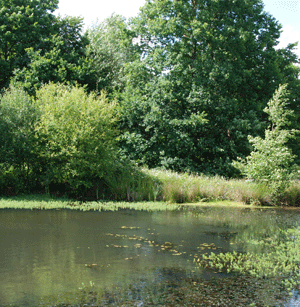
Whilst the loss of the hedgerows and the associated wildlife is well documented, the loss of ponds during this time has not attracted the same level of attention. Many hundreds of ponds were filled in, to give a few more metres of arable land. The whereabouts of some of these ponds can sometimes be found on old ordnance survey maps. Many were located on farmland and their origins may extend back centuries to when they were created as marl or clay pits, sometimes for the watering of livestock. Some were formed in depressions (pingos) left after the last ice age.
There are still thousands of ponds across the UK but many are polluted to a greater or lesser extent, or drained. The pollution may be associated with the the surrounding land use or agricultural runoff. Runoff may take the form of nitrates / phosphates from the use of fertilisers. In freshwater systems, these nutrients can cause eutrophication. Other agricultural chemicals may enter ponds and water courses - insecticides, fungicides, herbicides etc.
Consequently, out of the thousands of ponds, only a very small number provide a suitable habitat for pond organisms such as the medicinal leech. Leeches are rarely found for the reasons cited above but also because, as agriculture became more mechanised and less reliant on ‘animal power’ [horses, oxen], the ponds (or wetlands) are no longer visited by these animals, which leeches would have fed on. Leeches used to be abundant, but their number declined when their use in blood letting was largely abandoned, and their natural habitats were drained or damaged. The medicinal leech is one of the largest leeches found in the UK, it can grow to a length of ten centimetres, and may have stripes / patterns on its body. Some of the ponds that are home to medicinal leeches have been designated Sites of Special Scientific Interest.
Since historic times, the extraction of blood by leeches was deemed to be a ‘healing process’ for patients. This practice of hirundotherapy / bloodletting spread widely and the collection of leeches resulted in the over-exploitation of many populations. The leeches were used widely in the treatment of many conditions and diseases such as cholera, regardless of whether or not they were effective. At one stage, leeches were in such demand that there were ‘leech farms’, and people could earn a living as leech collectors. Indeed, so commonplace was leech collection that Wordsworth wrote about it in his poem Resolution and Independence :
“He told, that to these waters he had come
To gather leeches, being old and poor:
Employment hazardous and wearisome!
And he had many hardships to endure:
From pond to pond he roamed, from moor to moor;
Housing, with God’s good help, by choice or chance;
And in this way he gained an honest maintenance.”
Although the use of medicinal leeches was discredited and virtually abandoned for many decades, they are medically effective in certain circumstances. The leeches produce a saliva which contains a number of different proteins. These help the leech to feed by keeping the blood from clotting, and actually increasing blood flow to the leech at the point of attachment. Some of these proteins act as anticoagulants (notably hirudin), It is also possible that the saliva contains an 'anaesthetic / antiseptic' as leech bites are generally not painful. These leeches have now found a use in microsurgery. They are used to stimulate the circulation in tissues which experience post-operative congestion. They are helpful in finger reattachment and reconstructive surgery of the ear, nose, lip, and eyelid.
The creation of a network of new or restored freshwater ponds across the landscape will be needed if natural populations of the leech are to expand.