Woodlands.co.uk

Blog - glyphosate

Can bracken be defeated?

Can bracken be defeated?

by The blog at woodlands.co.uk, 20 February, 2026, 5 comments

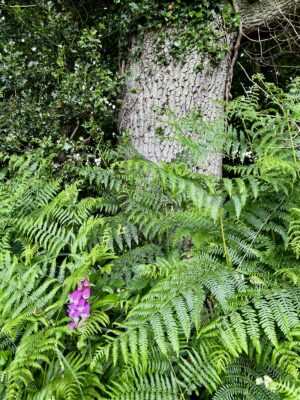
Pteridium aquilinum otherwise known as Bracken, is a common fern in many woodlands.  It is a vigorous and resilient species found throughout the UK.  When trees are felled or spaces appear in woodlands, bracken is quick to colonise taking advantage of the increased light. It grows quickly and its fronds can limit the growth of young trees through its dense shading. Similarly at the end of a growing season, the dying fronds can literally smother germinating seedlings and young saplings. Before dying down, bracken can store many materials in its extensive underground rhizome system.  It can tolerate adverse weather and difficult soil conditions  but generally prefers not to be in waterlogged  soils. It is not subject to significant grazing pressure or attack by insect pests or pathogens.  Consequently, it is a highly competitive species, reducing biodiversity.  Some woodland plants can survive in its presence, if they grow in early spring before the emergence of the fronds. [caption id="attachment_5892" align="alignleft" width="240"] A TICK[/caption] Bracken contains metabolites, which when ingested by animals, like cattle, have been linked to cancer of the bladder. It contains a toxin Ptaquiloside and the young leaves when crushed or eaten release hydrogen cyanide. Bracken is also known to harbour ticks, which can spread Lyme Disease. So, it not surprising that bracken is regarded as a weed by managers of woodland, field and pasture; it needs to be controlled, preferably eliminated.  But how to do this is problematic.  A number of strategies have been employed with varying degrees of success.  In woodland, the main objective is to suppress its vigour so that saplings can fully establish themselves . In the past, bracken had a number of uses – for example, as animal bedding which was later composted to give a nutrient-rich mulch.  Also, used for thatching, as a source of potash (pot ash = plant ashes soaked in water in a pot giving a soluble form of potassium K+).  This harvesting of bracken in historical times probably helped limit its spread. However, it is now spreading and its dominance in some areas / habitats is a concern. [caption id="attachment_15642" align="alignleft" width="300"] Rolling bracken[/caption] Bracken can be weakened by the cutting or crushing of the fronds, particularly if this is repeated on a regular basis.  This is both time consuming and expensive. Ploughing the soil, this cuts the underground rhizomes, exposing them on the  surface where they might dry out or freeze.  Ploughing has to be done carefully, as can significantly disturb the soil which can lead to erosion. Pigs can have the same effect as ploughing if the soil is shallow.  Generally these methods are now used. Other techniques included the burning of leaf litter and woody material but this has little effect on reducing the vitality of the bracken, in fact, the release of nutrients from the resulting ash may encourage the growth of the bracken.  Wood chip mulches are similarly ineffective, as are artificial mulches / membranes (difficult to secure them). Herbicides, such as asulam and glyphosate are effective in reducing fronds emerging after its application.  Asulam did little harm to young trees and other plant species, however its use is no longer approved of.  The use of glyphosate is also problematic. It has been suggested that it may be geotoxic & carcinogenic [EFSA 2017 Risk Assessment: Glyphosate]. The UK considered a ban, but as of last year its use was still allowed. Recent work [by Forestry England et al] has revealed an alternative herbicide that may be useful in controlling bracken - namely amidosulfuron. It works by inhibiting enzymes which control amino acid and protein metabolism.  It is thought to have low toxicity to mammals, and is stabile in light. Early trials indicate that it might be suitable for the suppression of bracken in strands of norway spruce, oaks, scots pine, sitka spruce and silver birch. [caption id="attachment_42998" align="aligncenter" width="700"] During the Age of Dinosaurs,  ferns (Polypodiophyta) were among the most abundant ground level vegetation and a significant food source for many herbivorous dinosaurs.[/caption]
woodlands web updates : 25

woodlands web updates : 25

by The blog at woodlands.co.uk, 19 May, 2023, 0 comments

Earlier flowering times. A survey has shown that plants are flowering earlier in the year.  Cambridge University researchers compared the dates of flowering of some four hundred plus species before and after 1986. They found that plants are now flowering roughly one month earlier.  More recent decades have been associated with rising air temperatures. This change in flowering time may have profound consequences for the plants.  The vast majority of plants are dependent on pollinating insects (bees, bumblebees, hoverflies) to set seed and complete their life cycles.  By flowering early their cycle, plants may not match up  with the activities of their pollinators. They may flower but their pollinators bee ‘missing’. Their pollinators need to emerge from their overwintering stage earlier. Earlier flowering may not matter for those plants that are visited by several pollinators but for those that are dependent on one or two specific visitors - it may critical.  For example, Sainfoin.  Sainfoin is host to a particular (solitary) bee Melitta dimidiata (remote image here).   It is a monolectic bee; i.e., a bee that collects food (nectar and pollen) from only one species of flower - the sainfoin.  If the sainfoin flowers earlier in the year and the bee does not match the shift in flowering, then the bee has a problem. Work on the effects of climate change on pollinators has been somewhat limited to date, but studies in Japan suggest that bees / bumblebees are somewhat behind plants in their response to environmental changes. Bee and bumblebee news. Recent research data provide evidence that (buff tailed) bumblebees are not able to detect or avoid concentrations of pesticides [imidacloprid, thiamethoxam, clothianidin, or sulfoxaflor], as used ‘on the farm’ - from signals sent by their mouthparts. The mouthparts are covered with tiny hairs and these hairs have ‘pores’ in them. Chemicals pass through these ‘pores’ to sensory cells; this is how the bee tastes and smells. It seems likely that the bumblebees are at considerable risk of consuming pesticides in their search for nectar when visiting pesticide-treated crops. [caption id="attachment_19675" align="alignleft" width="300"] Bumbles foraging in artichoke[/caption] Another agrochemical,  Roundup,  has been found to affect the learning and memory of bumblebees. Roundup, which contains glyphosate, affects their ability to learn and memorise connections between colour and taste.  Impaired colour vision is likely to affect the foraging and nesting success of the bees.  The research was conducted in Finland by researchers at the University of Turku. In yet another concerning study, researchers at the University of Maryland have found that the life span of laboratory-raised honey bees has reduced considerably.    Five decades ago, the lifespan for a worker honeybee (Apis mellifera) under controlled laboratory conditions was about 34 days. Now it is some 17/ 18 days - according the report in Nature.  The study also reviewed the scientific literature [from the 1970s to now] and noted a trend in the life span of bees.   Shortened worker bee lifespan has implications for colony health and survivorship.  The work at the University of Maryland is ongoing. Methane release. Ghost forests are found in coastal areas.  As a consequence of climate change, sea water has ‘invaded’ low laying areas and trees have died. The dead trees are sometimes referred to as ‘snags.  A  number of woodland / forest communities along the eastern coast of the United States have been affected.  Recent work by North Carolina State University has shown that these ghost forests release methane.  The methane is generated by bacteria in the soil but then ‘escapes’ by means of the ‘snags’.  As it passes through the wood of the ‘snags’, microbes may consume and alter the methane.   As methane is a potent greenhouse gas, understanding the nature and extent of these methane emissions from ‘ghost forests’ is important. Tree rings The study of tree rings has been invaluable in dating many historic objects ./ archaeological sites.  Now, it seems that they could play a role in estimating the amount of carbon that trees are actually absorbing (carbon sequestration), if woodland / forest inventories are coupled with core samples of the trees. The measurement of the annual rings from such cores could create a record of ‘tree growth across space and time’, yielding a more accurate estimate of the amount of carbon being taken up by woodland and forests. Forests, soils and oceans are major ‘carbon sinks’.
Problems for bees and bumblebees.

Problems for bees and bumblebees.

by The blog at woodlands.co.uk, 18 November, 2022, 3 comments

The decline in many insect populations across the globe is worrying, threatening economies and ecosystems.  A German study in 2017 indicated that the mass of flying insects (in various natural areas) had fallen by some 70%+.  The decline in insect populations has been associated with habitat fragmentation, the spread of agriculture and the use of pesticides, with the neonicotinoids being particularly associated with damage to bee and bumblebee populations. Recent work at the University of Konstanz suggests that when bumblebee colonies are exposed to limited resources of nectar and exposure to the herbicide - glyphosate,  then their colonies may fail.  Bumblebee colonies need a good supply of nectar as a ‘fuel’ in order to maintain a constant brood temperature (of approximately 32oC).  Only at this sort of temperature does the eggs & larvae develop quickly from egg to adult, and the colony grow from a single queen to several hundred bees.  If the temperature is not maintained, then the brood develops slowly or not at all.  The loss of wild flowers (and their nectar) plus the use of the herbicide (in agricultural areas) looks to be a problem for the bumblebees. Just as bumblebees are facing problems, so are honey bees.  The bees have faced infections with a variety of viruses, such as the deformed wing virus.  This virus affects wing development so that the wings are 'stubby' and useless, plus they may be deformities of the abdomen and leg paralysis;  the insect cannot function and dies.  The virus is transmitted by the Varroa mite - a parasite (that also feeds on the bees’ tissues).  The virus was originally identified in Japan in 1980’s and is referred to as DWV-A.  However, a new form of the virus (DWV-B) was identified in the Netherlands in 2001 and it is spreading across Europe, and to other continents.  Sadly, this variant of the virus kills bees faster and is more easily transmitted (according to research at the Martin Luther University).
