Woodlands.co.uk

Blog - hedgehogs

The importance of hedgerows.

The importance of hedgerows.

by The blog at woodlands.co.uk, 17 April, 2026, 0 comments

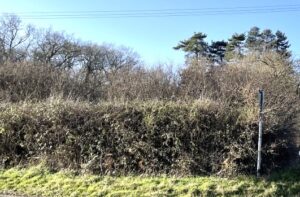
Woodlands and hedgerows are important features of our countryside.  Just as woodlands vary across the country, so do hedgerows.  A hedgerow usually includes a number of tree and shrub species, but may also include walls, banks, fencing and gates.  They may have been planted recently or may be ancient, dating back to the time of the enclosures. It has been estimated that there are over half a million kilometres of hedgerow across England, and the majority are actively managed.  In a managed hedgerow, the trees and shrubs have their form and shape altered.   The trees and shrubs that form the basics of a hedgerow include hawthorn, hazel, oak, holly, blackthorn, ash and yew. These may form the main body of the hedge but there are many other plants that contribute to its structure, such as bramble, honeysuckle and ivy, many wild flowers plus mosses, bryophytes, fungi and lichens.  [In urban settings, species like  privet, yew, box and holly may form the basis of the hedge / hedgerow.] [caption id="attachment_42838" align="aligncenter" width="675"] Beech hedge in garden[/caption] Consequently, hedges come in a variety of shapes and sizes and can include many different species. Rural hedges are often a mix of shrub and tree species, such as hawthorn, blackthorn, hazel, ash and oak. They were / are often planted to form boundaries around fields in managed agricultural landscapes.  Historically, many hedgerows were planted to keep livestock, such as sheep, cattle, pigs, chickens in specific areas. Other hedgerows were planted to define boundaries as in ‘who owned which bit of land’.  Hedgerows often surround fields.   The word ‘field’ comes from Old English ‘feld’, meaning 'an area of felled trees  or open country'.  Hedgerows are important as they offer habitats / niches for a variety of plants and animals. Not only do they provide ‘food and lodgings’ for many animals, they also act as biological corridors, supporting plant and animal connectivity across our landscape.  The flowers, fruits, berries and nuts are an important source of food for many invertebrates, birds and mammals. [caption id="attachment_24651" align="aligncenter" width="600"] Sloes on Blackthorn[/caption] Animals such the harvest mouse, the hedgehog and the vole may be found nesting in a hedgerow, and it offers food and / or homes for blue tits, and yellowhammers. They also support important insect pollinators, butterflies, hover flies, moths, bumblebees and bees. These insects may help with the pollination of crops in adjacent fields planted with oilseed rape, legumes or fruit trees. Other insects, such as ladybirds can help with crop yields by predating upon crop pests, such as green fly and blackfly (these aphids may spread viral diseases on crops such as sugar beet).  Sadly, hedgerows declined significantly in the last century, due mainly to intensification of agriculture. Fortunately, the destruction / loss has slowed since the 1990’s, though neglect and damage are significant threats even today.  Good management may involve planting of trees or shrubs to fill gaps, coppicing, laying a hedge or ‘considered’ cutting back.  However, there is no standardisation of the management of hedgerows and they can be harmed by excessive cutting back or flailing.   The effects of heavy pruning and cutting back during the nesting season can be disastrous. Whilst mechanical flailing of a hedgerow is fast and effective,  the regrowth is generally slower and its effects can be particularly bad for birds. [They may abandon their nests and / or  their eggs or chicks may be destroyed.] The pruning / flailing may also affect insect populations of the hedgerow (and / or other other food sources) on which the birds and other animals depend.  Another threat can be the use of agricultural chemicals [pesticides and herbicides] next to the hedgerow. [caption id="attachment_42843" align="aligncenter" width="675"] A managed hedge[/caption] For further and detailed information on hedgerows, visit : https://hedgelink.org.uk/guidance/importance-of-hedgerows/  
Going, going, gone ?

Going, going, gone ?

by The blog at woodlands.co.uk, 8 December, 2024, 0 comments

The UN Biodiversity meeting COP16 has announced that 38% of the earth’s trees are facing extinction in ‘the wild’.  The biggest threats to trees are Clearing land / forests for farming Fires and climate change Logging tree for timber The spread of pests The spread of disease One example of a tree under threat is the monkey puzzle tree.  In Chile, climate change has resulted in the country’s Araucanía (Monkey Puzzle) region becoming hotter and drier, and as a result forest fires have become more frequent. It is thought that a million of these trees have been lost in a recent fire in the National Park, and many of these trees were mature specimens - hundreds of years old. Apart from their intrinsic beauty, trees, woodlands and forests are important.  They Absorb carbon dioxide from the atmosphere, helping mitigate global warming Produce oxygen vital for us (for respiration) and so many living organisms on this planet Provides ‘homes’ / habitats for many hundreds of species of birds, mammals, insects, arachnids, lichens, mosses and other epiphytes. Help offset some of the effects of pollution. If the trees are lost, then many of the species that live on or in the trees will also be lost, so the world is at risk of a major biodiversity crisis.  The list of endangered species grows longer.   Populations of the hedgehog have shrunk across Europe, as farming expands, and cities & roadways grow so its natural habitat shrinks. In the UK, other species such as the Red Squirrel, the Water Vole, the Scottish wildcat (an elusive and rare animal), the hazel dormouse and the grey long eared bat maintain a precarious hold on life. A delegation of scientists from Kew Gardens, was present at COP 16 in Colombia, talking about ‘the dark spots of biodiversity knowledge’, that is, identifying those regions of the world where collecting efforts need to be prioritised in order to document the plant species currently unknown to science (before they are lost).    
Facts about badgers, a Woodlands TV film

Facts about badgers, a Woodlands TV film

by The blog at woodlands.co.uk, 15 October, 2024, 0 comments

The badger (strictly speaking the european badger) arrived in this country,  like everything else, as the ice retreated some thousands of years ago.  It is our largest land predator, others such as the wolf are no longer with us - though some would support their reintroduction as part of rewilding programs. Whilst badgers are predators, they are, in fact, omnivores - eating both plant and animal material.  Much of their diet is earthworms, though they are not averse to small mammals such as mice, rats and hedgehogs!  Whilst badgers tend to make their home (setts) in woodlands, they will travel to open fields and pastures in search of food, digging for grubs [for example, chafer larvae]. A badger sett is a complex, extensive engineering feat accomplished by using their powerful front limbs and claws.  They dig down and then drag the earth out of the tunnels by moving backwards with the soil under their chin and then deposit it in a ‘spoil heap’.   The presence of a spoil heap is a good indication of a badger sett in your woodland.   If a colony is well established there will be a main sett, but also an ‘annex sett', and possibly even smaller setts away from the main sett.  Recently Woodland TV filmed Adrian Coward from the Somerset Badger Group, who explains in details the nature and relationship of these setts and how badgers recognise their ‘family members’ and how they mark their territory.  They move around their territory along well defined paths. [embed]https://youtu.be/vv3CK1hVM2o?si=_TmpkcXhKoxqy24A[/embed] Whilst we know a lot about how badgers move through their home territories, little was known about any long distance movements. To investigate such movements, scientists set up a study in County Kilkenny (Ireland).  It was one of the largest badger studies of its type,  The study spanned a large area and some four years ,and 'followed' some 900+ badgers.  They found that whilst most badgers only moved 2 to 3 kilometres from their sett, some travelled 7.5 km and the longest distance travelled by a badger was 22 km.  If animals can move around and meet with other populations, this can promote outbreeding. Learning about these 'lengthier' movements may be a useful contribution in the discussion of badgers and bovine tuberculosis - which is also discussed in the Woodlands TV film ‘Facts about badgers’, and the topic has featured in other woodland blogs. Curious fact : The French call a wet shaving brush blaireau or “badger", because quality brushes use badger hair. Apart from viewing Woodlands TV on this site, it may also be viewed on YouTube : www.youtube.com/@WOODLANDSTV 82K subscribers 482 videos 15,896,142 views Joined 9 Jul 2008 United Kingdom
Hedgehog decline

Hedgehog decline

by The blog at woodlands.co.uk, 3 March, 2023, 0 comments

The (European) hedgehog population is in decline.  In Britain, the population has roughly halved in recent times and is considered to be vulnerable to extinction.  The Danish Hedgehog project, a citizen science project, headed up by Dr Sophie Lund Rasmussen* (also known as ‘Dr Hedgehog’ : link to YouTube videos) has been investigating the life span of hedgehogs.    This has been done by analysing the jaw bones of dead hedgehogs collected by volunteers all over Denmark.   The jawbone shows a line of reduced growth when the animal goes into hibernation, the number of lines equates to the age of the animal in years.  The oldest hedgehog found to date was 16 years old.  Sadly this hedgehog died after being attacked by a dog, which is not an uncommon cause of death for hedgehogs.   The study has revealed the average life span of a hedgehog to be roughly two years only, with males faring slightly better than females.  The study also found that the most common cause of ‘hedgehog death’ was crossing a road. Another finding was that the hedgehog population is quite inbred.  This may be due to the reduced population size and the difficulty hedgehogs face in finding a mate due to habitat fragmentation (garden fences, roads, railway lines which divide up the environment).  Inbreeding leads to loss of genetic diversity, which in turn reduces the overall fitness of the individual and the population. Hedgehog populations can be helped by Creating hedgehog friendly gardens by removing barriers to movement between gardens. Ensuring there is plenty of greenery /  plant life in the garden so there are earthworms, insects, snails etc. for hedgehogs to feed on. Avoiding the use of pesticides and slug pellets in the garden.  Also be careful with the use of netting, keep it above ground level.  Providing a shallow dish of fresh water and food (such as meaty cat or dog food), particularly during long dry spells. NB : ponds with steep sides can be a problem for a hedgehog if it falls in.  More information on hedgehogs can be found here : https://www.britishhedgehogs.org.uk/ Thanks to Nigel Palmer for his excellent hedgehog pictures, visit his hedgehog post here * https://www.biology.ox.ac.uk/people/dr-sophie-lund-rasmussen#tab-3324091  
Autumnal changes

Autumnal changes

by The blog at woodlands.co.uk, 14 October, 2022, 0 comments

In 1820, John Keats famous poem “To Autumn’ was published.  Its opening line often serves to describe autumn as ‘The season of mists and mellow fruitfulness’.  Indeed, Autumn has arrived here.  Woodlands have been transformed into a 'tableau' of red, yellows, and oranges as the leaves are shed and the woodland floor has become a veritable fungal jungle, (as Jasper has described).  Hawthorn and other bushes are laden with berries, conkers and acorns are generously strewn across woodland floors, squirrels are eating hazelnuts (and hiding them as a winter food store).  But this cornucopia of fruits and seeds may be in response to the long, hot and very dry summer we have experienced.  Trees and shrubs have been stressed by the heat and drought. Some have responded by mobilising their reserves / efforts into producing more fruits and seeds, to ensure that they pass on their genes to the next generation.   Different trees are responding in other ways. Some are ‘holding on’ to their leaves for longer, whilst others (like some birches and rowans) have already shed theirs - in order to limit the damage from wilting and water loss during the intense heat and drought of summer.  [caption id="attachment_39130" align="aligncenter" width="675"] Autumnal colour[/caption] Blackberries appeared early this Summer and few are to be seen this Autumn, some animals (like the dormouse) will search in vain. [caption id="attachment_39026" align="aligncenter" width="675"] Black Bryony berries (photo by Art Symons)[/caption] Will this Autumn be long and mild? It may extend into the traditional winter months. There is also the threat of extreme weather events (like Storm Arwen that brought severe winds across the UK last November).  Whilst we might welcome mild weather (with the high price of gas and electricity), it could be mean an increase in bacterial and fungal infections, not only of plants but also affecting overwintering insects - tucked up in cocoons and pupal cases. Prolonged cold periods, coupled with frosts limit the spread of such infections.  The cold of winter is also the traditional signal for animals like hedgehogs to hibernate.  If they are still active in winter when food is scarce, then they will lose condition and possibly starve to death.  Milder weather in Autumn and Winter also affects the migratory behaviour of birds, some birds may choose to overwinter here.  Some seeds need to experience cold temperatures before they will germinate in the following Spring. Climate change and severe weather events are here to stay until there is a coordinated and concerted effort to reduce greenhouse emissions on a global scale.  On a local scale, our gardens (which represent some 400,000 hectares of land) can make a contribution by encouraging wildlife / pollinators and promoting biodiversity.  Gardens can also help to some extent with extreme rainfall.  During heavy rain, water runs off hard surfaces and into the drains, these may also deal with sewage.  When the drains are overwhelmed by storm water, sewage is discharged into our rivers (and the sea).   Gardens can help by  reducing hard landscaping, so that rain can soak into the soil instead of running off into the drains making use of water butts.  They capture water, so it does not enter the drainage system.  It is also there to use when the garden needs water (and there is a hose pipe ban) mulching the soil with a layer of plant material. It is an effective method of conserving water in the soil and it reduces surface runoff, increasing the infiltration / penetration of water into the soil.  It helps keep the soil moist in times of drought, and helps reduce run off during heavy rainfall.  Particularly important when planting young trees / shrubs. [caption id="attachment_38957" align="aligncenter" width="675"] a light mulch (in Art's garden)[/caption]
