Woodlands.co.uk

Blog - jays

The times they are achanging

The times they are achanging

by The blog at woodlands.co.uk, 1 September, 2025, 4 comments

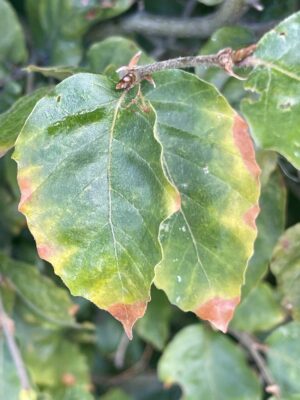
This morning,  the Today programme (Radio 4) featured an interview with Kevin Martin ( Head of Tree Collections at Kew) and Chris Packham (environmental compaigner).  They were explaining the ongoing effects of this summer’s hot and dry weather.  Mr Martin said that the trees at Kew were “ tired, they have had a stressful summer”.  The result is that many trees are entering their dormant stage, moving materials from aerial regions to the roots - much earlier than usual.  The colour changes in leaves and leaf drop do not usually occur until well into October but this year such changes are already  proceeding apace.  Kew has been able to put some mitigations in place, for example, the watering of young trees which have yet to establish extensive roots systems. This is not true for trees across the UK, where young saplings in particular may have been affected by the dry weather and successive heat waves, [plus increased browsing by the extensive deer population]. Chris Packham spoke of “climate breakdown” and “environmental chaos”, noting that an oak tree near him was ‘festooned with acorns’, but they were only the size of peas.  Normally acorns would fall later in the year as food for wood pigeons,jays, squirrels and badgers.  Jays help ‘plant’ oak trees by distributing acorns.  He said that whilst local hawthorns were red with berries, which would normally be food for winter thrushes later in the year, the berries would now be dried up / shrivelled when the birds arrived to search for them.  Though lots of hedgerow fruit [e.g. sloes, rose hips, blackberries] is being produced, it is being produced at the wrong time.  He also commented on the scarcity of mole hills as moles are forced to burrow deeper in the soil in search of earthworms etc. As the seasons change, some plants and animals adapt. For example,  blackcaps from Northern Germany fly to the UK rather than Spain to overwinter.  During a relatively short period, their wing length has changed, actually shortened - a case of evolution in action.  However, many species are struggling.   The  wet summer of 2024 was particularly difficult for butterflies, as evidenced by the data collected by the Big Butterfly Count. Nature's timings are now ‘out of sync’, plants and animals are further impacted by extreme weather events, flooding, high winds and extreme temperatures. [caption id="attachment_24651" align="aligncenter" width="600"] Sloes on Blackthorn.[/caption] https://www.metoffice.gov.uk/about-us/news-and-media/media-centre/weather-and-climate-news/2025/double-record-breaker-spring-2025-is-warmest-and-sunniest-on-uk-record  
Tree planting vs Natural Regeneration? And a film

Tree planting vs Natural Regeneration? And a film

by The blog at woodlands.co.uk, 13 January, 2025, 1 comments

Woodlands TV has just released another film, which discusses the pros and cons of tree planting in an area, as opposed to allowing natural regeneration.  Many years ago, Kenneth Mellanby [Director of a Research Station near Huntingdon] thought that it would be interesting to watch what happened to a barley field if it was left to its own devices.  The 4 acre field was ploughed for a final time in 1961 and then ‘abandoned’. The field sat next to an area of ancient woodland - Monks Wood. The changes in the field were monitored in succeeding years and eventually becoming known as the Monks Wood Wilderness Project.   In the first 10 to 15 years, a thorny scrubland developed with hawthorn and bramble.  Birds were attracted by their fruits and berries.  The birds dispersed the seeds of the fruits across the plot, and also brought in seeds from other areas (such as the adjacent woodland).  The bramble and hawthorn scrub afforded protection from the wind and herbivores [rabbits, deer etc] for young, delicate tree seedlings.  Wind blown seeds arrived in the area, such as ash and field maple.  Other tree seeds were deposited by birds, Oak began to grow.  Acorns were probably carried in by Jays, who bury them as a winter food store.  An acorn is a rich food source - containing fat, carbohydrates, proteins and micronutrients.  A single jay can scatter many hundreds of acorns each year.  They store more than they need, so some will germinate and grow on to saplings.  Whilst many different birds spread tree and shrub seeds, jays have been known to carry acorns significant distances and probably contributed to the northward spread of the Oak as the glaciers of the last Ice Age retreated. A mature oak tree can provide food and / or a home for many species of animals, plants and fungi. The former barley field has been monitored over the decades, and by 2014 it had become an oak woodland.  This despite the usual depredations of Rabbits, Hares, Muntjac Deer and Roe Deer which have been present at various times over the years.  So given time, former agricultural land can revert (rewind) to mixed deciduous woodland with a diverse collection of plants and animals.  For further details of Monks Wood - visit https://www.naturewalkswithcarol.com/monks-wood-nature-reserve.html The woodlands TV film features ecologist Connor McKinnie who highlights key factors to consider when planning woodland creation, such as tree protection methods, planting pattern, and species. This is the second film with Connor, exploring aspects of rewilding.  The first film is presented below : [embed]https://youtu.be/HZNX9hTzQaU?si=-Ivv4aziPzi4a3cA[/embed] The latest film may be viewed on YouTube by following this link : https://youtu.be/Qx7uiOlGjFY
