Woodlands.co.uk

Blog - Kew Gardens

Changing times?

Changing times?

by The blog at woodlands.co.uk, 9 November, 2025, 0 comments

The Earth has experienced many glacial and interglacial periods over hundreds of thousands of years.  Since the last ice age, the Earth has warmed (the average global temperature has rising by some 4 to 5oC) but the temperature rise was about 0.1oC per century.  Today's warmer climate took 5,000–8,000 years to ‘evolve’, during which time the average global temperature rose at a rate of around 0.1oC every century.   This gradual change allowed trees to adapt to the changing climate.  In the last century, ‘we’ have driven a 1.3oC rise just in the last century - this is some ten times faster than the change post ice age.  [caption id="attachment_35526" align="alignleft" width="300"] drought[/caption] Not only has the climate warmed, it has become increasingly unpredictable with heat waves, drought and torrential rain.  These can have dramatic effects on our trees and heathlands.  For example, the heatwave in 2022 resulted in Kew Gardens losing some 460 of its trees.  This last summer saw 4 periods of heatwave conditions.   So, it is not surprising that some of our most familiar trees are struggling with these changed conditions.  They are stressed, and it would seem that the climate is not likely to moderate in the immediate future.  In recognition of the changing climate, Forestry England has produced a 'species for the future' list.  The trees in the list are those which might thrive in a warmer climate. Whilst it includes familiar species like oak, birch, and alder, other species such as the coast redwood and Corsican pine are included,  which hopefully will create more resilient woodlands.  The trees are listed below Aspen (Populus tremula) Beech (Fagus sylvatica) Coast redwood (Sequoia sempervirens) Common alder (Alnus glutinosa) Corsican pine (Pinus nigra subsp. laricio) Douglas fir (Pseudotsuga menziesii) Downy birch (Betula pubescens) European silver fir (Abies alba) Field maple (Acer campestre) Grand fir (Abies grandis) Grey alder (Alnus incana) Hornbeam (Carpinus betulus) Japanese red cedar (Cryptomeria japonica) Lodgepole pine (Pinus contorta var. latifolia) Macedonian pine (Pinus peuce) Maritime pine (Pinus pinaster) Norway spruce (Picea abies) Pedunculate oak (Quercus robur) Red oak (Quercus rubra) Rowan (Sorbus aucuparia) Scots pine (Pinus sylvestris) Sessile oak (Quercus petraea) Silver birch (Betula pendula) Sitka spruce (Picea sitchensis) Sweet chestnut (Castanea sativa) Sycamore (Acer pseudoplatanus) Western hemlock (Tsuga heterophylla) Western red cedar (Thuja plicata) Wild cherry (Prunus avium) Wild service tree (Sorbus torminalis) The list contains both native and non-native species, the aim is to create through planting stronger and more biodiverse woodlands that can tolerate our changing climate over the coming decades.  The rate of climate change is the main issue. Whilst some of the trees already grow here, others come come from warmer / drier areas, such as the Mediterranean or  North America.  There are already many redwoods in the UK.  They were introduced in victorian times, when they were planted on the estates of the wealthy and landed gentry. There are now probably more redwoods in the UK than in their native Pacific Coast range,  there intense heat and dry weather has exposed them to intense forest fires. Another possibility to promote resilience is to use seed produced by trees such as Oak that has been ‘produced’ by trees growing in warmer regions. The inclusion of trees that might be suited to our changing climate is often referred to as assisted migration.  However, the introduction of non-native species is not without its problems, for example the introduced species could become of invasive or add to the burden of pathogens that our trees are exposed too.
immature pine cone

A variety of conifers (at Bedgebury Pinetum).

by The blog at woodlands.co.uk, 31 July, 2025, 0 comments

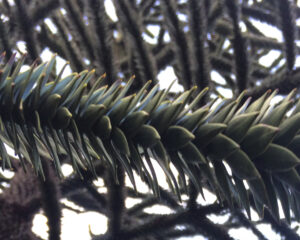
When thinking of conifers, one might feel a bit ‘schizophrenic’.  Perhaps picturing a Leylandii encroaching on your garden, whilst also remembering your Christmas tree.  Maybe the typical image of conifers is that of a tree with dark green foliage all year round.  However, this would be something of a disservice to the Conifer family - the Pinophyta, which contains an amazing variety of trees, many of which are at risk of extinction.  This group includes cedars, firs, cypresses, junipers, larches, pines, hemlocks, redwoods, spruces, and yews. [caption id="attachment_32107" align="aligncenter" width="650"] Leaves on the branchlets of Dawn Redwood[/caption] Conifers are important because They dominate vast areas of land, particularly in the Northern Hemisphere,  forming the boreal forests or taiga. Softwood from conifers accounts for approximately 45% of global timber production. Pine, spruce and larch are often grown specifically for softwood production. The wood is also used in the paper production[.and, to a lesser extent, in making plastic from chemically treated wood pulp].  Some species produce edible seeds , such as pine nuts provide foods such as pine nuts for humans and wildlife and juniper berries, which are used to flavour gin.  The Monkey Puzzle tree, (also known as the Pehuen Pine, native to Chile and Argentina) produces seeds known as piñones; traditionally harvested by indigenous communities.  [caption id="attachment_27592" align="aligncenter" width="600"] Monkey puzzle tree[/caption] To see the diversity of the Conifer family one could visit the Bedgebury Pinetum.  This is home to one of the world’s most important conifer collections.  Bedgebury was established in 1925 by Kew Gardens and the Forestry Commission.  The curator at Kew had observed that the conifers there were ‘being choked by London Smogs’.  The site at Bedgebury, situated on the Southern Kentish weald, was ideal.  It offered an escape from the pollution of London and it had wet and free draining areas, plus varied soils so it a range of conifer could be grown. The land already had some conifers that had been planted by Viscount Beresford - an evergreen enthusiast.  In 1925, some 315 trees were planted.  This year, to celebrate reaching a century, some 89 of the original trees are marked with special yellow labels.  For  its first twenty years, the pinetum was managed by William Dallimore. His diaries record in some detail the trees he planted, and the challenges faced in establishing the pinetumIf you visit, then you might walk through through Dallimore Valley, and view his legacy. Bedgebury soon became a centre for the scientific interest in conifers, their conservation, and landscape planning.  The current curator is Dan Luscombe. Apart from seeing a range of conifers, the pinetum offers a variety of activities, e.g. family cycling, mountain biking and walking, There is also the play trail or you can explore the canopy on a Go Ape tree-top adventure or challenge.  It is rumoured that the Gruffalow lurks within the grounds of the  Pinetum. There is also a cafe, serving a range of drinks, plus  breakfast and lunch options. The pinetum is open from from 8 AM to 8 PM (March 2025 to 26 October 2025), and there are charges for car parking.  
Going, going, gone ?

Going, going, gone ?

by The blog at woodlands.co.uk, 8 December, 2024, 0 comments

The UN Biodiversity meeting COP16 has announced that 38% of the earth’s trees are facing extinction in ‘the wild’.  The biggest threats to trees are Clearing land / forests for farming Fires and climate change Logging tree for timber The spread of pests The spread of disease One example of a tree under threat is the monkey puzzle tree.  In Chile, climate change has resulted in the country’s Araucanía (Monkey Puzzle) region becoming hotter and drier, and as a result forest fires have become more frequent. It is thought that a million of these trees have been lost in a recent fire in the National Park, and many of these trees were mature specimens - hundreds of years old. Apart from their intrinsic beauty, trees, woodlands and forests are important.  They Absorb carbon dioxide from the atmosphere, helping mitigate global warming Produce oxygen vital for us (for respiration) and so many living organisms on this planet Provides ‘homes’ / habitats for many hundreds of species of birds, mammals, insects, arachnids, lichens, mosses and other epiphytes. Help offset some of the effects of pollution. If the trees are lost, then many of the species that live on or in the trees will also be lost, so the world is at risk of a major biodiversity crisis.  The list of endangered species grows longer.   Populations of the hedgehog have shrunk across Europe, as farming expands, and cities & roadways grow so its natural habitat shrinks. In the UK, other species such as the Red Squirrel, the Water Vole, the Scottish wildcat (an elusive and rare animal), the hazel dormouse and the grey long eared bat maintain a precarious hold on life. A delegation of scientists from Kew Gardens, was present at COP 16 in Colombia, talking about ‘the dark spots of biodiversity knowledge’, that is, identifying those regions of the world where collecting efforts need to be prioritised in order to document the plant species currently unknown to science (before they are lost).    
The trees of Kew Gardens.

The trees of Kew Gardens.

by The blog at woodlands.co.uk, 2 August, 2024, 0 comments

There are eleven thousand trees in Kew Gardens.  Each year, a few trees are lost due to natural causes, old age, disease etc.   In 2002, a drought resulted in the loss of  some 400 trees.  Such a prolonged dry spell is  likely to occur again and again as global temperatures rise, and climate change takes a hold. Modelling of future climate scenarios by Kew scientists suggests that towards the end of this century between a third and a half of Kew’s trees could be lost.  Trees like the English oak, beech, birch and holly could be vulnerable to warmer temperatures and extended dry spells.  There is a plan at Kew to replace gradually trees with species currently found in warmer areas, such the Mediterranean, Asia and Central America. Examples might include species such as the iberian alder, cherry hackberry and Montezuma’s pine.  Many of the plants in the gardens will survive, [including Kew’s ‘Old Lions’] as they were collected from in and around the Mediterranean; some of these date back to the victorian era or earlier. The ‘old lions’ of Kew are trees from the original grounds / garden that still survive. Examples include : Japanese pagoda tree (Styphnolobium japonica) Maidenhair tree (Ginkgo biloba) Oriental plane (Platanus orientalis) Caucasian elm (Zelkova carpinifolia) Black locust (Robinia pseudoacacia) The Caucasian elm dates from 1762, when an arboretum was planted.  It is thought that it might have been in a batch of plants from the Caucasus, planted in what is now the herbarium paddock.  In 1905, the height of the tree was recorded as 60 feet (18M), though they can grow to 100 feet.  A larger caucasian elm can be seen at  Tortworth. One species of oak that is common at Kew is the holly or holm oak (Quercus ilex).  This is a common, naturalised oak that was probably introduced into the country in the sixteenth century.  It is a hardy, slow growing tree and many new holm oaks were planted in 2008 to redefine the Syon Vista.  The wood of the tree is strong and, in the past, it was used in carts and farming equipment. Its acorns start off green in colour but turn a reddish brown; they are a tasty treat for pigs. The threat to Kew's trees is not unique, parks and urban spaces across the country need to plan for the future, to ensure that their trees can offer some resilience to changing weather patterns. Full details of Kew's planning here.  

Next Page »