Woodlands.co.uk

Blog - keystone species

Woodland Oaks.

Woodland Oaks.

by The blog at woodlands.co.uk, 10 July, 2026, 1 comments

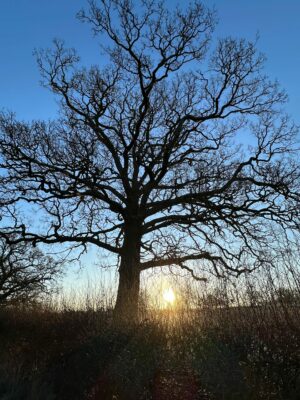
The oak is a keystone species.  Just as building an arch, the stability of the arch is gained from the positioning of the central stone - the keystone, so in many woodlands oak trees are what holds the woodland together; offering both stability and diversity.  There are two types of oak : The pedunculate oak, which ‘likes’ richer and somewhat heavier soils.  It can be distinguished from the sessile oak as Its acorns grow on long stalks [called peduncles]. The sessile oak, which can grow and survive on poorer and somewhat acidic soils, so can be found in upland areas.  Its acorns sit more or less directly on a twig. Both these oak trees contribute to many woodlands across the UK, and have done so for thousands of years.  Some have great age and are veteran trees. Their life can be between 300 and 800 years.    An oak woodland often represents the climax community in lowland Britain, which has considerable stability.  Because of their long lifespan and great biomass, they also represent significant stores of carbon.  Their extensive canopy also moderates the temperature and humidity of the woodland beneath, allowing for the growth of shade tolerate species such as hazel and holly. The trees also support an amazing diversity of life,  some two thousand species are known to find a ‘home’ in oak trees.  Feeding on the leaves or flowers are hundreds of species of insects - notably moths and butterflies.  The leaves provide food for many species of caterpillars, which in turn are a food source for birds, like the tits and warblers.  The branches of the trees provide nesting and roosting sites for many bird species.  The acorns of the oaks are a rich source of nutrients and energy not only for squirrels, but also mice, deer and other mammals.  Birds, like the jay, also take them.  Jays and squirrels create ‘caches of acorns’, that is they bury them as a store for later.  However, many are forgotten so they effectively distribute the acorns over a wider area and ‘plant’ future oak trees. The bark of the oak is rough and corrugated offering specialised niches for lichens and mosses.  When an oak dies , it is then home to a variety of fungi and beetles, which feed upon the rotting wood (saproxylic beetles).   The roots of an oak penetrate deep into the soil, which helps improve drainage, and the roots establish mycorrhizal connections with soil fungi.  These connections are symbiotic in nature, in that both partners benefit from the association.   The tree gets mineral nutrients from the fungi, and, in return, diverts some of its carbohydrate material to the fungi.  The breakdown of the oak leaves in autumn returns vital nutrients to the soil and provides food to a variety of decomposer organisms, from bacteria to earthworms.  Thus, oaks are a vital part of many woodland food chains.   Sadly, our oaks face a number of threats.  In elizabethan times, the main threat was that of being cut down and used in ship building.  At the height of Nelson’s navy in the late eighteenth century / early nineteenth century it took some 4,000 oak trees, to build a single 100-gun ship, and the navy had some 300 ships!  More recently, there have been problems with acute oak decline and infestation by the oak processionary moth.  The caterpillars of this moth feed on oak trees and large populations can strip an oak tree bare.  This leaves the tree vulnerable to other pests, and stresses such as drought.    Incidentally, contact with the hairs of the older caterpillars of this moth can cause itching, skin rashes and eye irritations, plus sore throats and breathing difficulties in us and other animals.   
The work of ants in woodlands.

The work of ants in woodlands.

by The blog at woodlands.co.uk, 10 February, 2025, 0 comments

At first, you might not notice them, but ants in a woodland are important. Their presence indicates healthy woodland, and the Forestry Commission recognises them as a ‘keystone species’ in the woodland / forest ecosystem and encourages woodland owners to treat them sympathetically.  Ants, like bees and wasps, belong to a group of insects known as the Hymenoptera .  These are insects with membranous wings and narrow ‘waists’. Like bees, ants are ‘social insects’  and within their nests, there is a division of labour (workers, soldiers, queens).    There are four main species of true wood ant - Formica rufa, F. aquilonia, F. lugubris and F. pratensis. Ants are important for a number of reasons, for example :- They help disperse seeds.  They manage pests by preying on herbivorous insects that damage leaves They contribute to nutrient recycling, t Their nests provide a habitat for a whole range of invertebrates that live specifically in wood ant nests. For example, the woodlouse  (Platyarthrus hoffmannseggii), which has ‘lost’ its eyes and colour and is completely adapted to living in the dark recesses of the ants’ nests. They are a source of food for various predators including woodpeckers. Through the building of nests, they affect the soil profile, the drainage and permeability of the top soil, and help with the distribution of various nutrients.  A wood ant colony nest can persist for many years and survives so long as there is a queen / s present.   During the winter months, only queens and a limited number of the workers live on deep inside the nest. Once the temperature begins to rise in the Spring, then workers will begin to emerge and start to forage – and the queen(s) will begin to start laying eggs again.   Fertilised eggs will give rise to female ants, and unfertilized eggs give rise to males.   The males and queens have wings, and are bigger than the workers. The life expectancy of a worker is about 60 days.   Ants such as the southern wood ant [Formica rufa]. build large, ‘thatched’ nests, (see the film link below) which may contain many thousands of workers and queens (up to a quarter of a million). An ant nest is instantly recognisable, it looks like a roughly shaped dome, made from an untidy heap of leaves and twigs – with ant trails leading to and from. The heart of the nest is deep underground, whilst on the surface is the dome shaped ‘thatch’. The thatch consists of a variety materials in the thatch – small twigs, moss, heather, pine needles.   These materials are positioned so that they  not only intercept the sun’s rays to help warm the nest  but also are laid in such a way that water / rain runs away from the nest, reducing the risk of flooding.  Some ant species build their nests in /on gravel or sandy / stony soils - which reduces the risk of water logging. Like many insects, ants make use of pheromones (volatile chemicals). For example, to lay paths to the nest. The study of ant trails and ant behaviour has inspired computer programs / simulations to the “travelling salesman problem”, that is finding the shortest route round a large number of fixed locations (think of the Amazon’s driver’s day!  Woodlands TV has produced another film that focuses on woodland ants.  The film, presented by Giles Pitman, can be seen either on this website or on YouTube https://youtu.be/9wtvwlL2Wzg. Interesting fact : Ants can spray formic acid from their abdomen – when threatened. This smells like vinegar and is thought to be a deterrent to birds or other predators.
