The Art of Stacking Firewood
by Angus, 2 October, 2025, 2 comments
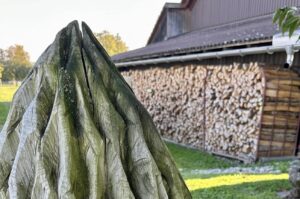
A good friend of mine is tragically dying of cancer. He has spent a good part of his retirement chopping and stacking logs for his home and he sees this as part of his duty to look after his wife. He has often explained to me how to make kindling and how to split logs efficiently and safely and, like me, he has always been interested in how other people stack their logs. This picture is one of his own log piles.
Storing firewood is far more than piling logs in a corner. In the UK’s damp climate, how you stack and season wood makes a big difference to how well it burns. The secret is to keep it dry, to create airflow and to make it accessible. A rule of thumb among woodfuel users is that a well-stacked pile may be about 70% “solid wood” with about 30% air gaps, whereas loose heaps might drop to only 40% wood or less and are hard to handle. Stacking also allows you to go higher and a wood stack can be used as a temporary wall for a screen or a windbreak.
Logs should be off the ground (often on pallets or a raised plinth) and arranged with small spaces between them rather than in a random heap. Ultimately moisture levels need to drop below 20%. Many people - such as my friend - use the straightforward “row stack” method: logs laid horizontally, tightly but with small air gaps, in rows on a raised base, with a cover on top but open sides. It’s functional, efficient, and relatively quick.
However, more decorative or artistic stacks have become popular, sometimes as garden features, but also as a way of celebrating wood itself. One example is the Holz Hausen or "round house" where logs are arranged in a circular, inward-leaning structure to shed rain and encourage drying.
Another system is crisscross or “grid” stacking (alternating orientations by layer) to add structural strength while allowing airflow. Sometimes hobbyists create log mosaics or colour-sorted stacks, either by colour of the wood or the bark to build visual patterns. There have even been stacks shaped as domes, cubes, or sculptures. Some “log art” images show stacked owl or heart shapes, or wood as garden sculpture.
The Dull Men’s Club is a UK group celebrating “mundane” hobbies and they frequently share pictures of beautiful wood stacks. In some rural UK properties, it’s not unusual to see stacks that form entire sheds or rows along wood sheds measuring over 10 metres long. Some woodland owners will harvest and stack multiple seasons’ worth of fuel, turning their woodlot into a homegrown energy store. The Dull Men's Club website says that they do a lot "more than watch the paint dry."
An emerging idea is that wood fuel is virtuous as a locally grown energy source. People with small woodlands or hedgerows may plan rotational coppicing or tree thinning with the intent to supply their own heating. The idea is: plant a tree today, in 20–40 years it's fuel, stack it well, burn it in winter. Fuel from your land, stacked carefully, can contribute to sustainability. The old saying is that it warms you three times - when you cut it, when you handle it and when you burn it.
Stacking firewood is a humble but fascinating intersection of craft, utility, and sometimes artistry. Smart stacking is almost as important as the wood itself. And for those treating wood as a renewable, grown-on-your-land fuel, it becomes a statement of independence and planning. For some people their "firewood legacy" will be more than just the years' supply of firewood they have left behind, but will also be what they have passed on to others about how to handle and store firewood.