Woodlands.co.uk

Blog - lignin

xylem vessels

Annual rings, blue rings !

by The blog at woodlands.co.uk, 24 February, 2025, 2 comments

Trees and shrubs that grow in temperate regions, where the seasons alternate (warm / cold, dry /wet) create annual rings.  The rings formed in a deciduous tree (like beech, oak, lime) are generally quite noticeable when the tree is felled.  They may be counted to give an indication of the age of the tree.  Annual rings are formed because there is a difference in the creation of ‘wood’ / xylem tissue when growth is fast in the Spring and slow as Autumn progresses.  The thickness of the rings from year to year reflects the changing climate and environment that the tree experiences during its life. Xylem tissue is one component of a tree’s vascular tissue.  The xylem tissue conducts water and minerals around the plant, whereas phloem tissue transports sugars and other organic molecules.  Lying between these two tissues is the cambium.  This is a layer of dividing cells, which becomes active in the Spring forming new cells some of which will form new phloem tissue and others develop into xylem tissue. The cells that will form the xylem tissue undergo a series of dramatic changes.   The walls of the cells that will form the long tubes of the xylem are made of cellulose to begin with, but then they are strengthened with lignin.  Lignin is the ‘stuff of wood’.  It is a complex material - made from polyphenols and other substances such as pectins and hemicelluloses.  It is a waterproofing material that is highly resistance to decay.  It lines the tubes of the xylem so that water can be transported from the roots, up the trunk / stem to the leaves etc.  The xylem vessels that form in the Spring [early wood] have a greater diameter than those formed later in the year [late wood].  It is this size difference in the vessels that results in the visible ‘rings’ when a tree is felled. Careful study of tree rings can reveal information about climate, sometimes extending back through the centuries   using species such as the long lived Bristlecones. It has given rise to the discipline of dendrochronology [link opens / downloads a PDF].  This information can then be ‘combined’ with tree ring data from intact remains in cold, dry (and often high altitude) environments and material from archaeological sites.   Apart from measuring the ‘width’ of the annual rings by creating thin section of the wood that can be examined under microscope, it is also possible to use staining techniques to reveal which xylem tissue has a higher / lower, lignin / cellulose content.  By using a double staining technique with the dyes Safranin and Astra Blue, it is possible to identify which xylem vessels are rich in lignin, and which have more cellulose.  Tree rings which stain largely blue are formed from cells which have not lignified properly.  Lignin stains red.  A recent study of blue rings in Pine trees and Juniper shrubs suggests that blue rings are indicators of cold summers. These two species are typical of the upper tree line in Northern Norway. Furthermore, blue rings have the potential to weaken the pine trees, leaving them more susceptible to mechanical damage and / or disease.  This study has identified blue rings associated with the cold summers of 1877 and 1902, which might have been caused by the eruptions of volcanoes as far away as Ecuador and Martinique. Note : The xylem tissue in conifers is different to that of broad leaved deciduous trees.  It is made up of shorter structures called tracheids, which pass water from one to the next via pits - ‘pores’ in their lignified walls. For more information on Blue rings in Black Pine, click here  
Burrs or Burls?

Burrs or Burls?

by The blog at woodlands.co.uk, 18 February, 2025, 0 comments

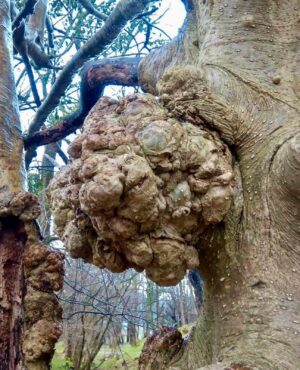
Burrs or Burls? What’s in a name. What are they?  They are woody outgrowths found on stems, branches, and often on roots.  They are  typically rounded, somewhat bulbous in form.  Burrs develop as a result of rapid and uncontrolled growth,  leading to a dense and irregular wood grain beneath the external bark of the structure. The uncontrolled and abnormal growth may result from various stressors, such as :- Physical damage eg. wounds, where branches are lost in high winds, injuries as the result of boring insects, or damage from squirrels or deer. Infections caused by bacteria, viruses, or fungi may trigger burr formation  These infections can induce  hormonal changes that affect cell division. Environmental factors such as extreme weather events or pollution can influence tree physiology and growth, as can somatic mutations. In most cases, a burr does not harm a tree, indeed they may persist for decades.  If the burr formed due to injury to the tree, then it could even be considered protective.  However, If a burr develops on a branch then it may become so heavy that the branch breaks. Burrs may be seen on a variety of trees, but some species are more prone to developing them, notably oaks, maples, walnut, and birch.  Coastal redwoods are known to produce burrs of considerable size, sometimes reaching several metres in width and even encircling the trunk of the massive trees..  Although burrs may not be visually appealing from the outside, internally the complex grain pattern means makes them highly valued for woodworking.  They are used to create bowls, furniture, musical instruments and sculptures.  It is generally unwise to cut a burr from a living tree; instead they are typically harvested from fallen or dead trees. Thanks to Steve Sangster for Burr images.

Next Page »