Woodlands.co.uk

Blog - microbiome

Diet and Digestion in Grey squirrels & Red squirrels.

Diet and Digestion in Grey squirrels & Red squirrels.

by The blog at woodlands.co.uk, 6 February, 2026, 0 comments

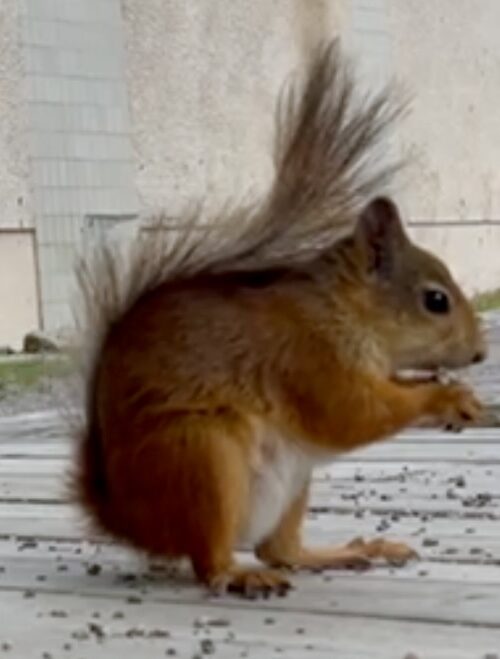
Whilst it can be amusing to watch the antics of a grey squirrel hopping about in your garden, they are generally seen as a pest.  In your garden, you might find some of your bulbs have disappeared or in the fruit season, some of your soft fruits might be ‘missing’.  However, in woodland and forests they are adept at stripping bark from trees, which obviously wounds the trees, distorts growth and may allow for the entry of pathogens.  Grey squirrel damage to trees in England and Wales has been estimated to cost £37m a year in lost timber value and reduced carbon capture. The squirrels tend to select vigorous trees as they have a bark with a rich sap content, such as  sycamore, beech, birch and oak.  It has been suggested that they targeted such trees for their sugar content, as much bark stripping activity occurs in May to July, a period when the tree would be actively photosynthesising and transporting sugars around the tree in the phloem tissue (bast).  However, recent work suggests that they may be after micro-nutrients, such as calcium.   [caption id="attachment_41889" align="alignleft" width="300"] squirrel[/caption] Scientists from Bangor University have investigated and compared the microbiome of grey and red squirrels.  The microbiome refers to the make-up on the bacteria and other microbes present in the gut.  They help in the breaking down of food materials, and the production of vitamins.  They found the intestinal (caecum*) microbiome or microbiota of grey squirrels is more diverse than that of red squirrels, and where there were bacterial species in common then the amounts differed. These findings might help explain why grey squirrels can, for example,  digest acorns readily despite their tannin content, whereas red struggle to make full use of this plentiful food supply.   The grey squirrel gut also has a bacterium - Oxalobacter.  This bacterium can change the insoluble calcium from tree bark into a more digestible form.  Calcium levels in trees tend to rise in late spring / early summer when squirrels indulge in bark stripping.  Red squirrels strip bark less frequently than greys, this may be due to their somewhat more limited, less diverse microbiome.  The microbial diversity of grey squirrels may enable them to use a greater range of materials than the red squirrels, perhaps explaining in part their spread and the displacement of the red squirrel. Another factor leading to the displacement of the red squirrel has been the spread of the squirrel pox virus into the red squirrel population.  This virus has little effect on grey squirrels but leads to sickness and often death in red squirrels.  The grey squirrel also harbours another threat to red squirrels - the adenovirus.  Again grey squirrels seem unaffected by this, but red squirrels develop severe intestinal damage.  This difference may again be related to the difference in the microbiome of the two types of squirrel. Note : the caecum is a pouch within the gut, between the small and large intestine where the digestion of cellulose etc takes place, it is 'rich' in bacteria. More detail on grey squirrels in the links below :  https://www.microbiologyresearch.org/content/journal/jmm/10.1099/jmm.0.001793 https://pubmed.ncbi.nlm.nih.gov/38354038/ https://www.bangor.ac.uk/news/2024-02-21-gut-bacteria-may-explain-why-grey-squirrels-outcompete-reds-new-research and https://rfs.org.uk/insights-publications/rfs-reports/report-overview-the-cost-of-grey-squirrel-damage-to-woodland-in-england-and-wales/
Grey squirrel damage.

Grey squirrel damage.

by The blog at woodlands.co.uk, 22 July, 2024, 0 comments

Much has been written about the explosion of the UK deer population in recent times, and the damage to woodlands through their browsing activities.  However, the grey squirrelis associated with tree damage.  The grey squirrel is not just the 'cheeky chap' who steals the bird food in the garden, it is a serious pest.    The grey squirrel is a non-native species.  It was introduced in the 19th century.  The squirrels have spread across the country and have displaced the native red squirrel from many areas (either through competition or disease).  The grey squirrel's bark stripping activity now poses a threat to the sustainable management of woodlands. Gnawing of the bark means that they can get to the sweet, sap filled tissue (phloem) just beneath the bark. This tissue is responsible for the movement of sugars and other organic molecules around the plant (known as translocation). If the gnawing extends around the stem then the tree is ‘ringed’ [i.e a complete circle of bark and underlying tissue is removed]  then the tree us likely to die.  The squirrels tend to take bark from the main stem (and branches). The bark stripping may : Lead to the loss of particular tree species (for example, beech) Lead to the loss of insect / spider and fungal species associated with the loss of tree species, i.e. a loss of biodiversity allow fungal infection of the tree Reduce carbon capture Reduce the economic value of timber Act as a disincentive to creating new woodland for timber In order to reduce squirrel damage, it is important to Start inspecting for damage in late February as damage typically occurs in early Spring.  Examine the base of trees for damage. Look for ‘tester patches’ made by squirrels (to which they may well return later). Check young, broadleaf trees as they are particularly favoured by the squirrels.  Oak and beech are quite vulnerable to damage (see image of damaged beech trunk below). Recent research* at Bangor University has investigated the microbiome of the squirrel in relation to its bark stripping activity.  The microbiome of the gut refers to the various micro-organisms found with the intestines.  Analysis of bacterial DNA found in the colon of great (and red) squirrels revealed that grey squirrels had 'oxalobacter' bacteria in their colons.  These bacteria are able to 'release / access' calcium from the tree bark to the squirrels.  Calcium is an important nutrient in terms of bone building and is also involved in muscle contraction. had  a more diverse bacterial population in the colon. These findings may help explain why the grey squirrel 'outcompetes' the red squirrel.  Their more diverse gut microbiome may mean that they can access a greater range of resources. For example, grey squirrels can digest acorns, which red squirrels cannot;  this is possibly associated with tannin content of acorns. In order to reduce damage in a woodland, the number of grey squirrels may need to be managed.  This can be done though trapping or shooting.  Trapping is a legally acceptable and effective way of controlling grey squirrels in most situations. Grey squirrels can be trapped throughout the year though March to September is a good time as food is less abundant. Through autumn, berries, nuts and seeds [natural foods] are available so trapping is less successful.  Details of the various types of traps and their use / placement may be found at: https://greysquirrelcontrol.co.uk/trapping-method.php https://www.britishredsquirrel.org/wp-content/uploads/2016/07/Grey-Squirrel-Best-Practice.pdf https://basc.org.uk/pest-and-predator-control/grey-squirrel-control-with-live-capture-traps/ https://www.britishredsquirrel.org/wp-content/uploads/2016/09/Trapping-Protocol.pdf  https://bpca.org.uk/a-z-of-pest-advice/squirrel-control-how-to-get-rid-of-squirrels-bpca-a-z-of-pests-/188983 To go down the ‘shoot to kill’ route then there are a number of rules and regulations to observe.  Details may be found in the link below : http://www.britishredsquirrel.org/grey-squirrels/grey-control/ It is hoped that eventually a form of oral contraception will be developed, which will offer a non-lethal and humane means of population control. Full details of this research work may be found here
The bee 'microbiome'.

The bee ‘microbiome’.

by The blog at woodlands.co.uk, 29 June, 2024, 0 comments

The honey bee, Apis mellifera, stores food in the form of bee bread. Bee bread is formed through the fermentation of a mixture of pollen, nectar and bee saliva.   It is 'inoculated' with a range of bacteria and yeasts that ferment the material after storage in the comb cells of a hive.  Bee bread is the chief protein resource for bees, particularly for the feeding of larvae [and adults].  As it is a nutrient-rich material, it ‘supports’ various microorganisms, despite its acidic nature and low water content. Bee bread is also coated with propolis.  Propolis (sometimes called ‘bee glue’) is a resinous substance collected by bees from tree bark and leaf buds. This resin is ‘chewed’, mixed with salivary enzymes and the partially digested material is mixed with beeswax.  It is an antimicrobial substance.  It is used by bees to seal holes in their honeycombs and help in the construction of the hive. The very nature of bee bread and the coating of propolis create a ‘challenging environment’ for microbes to grow and survive.   However, despite the ‘unwelcoming’ nature of bee bread, several species of fungi and bacteria form a microbiome within a hive, and are thought to play an rôle in the life of the bees. Recent studies have revealed that the fungus Aspergillus flavus is well adapted to survive in bee colonies.  A strain extracted from a hive was found not only tolerate low pH (which other strains of the fungus could not cope with) but could also deal with the low water content of bee bread, and with the propolis - which is thought to have anti-fungal properties.  Further work demonstrated that this strain of the fungus had mutations that allowed it to develop within the ‘bee bread environment’.  That this fungus can live with the bees suggests that there might be some form of mutual benefit to both fungus and bee, but the relationship (if there is one) is not as yet understood. Full details of this study can be found here  
Bees, agrochemicals and the microbiome

Bees, agrochemicals and the microbiome

by The blog at woodlands.co.uk, 23 October, 2023, 0 comments

Mason bees and agrochemicals The blog has reported many times on the threats to bees - money bees, bumblebees and ‘wild bees, such as mason bees / solitary bees.  The threat to bees from neonicotinoids has been well documented, now there is a report that suggests that certain other agrochemicals may be harmful to bees. Researchers at the Julius Maximilians University at Würburg have been investigation the effect of a fungicide (Fenbuconazole) on the reproductive behaviour of horned mason bees (Osmia cornuta).  A number of Osmia species are used to improve pollination in fruit and nut crops.    They are efficient pollinators having a special pollen collecting / carrying structure called a scopa.  Mason bees are solitary bees.  Each female is fertile and makes her own nest and no worker bees for these species exist. In the Spring, male and female bees emerge from a nest.  The males generally exit first and remain near the nest, ready to mate with the females.  A female bee selects a mate on their ‘smell’ / odour and the ‘quality’ of their thoracic vibrations (achieved through muscle contractions).  After mating the males soon die.  The females search for and select a nest site, visiting flowers to collect pollen and nectar for their nests.  Once a certain amount of food has been collected within the nest, the females lay their eggs on top of this material (in a series of cells) and then seal off the nest.  The eggs hatch to form larvae which feed upon the food and within weeks forms a cocoon, in which it continues to develop to an adult. Though the fungicide (Fenbuconazole) is considered to be of low toxicity and the bees were exposed to a sub-lethal dose, nevertheless the Fenbuconazole had significant effects on the bees.  Pesticide exposed males were more likely to rejected by the females, compared to ‘control’ bees that were not exposed to the fungicide.  The thoracic vibrations of the exposed males were less powerful / noticeable and the composition of their odour or smell was different. The smell of the bees is dependent on particular hydrocarbon compounds in their cuticle  - their exoskeleton.  It is possible, therefore, that the mating behaviour and reproductive success of these bees is being affected by agrochemicals. Carpenter bees. The microbiome refers to the collection of micro-organisms that lives on or in us, particularly within within the gut. Whilst these micro-organisms are small, they contribute to our health and ‘well being’. They offer protection against pathogens, help our immune system develop, and enable us to digest.  Just as we have a microbiome so do bees.  Scientists as York University (Canada) have been investigating the microbiome of three species of carpenter bees (from North America, Asia and Australia). The term "carpenter bee" comes from their nesting behaviour,  most species burrow into plant material such as dead wood or stems, though a few create tunnels in soil.   Social bees (like honeybees and bumblebees) acquire their microbiome by interacting with their hive or nest ‘mates’. Solitary bees, like the carpenter bees, get their microbiome from the environment as they forage for food.   The researchers found that: The bees’ microbiome contained Lactobacilli, which are important for good gut health, helping protect against fungal pathogens and facilitating nutrient uptake. They also discovered crop pathogens in the microbiomes of the carpenter bees which were previously only found in honeybees. Whilst these pathogens are not necessarily harmful, it is possible that the wild bees could be vectors for spreading disease.  With thanks to Pixabay  (Umsiedlungen and Sabinem34) for the above images of bees Finding flowers. Research at the University of Exeter has shown that bees can distinguish between various flowers through a combination of colour and pattern.  This selectivity is achieved despite the ‘acuity’ of a bee’s vision being quite low (about a 100 times lower than ours) - this means they can only see the pattern of a flower when they are quite close (a matter of centimetres).  The researchers analysed a significant amount of data on plants and visiting bee behaviour, and they used experiments involving artificial shapes and colours.  One particular finding was the importance of the contrast between the outside of the flower and the plant’s foliage.  This seemed to help beesfind their way to the flowers quickly .    
Woodland web updates : 23

Woodland web updates : 23

by The blog at woodlands.co.uk, 7 April, 2023, 0 comments

No match for nonpareil ? Many varieties of apples have been around for centuries.  For example, the nonpareil which was bred (in France) back in 1696, the Egremonet russet much admired for its flavour and appearance dates from Victorian times. The  Cox's Orange Pippin is a cultivar first grown at Colnbrook in Buckinghamshire by Richard Cox.   By end the of the C19th, the Cox’s pippin was one of the most popular apples. However, there is a concern for these heritage apples in our changing climate.  In recent years, we have experienced warmer and wetter winters.  Such winters do not offer enough chilling hours for these trees.  Many trees need a period of cold in the winter months, where the temperatures are below 6oC but above freezing.  About 1000 chilling hours are needed for apples such as the nonpareil.  However, winters are present are offering approximately 600 chilling hours. Gala apple trees (developed in New Zealand) need only 600 chilling hours but it might be that they will not respond well to the wet winters we (currently) experience.  Some feel that they do not offer the complex flavours of ‘classic apples’.   Kew Gardens has now planted a varied selection of apple trees One third are heritage apple trees One third are ‘new’ varieties needing fewer chilling hours One third are varieties from countries warmer than the UK Over the coming years, the trees will be monitored to see which ‘do best’ in terms of cropping in London’s warming temperatures. The apple-growing industry in the UK is under considerable strain, with many growers unable to afford replanting this year.  Growers ‘refresh’ their orchards regularly, replacing older trees with new ones, but now many cannot afford to do this.   The sector is struggling with  a shortage of workers - made worse since the UK's exit from the European Union  high energy costs low returns from the supermarkets that buy their produce The option to ‘buy British’ may become a much rarer option.   Further details here Recovery after forest fires. Bacteria and fungi are the first to start rebuilding from the charred remains of burnt forest and woodland.  The number and variety of microbes falls dramatically after a fire.  Then, there was a microbial succession in the burned soil, that is, the number and types of bacteria and fungi changed quite quickly, with fast growing types able to advantage of the reduced competition for resources.  The situation is not dissimilar to what happens to our gut microbiome when we have to take antibiotics.  Antibiotics ‘knock out’ many of the useful bacteria in our gut, but gradually the microbiome is re-established.   Reporting on weeds. It seems that our gardens may be home to ‘new’ or unusual species of plants.   The Royal Horticultural Society would like gardeners to report on interesting ‘weeds’ that might find as they could be rare plants or plants growing in unusual places / areas.  You are asked to take photographs of anything that you find interesting and upload the images to iNaturalist. Reporting on unusual plants is not the only thing that the RHS is interested in. There are other garden projects that one can contribute to, for example, reporting sightings of garden pests such as the berberis sawfly, cellar slug, hemerocallis gall midge, lily beetle, rosemary beetle and spittlebug.
