Woodlands.co.uk

Blog - monocultures

spruce woodland

With a little help from my friends ……

by The blog at woodlands.co.uk, 6 June, 2025, 0 comments

Plantations are generally monocultures of economically important tree species, trees that are valued for their timber and rapid growth.  Compared to natural woodland, biodiversity is lower in monocultures. They are less resilient to extreme climatic events, attack by pests and/or disease and offer fewer ecosystems services.  Adding different trees into the mix of species can result in an increase in biomass (timber) production and resilience. Since the 1930’s, a ‘nursing mixture’ of Pines and Sitka Spruce has been used to establish Sitka forest in nutrient-poor soils (without the use of fertilisers or herbicides).  Quite how the pines benefited the growth of the Spruce was not known. One possible ‘mechanism’ is plant soil feedback [PSF], where plants change the nutrient make-up and/or the  bacterial and fungal community of the soil.  These changes then benefit the subsequent growth of seedlings / saplings.  Important in this respect are the fungi that can establish symbiotic / mycorrhizal associations with plant roots.  Ectomycorrhizae (ECM) exist mainly as an external coating on the roots, with some of the hyphae penetrating into the root tissue. Ectomycorrhizae are often associated with woody tree species, particularly conifers. There are a number of parts to a mycorrhizal association with trees: The Hartig net, this is the fungal hyphae that penetrate the roots of the tree, and make contact with the root cells, allowing for the exchange of carbon compounds, mineral nutrients, and water. The Mantle is the sheath of hyphae that covers the tree roots.  It is a more substantive structure than the Hartig net.  The fungal sheath probably offers some protection to the delicate root tips from pathogens and pests.   The Extra-radical hyphae. These grow out from the mantle into the soil. They may spread a significant distance from the actual roots, increasing the surface area for the absorption of water and minerals.  The Fruiting bodies.  These are the reproductive structures of the fungus and are visible above ground. Now some evidence is accumulating about how nursery mixtures / species have their effect.  Last year, researchers at Manchester University looked at the nursing effect of pine and silver birch on Sitka Spruce.   They collected soil from Cannock Chase, where these tree species co-existed.  The soil was sieved and some sand added and then placed in pots. Four groups of pots were created Pots with pine seedlings Pots with Spruce seedlings Pots with silver birch seedlings Pots with all three types of seedlings Pot Treatment Species grown in the conditioned soil Pine conditioned soil  Pine Spruce Birch Spruce conditioned soil  Pine Spruce Birch Birch conditioned soil  Pine  Spruce Birch Pine, Spruce & Birch conditioned soil  Pine Spruce Birch All the pots were placed in a greenhouse and the seedlings allowed to grow on for 34 weeks.  This allowed the growing seedlings to ‘condition’ the soil.  At the end of this time, the seedlings were removed and soil sieved and placed in fresh pots.   The four ‘types’ of ‘conditioned’ soil were then used to grow on newly germinated seeds of the three tree species.   One seedling was grown per pot, and the pots grown on for 24 weeks in the greenhouse again.   At the end of the 24 weeks, the seedlings from each pot were harvested and carefully examined.  For each, many features were recorded Root length Branching intensity Root tissue density Total root length dry weight /mass recorded Ectomycorrhizal colonisation (microscopic analysis) Specific leaf area VIII.Leaf dry matter Photosynthetic rate The soil was also subjected to detailed analysis (e.g : pH, nitrates, microbial enzymes etc). The results showed that  The Spruce seedlings grew best in the soil that had been previously ‘conditioned’ with Pine growing in it. The Spruce fared less well in the previously Spruce ‘conditioned’ soil The increased growth was associated with greater root colonisation by mycorrhizae. Longer term increased growth in the silver birch ‘conditioned’ soil might be associated with increased availability of soil nitrates It would seem that Pines facilitate the growth of the Spruce through the enhanced establishment of symbiotic, mycorrhizal connections.  These connections allow saplings to access vital mineral nutrients such as phosphate.  This study therefore goes some way to explaining the nursing effect of mixed species planting. Full details of this work may be accessed here :  https://besjournals.onlinelibrary.wiley.com/doi/10.1111/1365-2664.14848
orange tail bee 1

The importance of woodlands to bees.

by The blog at woodlands.co.uk, 16 February, 2024, 0 comments

The diet of bees has changed over the years.   In the past, bees were able to forage and collect pollen and nectar from a variety of plants.  With the spread of highly mechanised agriculture, increasing urbanisation and road network - now their options are somewhat limited.  Large fields of monocultures, for example, of oil seed rape are now common. Whilst oil seed rape is a good source for foraging bees and bumblebees, they need to collect nectar and pollen from a variety of sources so that they get a range of nutrients, such as the essential amino acids.  Without these particular amino acids, the growth and development of bees is affected, as is their resistance to disease and their ability to raise the brood.  It is important that our pollinators are able to find a range of plants / pollen to provide all their nutrients. Whilst wild flowers [aka weeds], like dandelions, ragworts, and clovers are a lifeline for bees and bumblebees, recent research at the University of East Anglia has shown that woodlands can offer important habitats for bees, isuch as the leaf canopy.  The research team studied 15 woodland sites in agricultural areas across Norfolk (in Spring).  Within the woodlands, they looked at the bee activity in  the understorey  the woodland edge  and at different levels in the tree canopy.   They found that bees were active high up in the sunlit tree canopy, and their activity was particularly high near flowering sycamore trees.  Red tailed bumblebees (Bombus lapidarius) were busier in the canopies than elsewhere.  The understorey and woodland edges were also significant contributors to bee activity.  This study emphasises the importance of woodland habitats for the wild bee community.  
How "sticky-up things" act as refuges to protect diversity against intensive farming

How “sticky-up things” act as refuges to protect diversity against intensive farming

by Angus, 22 November, 2022, 1 comments

When you look across cultivated fields you are usually surveying an unrelenting monoculture  -of earth or wheat or grass. Lots of pesticides and fertilizers are used and there are regular assaults by bladed machines.  It's bleak for wildlife, whether plants or animals.  But nature is resourceful and clings on where it can.  And within intensive agricultural areas there is a pattern to the small oases of diversity. There is more diversity where an obstacle stops the machines in their track  Sometimes that's a linear feature like a river or a hedge or maybe just a fence, but often it's just a sticky-up object. A tree, a pylon, a pole, or even a wind-turbine.   At the base of objects sticking up in fields you often find a clump of plants, sometimes flowers, and shelter for small mammals and birds.  Taking the train through northern France recently, I realised how extremely industrialised their countryside has become and it's the same in most of Lincolnshire.  Hedges have been removed, single trees are rare and every effort is directed to increasing wheat / crop production.  Diversity is not just discouraged but it is seen as the enemy - a small copse or hedge can harbour swarms of crop-eaters so these have usually been grubbed out (as have many ponds (see the woodlands blog on ghost ponds in Norfolk).  Whatever the spin and rhetoric, the large scale farmer is at odds with biodiversity. The soil is a highly lucrative resource where farmers want to maximise their returns.  Increasingly, they use modern technology with tractors guided by SatNav, planting twice a year, with harvesting dictated by accurate weather forecasts and sophisticated seedlings being protected and fed by brutally efficient pesticides and fertilisers.  Lip service is often paid to the farmers' role in looking after the countryside but in reality most of them are businessmen and businesswoman wanting to optimise returns.  Farming businesses' borrowings and financial objectives don't allow them to spend too long worrying about biodiversity or the "hundred harvests" concern - that, when treated badly, the soil will be mostly gone (e.g fenland blows) or made unusable within 50 or 100 years. Refuge is an important concept in ecology: the idea that an organism gets protection from predation by hiding in inaccessible areas. Coral reefs are an example of habitats where animals can take refuge, and rainforests contain numerous physical refuges. [The concept of refuges or refugia has developed in recent years].   In the case of the arable fields of Britain,  it seems as if it is mainly the "sticky-up things" and linear features  (hedgerows etc.) which provide refuge, but not just from animal predation but from humans and their machinery.  Nature is reacting to humans as if they are the predators. There are thousands of objects in the countryside which act as refuges - it's a benign and unintended consequence of landscape clutter.  For example signposts, pillar boxes, mobile phone masts, abandoned fence posts, and even discarded farm equipment.  These objects can also offer a structure for plants to climb up in their quest for sunlight and they can provide shelter from wind, but mostly they offer protection against the farmer and the machines.  Unfortunately, the natural human instinct is usually to tidy up everything in sight, which often works to the detriment of biodiversity.  It would be better to protect vegetation and stop mammals from being mashed up by mowers / machinery, and it is often the residual sticky-up features that protect these small refuges.  Perhaps we need less rural de-cluttering of the British landscape, and more ‘mini refuges’.  
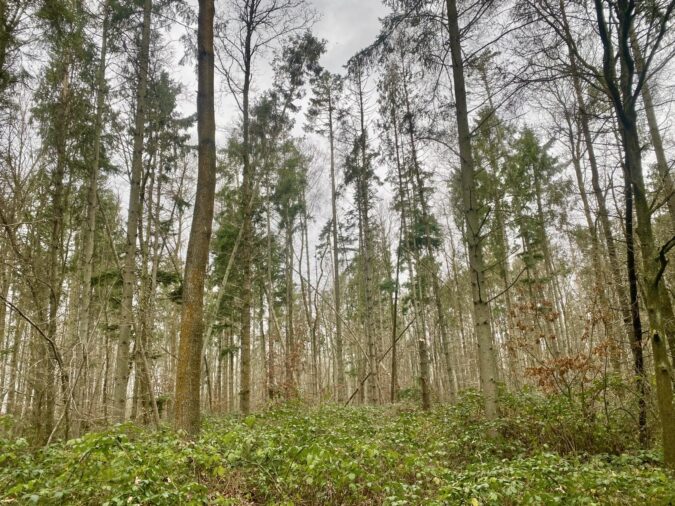
conifer woodland

Creating diverse woodlands and forests

by The blog at woodlands.co.uk, 14 December, 2021, 2 comments

We know that forests are important to all life on the planet.  They have often been referred to as the ‘lungs of the earth’, a reference to the fact that they produce vast quantities of oxygen - which is essential for respiration for so many forms of life.  They also take up carbon dioxide and ‘fix’ it into complex organic molecules - from starches, to cellulose and lignin.  Thus, the carbon is locked away for months, years or even millennia.  The equatorial forests of Brazil and Sumatra are species rich, incredibly diverse, but deforestation and the expansion of agriculture are threats to many biodiverse, forested areas across the world. As so many forests and woodlands have been felled, there is now a movement to plant millions and millions of trees (across the world) in an attempt to mitigate climate change and in the UK to increase our percentage tree cover from a pretty low base.  Sadly, twentieth century forestry in the U.K was largely based on monocultures (for timber production). The trees planted were large stands or plantations of conifers - using Scots Pine, Larch and Spruce. These plantations not only lacked biodiversity, but were / are susceptible to wide scale pest infestation and extreme weather events.   Woodlands and forests that have a diverse range of tree species are not only healthier but show greater growth and carbon fixation. They are more resilient.  The diversity of trees ensures the each species accesses slightly different resources from the environment  - from soil minerals, water and light.  Diversity means that trees of the same species are less likely to be clustered together so pest and pathogen outbreaks are less common or less severe.  One area that has undergone an extensive and diverse planting regime is Norbury Park Estate (near Stafford).  Since 2009, over 100 different tree species have been planted, and the woodlands can now produce 1500 tonnes of new wood each year, and harvest 5000 tonnes of carbon dioxide from the air.  Not only can diverse woodlands / forests fix carbon, supply harvestable timber but they also offer areas for rest and relaxation. Whilst it is not possible to plant an 'instant' forest or woodland, it is possible to plant a range of tree and shrub species that will in time grow and mature to form a diverse and species-rich area.  As Charles Darwin said many years ago “more living beings can be supported on the same area the more they diverge in structure, habits, and constitution” [On the Origin of Species by means of Natural Selection, 1859] Managing woodlands for wildlife - see here.   N.B.  Opens a PDF.    

Next Page »
