Woodlands.co.uk

Blog - mosses

Heat waves and urban heat islands

Heat waves and urban heat islands

by The blog at woodlands.co.uk, 21 June, 2026, 0 comments

Mosses and lichens are often overlooked as part of the woodland flora.  The same is true in towns and cities.  They can be found on the trunks of trees, on walls and rooftops.  They are epiphytes, that is,  plants which grow on the surface of another plant. They derive moisture and nutrients from the air, rain, and debris that is deposited on and around them. They cling to these surfaces, come rain or shine.  Climate change and pollution affects these small, often unnoticed plants in both woodland and urban settings.    As global temperatures continue to rise, many places face extremes of temperature.   Heat waves are becoming more common, as we have recently experienced.  Some 1500+ heat-associated deaths were recorded in England during the heat waves of  last summer [2025].    The highest rates were among elderly individuals [aged 85+] with the impacts felt particularly in care homes and hospitals.   London and the East of England recorded the highest number of heat-associated fatalities. Cities and urban environments often face the brunt of these climate extremes.  The concrete, brick and tarmac of cities absorb and hold onto the sun’s energy creating ‘urban heat islands’. Urban temperatures are often several degrees higher than surrounding rural areas. Urban temperatures have soared in recent times, for example in New Delhi, a record high of 126.1oF (52.3oC) was recorded. Such temperatures claim lives. This year parts of Europe have recorded temperatures of 40oC. Urban trees suffer in this heat as do their epiphytic flora.  The mosses and lichens in our cities fall into this category.  Researchers at Leiden University have investigated the effect of changing temperatures on the mosses and lichens growing on Lime (Linden) trees in Dutch cities (Amsterdam, Leiden, and Rotterdam).  They sampled numerous sites, measuring the microclimate for each tree and recording the species present.  They found, perhaps unsurprisingly, that urban heat islands were reshaping the moss and lichen communities.  Species that were adapted to drier, brighter and nitrogen-rich environments were favoured; for example, a type of wreath lichen [Phaeophyscia orbicularis]. When wetted this turns from a grey / brown colour to green, and its symbiotic green algae can begin to photosynthesise producing sugars. Those species that were associated with moister and shady conditions were found to be ‘losing out’.  They noted that the larger lime trees supported more diverse epiphyte communities; this might be associated with the older bark offering more micro-habitats for the mosses and lichens to ‘gain a foothold’.   [caption id="attachment_41261" align="aligncenter" width="675"] Lichens on an old stone wall.[/caption] The changing climate and urban heat islands are altering the species that can survive in our towns and cities, on trees and artificial surfaces.
Temperate rainforest or ‘Atlantic woodlands’, a WoodlandsTV film

Temperate rainforest or ‘Atlantic woodlands’, a WoodlandsTV film

by Angus, 8 November, 2024, 0 comments

Around the western coast of Britain, there are some rare and beautiful woodlands sometimes referred to as "temperate rainforest” or “Atlantic woodlands’.  There are such woodlands in North Wales, rich in ancient oaks and birch. They are ancient woodlands.  Such woodlands have little value in terms of timber but contribute massively to biological diversity - the trees are covered with different moss, liverwort and lichen species, underneath there is a ‘carpet’ of bilberries and varied ferns.  These woods have developed as a result of the influence of the  Gulf Stream.    This keeps the area warm but also wet,  the incoming air is also ‘clean’, creating woodlands unlike others in Britain.  Such woods have a damp and humid feel  and this dampness encourages mosses, liverworts, lichens and fungi. They are to be found on the rough bark of oak, the smooth bark of hazel, and covering rocks.  When one plant grows on another, it is termed an epiphyte. The tree canopy helps to ‘lock in’ the moisture. These epiphytes are discussed in some detail by April Windle of the British Lichen Society in a recent WoodlandsTV film on Temperate Woodlands, which can be viewed below. [embed]https://youtu.be/lO1H_iFFZJY?si=k0-UPv0DIsMJpwRs[/embed] The damp and humid conditions are also helped by the streams and waterfalls in these woods, plus the abundance of the epiphytes ensures that there is constant evaporation. The difficult access and rugged terrain of some of these woodlands may have helped them remain unchanged for centuries, probably dating back to the last ice age. Temperate rainforest must once have covered the Atlantic fringe of Western Europe, ranging from North West Scotland all the way down to the Iberian Peninsula.  Temperate rainforest is biodiverse, home to species not found anywhere else in the world.  Bats find a home here, such as the greater and lesser horseshoe bats, where they feed upon the rich source of invertebrates that thrive in these woodlands. The challenge for an owner of such a woodland is how to protect and manage it. It is not just a case of leaving them alone.  Winter grazing controls the bramble and holly, this helps protect the mosses and lichens, ensuring natural regeneration can occur.  If bramble and other botanical thugs gain an upper hand, then the mosses etc will be shaded out.  Tree seedlings would also struggle to establish themselves.  The intensity / frequency of grazing is critical, Natural Resources Wales (NRW) suggests one sheep per hectare for the winter months.  Ponies can be used for such grazing but they need more management than sheep.  The range of Woodlands TV films can be seen on the Woodlands TV channel on You Tube : https://www.youtube.com/@WOODLANDSTV  
The importance of biocrusts

The importance of biocrusts

by The blog at woodlands.co.uk, 4 June, 2024, 0 comments

The soil in many arid ecosystems (for example, savanna, deserts, & shrublands) is often covered by a thin layer of organisms, a community of lichens, mosses, liverworts, fungi, cyanobacteria and other microbes. They form a biocrust in the very top layer of the soil.  These organisms produce a variety of chemicals that glues together the soil particles.  Most biocrusts start of with a single type of organism (often a lichen or cyanobacteria, they are hardy). As these grow, they change the immediate environment so that others can then colonise the area so slowly the community grows.. The resulting biocrusts are important in helping reducing soil erosion and dust production.  Whilst dust can hold nutrients that will benefit plants as and when it is deposited, it can also have negative effects. Dust reduces water and air quality.  Dust storms can be truly massive and terrifying, for example, the 2009 Australian Dust storm. Occasionally, in this country we experience saharan dust that his been carried hundreds of miles on the wind.  If wind-blown dust lands on glaciers, snow or ice sheets then it affects the albedo.  The albedo is a measure of a surface’s ability to absorb and retain energy, or putting it the other way round, the ability to reflect heat / light energy.  Dark coloured objects tend to absorb more light energy than light coloured surfaces.  So if snow or ice becomes coated with dust, it will absorb more heat and may melt.   Biocrusts prevent many millions of tonnes of dusts entering the atmosphere each year.  It is thought that they may cover some 12% of the earth’s land surface.  Soil with a biocrust needs a far stronger wind before it starts to erode.  Sadly, like many other things, biocrusts are under threat due to climate change and shifting patterns of land use. [caption id="attachment_41261" align="aligncenter" width="675"] Church wall being colonised by Lichens[/caption] Biocrusts can also form on walls and buildings, for example, lichens and mosses colonise gravestones.  Whilst biocrusts have positive effects when they form on soils, it is thought that they can have deleterious effects on stone / brick surfaces due to the various organic acids and other chemicals that the colonising organisms can produce.  The production of these chemicals can degrade (weather) structures and lose their integrity / aesthetic appeal.   The Great Wall of China, which once stretched for some 8000+ kilometres, is protected by biocrusts in parts.  Construction of the wall started about. 200 BCE and continued (on and off) till the 1600’s CE.  Much of the wall has now been lost.  Some parts of the wall were made from stone and bricks (held together by sticky rice mortar). Other sections were constructed from ‘rammed earth’, made by compressing natural materials (eg. chalk, gravel, lime) with soil.  Some have regarded these sections of the wall as ‘weak points’.  Recent work by Bo Xiang and colleagues found that the ‘rammed earth’ sections were often covered by a biocrust, (of lichens, mosses and cyanobacteria).  This biocrust actually helps maintain the integrity of the wall by protecting it from wind and water erosion.  It reduces temperature extremes and the porosity of the wall, reducing infiltration and its water holding capacity.  All of these help maintain the integrity of these sections of the wall. If biocrusts are lost, through fire, climate change or human intervention then recovery can be problematic.  Organisms like cyanobacteria may recolonise a site quite quickly by organisms blowing in from nearby and undisturbed areas.  Full recovery of the crust and composition generally occurs more rapidly where the soil is fine  textured and moist. When the soil is coarse and dry then re-establishment of a biocrust may take hundreds or thousands of years. Thanks to Art for lichen image on church wall.  
Wild life and deadwood.

Wild life and deadwood.

by The blog at woodlands.co.uk, 28 April, 2023, 0 comments

For biodiversity to flourish, a wide variety of microhabitats is needed.  With many micro-habitats, more species are able to thrive. It may seem counter-intuitive but deadwood offers opportunities for a diverse range of species. Within a woodland, there are various types of deadwood, providing shelter and food for many organisms.  Perhaps one of the most obvious examples of deadwood is standing but dead trees.  If the dead tree was a veteran, then it will provide a variety of micro-habitats.  Holes and crevices may be used by bats and birds, the decaying wood will be colonised by bacteria and fungi, bracket fungi may erupt - whilst the bark will continue to offer a substrate for mosses and lichens.  As the wood decays, the material becomes a home for saproxylic beetles. Stag beetle larvae feed on decaying wood underground,  whilst the adults rely on fat reserves built up during their larval stage. Adults can ‘drink' oozing sap  and the juice of soft, rotting fruit. In the UK, some 650 beetle species are associated with deadwood [visit Dr Ross Piper’s website for full details of these insects].  As with many insects, many saproxylic beetles are threatened with extinction - due to the decline in the number of veteran / ancient trees.  Saproxylic beetles, apart from being important in the recycling of materials, are also food for birds and mammals. A previous blog has extolled the virtue of dead hedges.  Dead hedges are simply piles of branches and twigs arranged to create a barrier / hedge. They represent  a way of disposing of material that arises from thinning or clearing operations in woodlands. This ‘waste material’ of saplings and side branches are sometimes referred to as “arisings" by tree surgeons, or "lop and top” by foresters. Using this material in this way is good for wildlife, particularly for small mammals and birds - as it gives them somewhere to shelter from the wind and rain, and protection from predators. It's also good for insects.  As the material rots and decomposes, it adds humus / nutrients to the underlying soil. Larger pieces of wood from the felling of trees can be arranged to form a stack or pile, by simply laying branches and logs on top of one another  Such a stack wil rot and decay over time, but will provide a home to a variety of wildlife. So, deadwood in its various forms, is an important part of woodland ecosystems. It has a role in delivering biodiversity, but it also provides ‘ecosystem services’, such as soil formation and nutrient cycling. Deadwood contributes to the detrital food chain, which is driven by fungi, bacteria and detritivores.   Below : All that remains of a historic tree - the Wilberforce Oak. It was here at Holwood House (Keston , near Hayes, Bromley) in 1788 that William Wilberforce resolved to address the task of abolishing the slave trade. It took some twenty years for his vision to be realised. [Thanks to Ruth for images of the Wilberforce Oak] https://en.wikipedia.org/wiki/Holwood_House
Mosses in woodlands

Mosses in woodlands

by The blog at woodlands.co.uk, 6 November, 2021, 1 comments

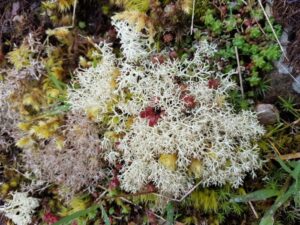
As we move through Autumn,  the leaves of deciduous trees have ‘done their job’.  Their capacity for photosynthesis dwindles (as does the light and temperature.  In fact, the leaves become a ‘liability’ to a tree, in that they would make use of the reserves that have been stored away. Also, the leaves offer resistance to the winds of winter so a tree is likely to sustain damage. If branches are lost from the stem,  then bacteria and / or fungi could enter.  The leaves are ‘discarded’ as Autumn progresses.  The green colour of the chlorophyll is lost and other colours emerge - reds, oranges and yellows. These colours are associated with different pigments, the carotenes, xanthophylls and the anthocyanins.   As the leaves are lost so the trunk and branches becomes more apparent, but they are not necessarily ‘naked’ - devoid of cover.  Indeed, walking through a woodland at this time of year, one is often struck by the abundance of mosses. Tree trunks are often laden with ‘carpets’ of moss and their branches bear ‘decorations’ of many different mosses.  Beneath the tree, there is often a soft, spongey layer of mosses. Mosses are bryophytes.  They are ‘simple’, non-vascular plants ; that is to say they do not have sophisticated transporting tissues (of phloem and xylem).  Nor do they have true roots, instead they have structures called rhizoids (which may be uni or multicellular). They live in moist places, indeed they are dependent on water for their reproduction. Mosses or rather their ancestors were some of the first plants to colonise land (which was the rather inhospitable rock of the Ordovician period), previously there were only algae in the seas.  Mosses develop sex organs, The male organ is called is called an antheridium, it produces male gametes that can move by means of a flagellum.  These gametes swim in a film of water towards the female organ (an archegonium).  When the male and female gamete fuse, the structure grows to form a sporophyte.  This eventually produces a capsule, which releases spores that grow on to form a new generation.   Mosses seldom grow to any great height, mainly due to the absence of supporting mechanical tissue but they can form extensive mats in damp, shady places (as can liverworts).  These mossy mats can in some situations prevent soil erosion, and in others allow the accumulation of humus and soil enrichment / formation.  An extreme example of the accumulation of mossy material I can be seen in the case of the moss Sphagnum.  Sphagnum is unusual in that can hold many times its own weight in water; because of this absorbency, Sphagnum was used as a wound dressing in WW1. It grows in acidic, marshy conditions, often forming a sphagnum bog. The low fertility and cool climate result in slow growth of the Sphagnum (and other plants). The decay of dead plant material is even slower (due low oxygen levels). Hence, peat forms and accumulates.  Large areas of the land can be covered to a depth of several metres with peat.  Peat bogs are a very effective means of carbon sequestration, locking away carbon for hundreds iff not thousands of years.  Unfortunately, many have been drained and allowed to dry out  and / or the peat cut from them as a form of fuel.  When peat areas are drained (channels are cut through the peat), they degrade and dry out.  Then, they are then at risk of burning as has been seem in recent years -for example, in the U.K (Saddleworth Moor). [caption id="attachment_39795" align="aligncenter" width="675"] Moss (Dicranum?) growing with Lichen (Cladonia sp)[/caption] 'Mossy ball', 'autumn leaves ', moss and lichen photos - thanks to Art Symons.
The effect of deer on woodland plant communities.

The effect of deer on woodland plant communities.

by The blog at woodlands.co.uk, 22 October, 2021, 0 comments

Images of deer in a woodland clearing may seem charming, but quite how deer and woodlands interact is not fully understood. It is certainly the case that deer affect tree regeneration;  they browse on saplings and can cause extensive damage to bark (through territorial behaviour / antler rubbing) to larger trees.  The lower levels of the plant communities are also affected by deer.  By changing these, deer also can change the animals to be found in this lower layer of a woodland. Research by Dr. Simon Chollet and colleagues showed that deer interaction can influence soil water availability,  and soil fertility. Their study looked at the role of Sitka black-tailed deer on the plant communities in forests in parts of western Canada. Chollet et al. examined twenty areas where deer were excluded for some two decades. An exclosure is a limited area from which browsing animals, such as deer, are excluded by fencing or other means. Unsurprisingly, they found that deer did have a significant effect on the plant communities. The exclusion of deer resulted in an increase in vascular plant richness and cover, though bryophyte (mosses etc) cover declined. They also found that with the deer gone,  the exclosures started to develop broadly similar plant communities.  There was no increase in beta diversity - that is the development small, localised communities of varying character. It was suggested that the dominance of certain species within the exclosures was linked to historic over-browsing.   Consequently, those plants that are able to withstand the presence of deer over time are best placed to achieve ‘dominance’ once this grazing pressure is removed.  This might explain why the different enclosures developed similar vegetation and plant species.    Biotic homogenisation has been seen in the UK woodlands, as was discussed in a previous blog.  It can be the result of introduced species, pollution (eutrophication - increased nitrate and phosphate levels), which allows botanical thugs (like nettles) to dominate, or poor woodland management.

Next Page »