Woodlands.co.uk

Blog - mycorrhizae

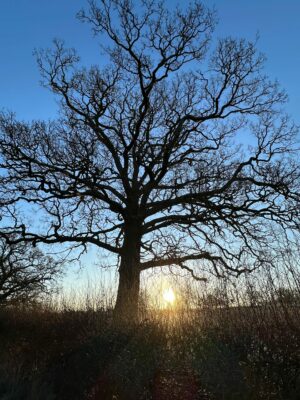
Woodland Oaks.

Woodland Oaks.

by The blog at woodlands.co.uk, 10 July, 2026, 1 comments

The oak is a keystone species.  Just as building an arch, the stability of the arch is gained from the positioning of the central stone - the keystone, so in many woodlands oak trees are what holds the woodland together; offering both stability and diversity.  There are two types of oak : The pedunculate oak, which ‘likes’ richer and somewhat heavier soils.  It can be distinguished from the sessile oak as Its acorns grow on long stalks [called peduncles]. The sessile oak, which can grow and survive on poorer and somewhat acidic soils, so can be found in upland areas.  Its acorns sit more or less directly on a twig. Both these oak trees contribute to many woodlands across the UK, and have done so for thousands of years.  Some have great age and are veteran trees. Their life can be between 300 and 800 years.    An oak woodland often represents the climax community in lowland Britain, which has considerable stability.  Because of their long lifespan and great biomass, they also represent significant stores of carbon.  Their extensive canopy also moderates the temperature and humidity of the woodland beneath, allowing for the growth of shade tolerate species such as hazel and holly. The trees also support an amazing diversity of life,  some two thousand species are known to find a ‘home’ in oak trees.  Feeding on the leaves or flowers are hundreds of species of insects - notably moths and butterflies.  The leaves provide food for many species of caterpillars, which in turn are a food source for birds, like the tits and warblers.  The branches of the trees provide nesting and roosting sites for many bird species.  The acorns of the oaks are a rich source of nutrients and energy not only for squirrels, but also mice, deer and other mammals.  Birds, like the jay, also take them.  Jays and squirrels create ‘caches of acorns’, that is they bury them as a store for later.  However, many are forgotten so they effectively distribute the acorns over a wider area and ‘plant’ future oak trees. The bark of the oak is rough and corrugated offering specialised niches for lichens and mosses.  When an oak dies , it is then home to a variety of fungi and beetles, which feed upon the rotting wood (saproxylic beetles).   The roots of an oak penetrate deep into the soil, which helps improve drainage, and the roots establish mycorrhizal connections with soil fungi.  These connections are symbiotic in nature, in that both partners benefit from the association.   The tree gets mineral nutrients from the fungi, and, in return, diverts some of its carbohydrate material to the fungi.  The breakdown of the oak leaves in autumn returns vital nutrients to the soil and provides food to a variety of decomposer organisms, from bacteria to earthworms.  Thus, oaks are a vital part of many woodland food chains.   Sadly, our oaks face a number of threats.  In elizabethan times, the main threat was that of being cut down and used in ship building.  At the height of Nelson’s navy in the late eighteenth century / early nineteenth century it took some 4,000 oak trees, to build a single 100-gun ship, and the navy had some 300 ships!  More recently, there have been problems with acute oak decline and infestation by the oak processionary moth.  The caterpillars of this moth feed on oak trees and large populations can strip an oak tree bare.  This leaves the tree vulnerable to other pests, and stresses such as drought.    Incidentally, contact with the hairs of the older caterpillars of this moth can cause itching, skin rashes and eye irritations, plus sore throats and breathing difficulties in us and other animals.   
Orchid germination

Orchid germination

by The blog at woodlands.co.uk, 17 December, 2025, 0 comments

Orchids are unusual, indeed exotic plants. After they have produced their flowers and they have been pollinated, the flower wilts and the ovary begins to swell to form a seed pod.  The time it takes for a seedpod to mature varies from species to  species, it may take eighteen months for a type of slipper orchid [Paphiopedilum].  When the capsule is mature, it splits open and its numerous, minute seeds are dispersed by the wind.  A single seed pod may contain millions of the dust-like seeds; a single seed may compared to a ‘speck of dust’.   Unlike the seeds of ‘normal’ plants, the seeds have no food reserve within them and in order to grow, they have to establish a symbiotic relationship with a specific mycorrhizal fungus.  This symbiosis is essential for the seed to germinate and grow.  The fungus enters the seed and provides the necessary nutrients for its development into a seedling. Propagating orchids from seeds is a complex process. sometimes done under sterile laboratory conditions using special culture media. In the wild, although an orchid may produce millions of seeds, only a minute fraction will successfully establish a symbiotic relationship with the correct fungal partner to grow and survive. Recent research with the orchid Cremasta variabilis has revealed some interesting facts about the germination of the seeds.  The orchid is found on the Korean Peninsula and is an insect pollinated, terrestrial orchid.  As with other orchids, its seeds are minute and are known to depend on a certain fungus to grow and develop.  In the past, most studies have focused on the fungi present in mature orchids but the team from Kobe University studied very young seedlings.  They noted that seedlings were often to be found near decaying logs, and this led them to test whether deadwood fungi are involved in early orchid development.   They buried seeds of four species of orchid in various forest locations, but they only observed germination  and seedlings near to decaying logs.  The seedlings were found to be exclusively associated with wood decaying fungi.  It may be that the orchids use other fungi to maintain the symbiosis as the deadwood dries out or is exhausted of nutrients. Some species of orchids have abandoned photosynthesis completely, and feed via fungi through their lives - a phenomenon known as mycoheterotrophy.  As woody (and rotting) debris represents a major carbon source in forests, it is a resource waiting to be exploited.  
Death from the woods

Death from the woods

by The blog at woodlands.co.uk, 9 September, 2025, 0 comments

A recent court case centred around the use of the death cap mushroom to poison people at a dinner party.  The use of this fungus to kill people is not as unusual as you might expect. It may have been involved in the death of the Roman emperor Claudius, and that of Pope Clement VII in 1534.  The death cap was also implicated in the death of the composer Johann Schobert.  Having collected wild mushrooms in Pré-Saint-Gervais, he was told that they were not edible, indeed poisonous.  Nevertheless, he used them to make mushroom soup. He and his wife, and one of his children died after consuming the soup. [caption id="attachment_33585" align="aligncenter" width="650"] A young Death Cap showing the somewhat hairy stem[/caption] The death cap looks inoffensive, with a pale yellow cap and white gills and can be mistaken for edible species if fungi.  It thought to be responsible for the vast  majority of fungal related deaths.  The active compound is a toxin called alpha-amanitin.  It is absorbed through the small intestine and as it circulates in the blood stream, it passes to the liver and then to the gall bladder. The toxin then enters the intestine again when the bile is released when the person next eats.  This cycle may repeat several times, with the toxin inflicting more and more damage. [caption id="attachment_33580" align="aligncenter" width="650"] Death Cap (Amanita phalloides)[/caption] Why the death cap makes this toxin is not clear.  It may deter insects and other invertebrates from eating the mushroom, or may help it establish mycorrhizal relationships by ‘interfering' with rival fungi.  Interestingly, the death cap was once assumed to be native to Europe, but it is now to be found America and other parts of the world.  It is thought to have travelled on the mycorrhizae of imported trees For further details of the toxin(s) produced by the death cap, and its reproduction - see the New Scientist 6th September 2025. Photos by Jasper, see his blogs on fungi month by month.  
Mature Beech on Box Hill, Surrey.

Trouble ahead for beech ?

by The blog at woodlands.co.uk, 14 February, 2025, 0 comments

In the southern parts of Britain, beech is a dominant woodland/forest tree, further north, oak is prominent.  Beech trees are often large with smooth, silvery grey bark.  They can grow to a height of 150 feet, with a stout trunk (perhaps 10 feet in diameter) and an impressive canopy. The leaves, certainly on younger trees, may persist throughout winter in a brown and withered state — a phenomenon known as marcescence.  The root system of the beech is shallow but extensive.  The large roots spread out in all directions, and establish mycorrhizal connections, often with fungi such as Russula and Laccaria.  The mycorrhizae help the trees by supplying mineral nutrients (like phosphate) and water.  In return, the trees provide various organic nutrients to the fungus. Despite these associations, beech trees are susceptible to drought.  After the drought of the summer of 1976, many beech trees died. It is not surprising that people are concerned about the ‘health’ of beech trees in light of climate change — higher temperatures, extreme weather,  specifically periods of drought.  It was thought that climate change would reduce growth of trees like beech through the increasing frequency and intensity of summer droughts. Recently, a study conducted by researchers at the University of Liverpool looked at tree growth data (annual growth ring and masting data) accumulated over more than forty  years and found that growth was indeed reduced (by some 28%).   However, the reason was that the trees were investing more energy into reproduction than into growth.  Beech trees are known for their mast years - see previous blog on masting. In a mast year, a tree will produce enormous quantities of seeds (beech nuts✝︎). However, it seems that the changing climate is causing a ‘breakdown’ in the masting process, and whilst the trees now reproduce more more frequently.  Total seed production and seed viability is reduced.   It may be that the diminished reproductive capacity of beech trees as a result of climate change will affect their ability to regenerate woodlands and forests in the UK and indeed across Europe in the coming years.   [caption id="attachment_41997" align="aligncenter" width="675"] Marcescence[/caption] ✝︎ Masting means that so many seeds that even the most voracious squirrels cannot consume all of them * After the summer of 1976, drought damaged trees were still dying some 15 years later.
The short lives of many urban trees

The short lives of many urban trees

by The blog at woodlands.co.uk, 3 November, 2023, 0 comments

The woodlands blog has reported on urban forests, the trees in our cities, lining our roads and in our gardens.  This green infra-structure in our towns and cities provides a range of economic, environmental, and social benefits. The importance of green, leafy spaces was emphasised during the early days of the Covid pandemic, helping with mental and physical wellbeing of many people. Urban trees offer  Valuable habitats for wildlife and can provide biological corridors / stepping stones that enable birds and other animals to move through the urban environment. Shade and cooling in streets and parks. They can help reduce the risk of flooding, allowing more water to enter the soil rather than running off hard surfaces of tarmac and concrete.   The capture of pollutants, improving local air quality by capturing fine particles from the air (mainly through deposition on leaf surfaces).  Trees and shrubs seem particularly effective in removing ozone.  Through their photosynthetic capacity, trees can take up carbon dioxide into organic form - carbon sequestration. The amount of carbon taken up by London’s urban forest each year has been estimated at 77,200 tonnes.  However, recent studies suggest that many urban trees are under threat : Trees are subject to heat stress as many cities experience the heat island effect, the ambient urban temperature is significantly above the surrounding countryside. Many struggle to get sufficient water as they are planted in small square of soil and surrounded by tarmac, concrete or paving stones. Soil compaction is often an issue, affecting water permeability. They may experience an ‘excess of nutrients’ - due to dog’s urine, this is a source of urea and other nitrogen compounds. Once planted, young trees may not receive after-care / management.  This point is significant.  Many trees die within the first few years of planting. In Boston (USA), some 40% of trees are dead within seven years of planting.  Similar figures are true for New York. Both rural and urban trees suffer significant mortality when young but whereas the death rate of rural trees tend to decrease after a few years - urban trees are more likely to die as they age.   [caption id="attachment_40541" align="alignleft" width="300"] Young urban tree[/caption] There is a struggle to reach maturity.  Most trees need two or three decades to offset the carbon emissions associated with their planting / maintenance etc, and they then sequester carbon at a significant rate.  Work at Boston University (in Professor Lucy Hutyra’s lab) and Harvard has focused on the problems that urban trees are facing, and another issue (apart from those mentioned above) has been identified - the microbiome of the root [that is the variety of micro-organisms that surround / inhabit the root tissues]. Urban trees seem to have fewer symbiotic fungi in their root systems when compared to rural trees.  Roots often develop mycorrhizal associations with fungi.  Such systems allow the roots to access more water / minerals and in return the tree ‘offers’ the fungal network a supply of carbohydrates.  Jenny Bhatnagar (Harvard) has investigated the soil microbiome in eight different plots, some urban and some rural in Massachusetts.  Interestingly, the investigation found that whilst there were more fungi in urban plots, they ‘seemed more reluctant’ to establish symbiotic associations with the roots of the trees.  This failure could be due to the excess nitrogen / nitrates in the soil (from animal urine / faeces?).  When there is an excess of nitrogen available, trees tend to dispense with their fungal partners. The hotter temperature of urban soils might 'favour' a bacterial population (some bacteria ‘fix’ nitrogen). [caption id="attachment_40526" align="alignright" width="300"] Once, there was a cherry tree ...[/caption] It is not clear as yet why so many urban trees fail.  It could be that the loss of the symbiotic fungi renders the trees more susceptible to certain disease-causing microbes.  The hotter and drier soils at the edges of fragmented forests have more pathogens and not so many symbiotic fungi. A number of simple aftercare / management measures would help young trees to establish : Watering the trees in their early years Preventing soil compaction to allow water to percolate, and oxygen to diffuse to the roots. Mulching around the tree base (helps water availability and slows nutrient input from urine etc.) An interesting article on mycorrhizae and urban trees may be found here. [caption id="attachment_40537" align="alignleft" width="220"] Olive[/caption]   The importance of soil micro-organisms is also indicated by research in Australia, where  shrublands / woodlands have been invaded by African olive trees.  The olives have disrupted the partnerships between the Acacia trees (hickory wattle) and symbiotic soil bacteria (Rhizobia ssp).  This is another symbiotic association, where the partners exchange materials for mutual benefit,  Where the Olives have grown, the Acacia have problems establishing root nodules with the bacteria.  To restore these scrublands, a full understanding of the soil / root microbiome will be important. Full details of this work can be found here.  Postscript : In today’s Guardian (03/11/2023), Helena Horton’s article “Ministers should target tree survival ‘rather than planting’” reinforces the points made in the blog about the early mortality of young trees - urban or rural.  Increasing woodland cover will only occur if young saplings survive.  
woodland web updates - 21

woodland web updates – 21

by The blog at woodlands.co.uk, 5 December, 2022, 0 comments

Ancient Trees A recent report has emphasised the importance of protecting and preserving ancient trees.  Ancient (or veteran) oaks can live in excess of a thousand years, as can Yews.  The Bristlecones of California and Nevada may live for some five thousand years ! Such trees represent a massive carbon store.  The carbon dioxide from the atmosphere being locked away for a millennium or five!  Not only are such trees a significant carbon store but they also offer a home or food for many other species - fungi, epiphytes such lichens & mosses, plus larval and adult stages of insects, and a variety of birds and mammals.  As such the are localised centres of diversity that contribute to ecosystem stability.  Not only are these trees ‘hotspots’ for species diversity but they are also centres of mycorrhizal activity and connectivity.  Mycorrhizae represent a symbiosis between fungi and plant. Plants ‘register’ wounding. When we are hurt, our nerves register the pain through the movement of sodium and potassium ions along the nerves.  When a plant is wounded, calcium ions are known to move in response, travelling from cell to cell, and leaf to leaf.  However, it is now known (through research at the John Innes Centre in Norwich) that this is not the first response of the plant to physical injury.  When cells are wounded they release glutamate, a form of glutamic acid (an amino acid).  This travels along the cell wall and activates channels in the cell membranes that then allow the movement of the calcium ions. A bumblebee pathogen. One of parasites of bumblebees is Crithidia bombi.  It is a protozoan (single celled animal) that reproduces in the gut of the bumble bee. When infected with this parasite the foraging behaviour of the bee is impaired, as is its ability to learn.   A colony may also suffer from increased worker mortality.  Now research has shown that floral structure may influence the transmission of this parasite from bee to bee.  The length and shape of the petals seems to be a critical factor.  If the bees ‘crawls’ in a ‘tube’ of petals, then it may leave behind some faeces.  If the bee is infected with the parasite, then it will be present in the faeces.  If the flower is then visited by another bee then it runs the risk of coming in contact with the faeces and being infected with the parasite.  Plants that have flowers with shorter petals / corollas are less likely to have faeces deposited within them, and therefore less likely to pass on the parasite to the visiting bumblebees.
The wood wide web, an underground network.

The wood wide web, an underground network.

by The blog at woodlands.co.uk, 29 November, 2022, 0 comments

Most months, Jasper has introduced us to a new fungus or group of fungi that have made their appearance in woodlands,  some on trees or branches or leaves, others simply emerging from the soil.  Some fungi are parasitic or biotrophic requiring a living host organism on which they feed.  Then there are those that live in and feed on dead and decaying matter in the soil; these are termed saprobic or saprophytic.  The structures that we normally see (particularly at this time of the year) are the fruiting or reproductive bodies of the fungus / fungi.  The majority of a fungus exists as a network of microscopic ‘tubes’ that permeate either the host organism, or the soil / decaying matter in which the fungus has made its ‘home’.  An individual tube is known as a hypha and collectively they form a complex network - the mycelium. The fungal mycelia present in the soil form a vast underground network.   Some of these fungi enter into beneficial associations with plants - mycorrhizal associations.  The fungal hyphae wrap themselves around (and sometimes into) the roots of plants and trees, with whom they share minerals and nutrients. Generally speaking, the fungus helps to supply the plant with mineral nutrients (like nitrates / phosphates) and in return receives carbohydrate material from the plant’s photosynthetic capacity.  These mycorrhizal systems form part of what has been termed the ‘wood wide web’.  Dr. Suzanne Simard, a forest ecologist from the University of British Columbia, coined the term to describe the complex relationships between fungi and plants in woodland and forest ecosystems. It has been suggested that (millions of years ago) fungi helped plants transition from their aquatic home to life on land, with the fungal network serving as a ‘root system’.  Fungi (and bacteria) release enzymes (biological catalysts) and these help break down the complex compounds (like lignin, cellulose and starch) present in dead plants and animals.  As a result of this decomposition, humus is formed. Humus is a colloid.  A complex mixture of materials, some in solution, some in suspension. Humus binds the inorganic mineral particles of the soil together, is a store of nutrients and helps water retention.  The fungal network in the soil sequesters enormous amounts of carbon.  The soil is one of the Earth’s main carbon ‘sinks’.   If soil is over-worked or damaged by the intensive and extensive use of chemicals in farming, then it degrades and with it the rich microbial network. Damage to the soil and its complex microbial population can impact on the growth of plants - from the simplest green plants to the largest trees. Not only are soil fungi and bacteria involved in the cycling of carbon and nitrogen, but they help maintain the fertility and structure of the soil.  Soil is the ultimate recycling system, we need to cherish the soil and its fungal and bacterial populations - it helps maintain the ecosystem services on which we all depend.  Without healthy soils, we face a very bleak future.  

Next Page »
