Woodlands.co.uk

Blog - mycorrhizal associations

Orchid germination

Orchid germination

by The blog at woodlands.co.uk, 17 December, 2025, 0 comments

Orchids are unusual, indeed exotic plants. After they have produced their flowers and they have been pollinated, the flower wilts and the ovary begins to swell to form a seed pod.  The time it takes for a seedpod to mature varies from species to  species, it may take eighteen months for a type of slipper orchid [Paphiopedilum].  When the capsule is mature, it splits open and its numerous, minute seeds are dispersed by the wind.  A single seed pod may contain millions of the dust-like seeds; a single seed may compared to a ‘speck of dust’.   Unlike the seeds of ‘normal’ plants, the seeds have no food reserve within them and in order to grow, they have to establish a symbiotic relationship with a specific mycorrhizal fungus.  This symbiosis is essential for the seed to germinate and grow.  The fungus enters the seed and provides the necessary nutrients for its development into a seedling. Propagating orchids from seeds is a complex process. sometimes done under sterile laboratory conditions using special culture media. In the wild, although an orchid may produce millions of seeds, only a minute fraction will successfully establish a symbiotic relationship with the correct fungal partner to grow and survive. Recent research with the orchid Cremasta variabilis has revealed some interesting facts about the germination of the seeds.  The orchid is found on the Korean Peninsula and is an insect pollinated, terrestrial orchid.  As with other orchids, its seeds are minute and are known to depend on a certain fungus to grow and develop.  In the past, most studies have focused on the fungi present in mature orchids but the team from Kobe University studied very young seedlings.  They noted that seedlings were often to be found near decaying logs, and this led them to test whether deadwood fungi are involved in early orchid development.   They buried seeds of four species of orchid in various forest locations, but they only observed germination  and seedlings near to decaying logs.  The seedlings were found to be exclusively associated with wood decaying fungi.  It may be that the orchids use other fungi to maintain the symbiosis as the deadwood dries out or is exhausted of nutrients. Some species of orchids have abandoned photosynthesis completely, and feed via fungi through their lives - a phenomenon known as mycoheterotrophy.  As woody (and rotting) debris represents a major carbon source in forests, it is a resource waiting to be exploited.  
Death from the woods

Death from the woods

by The blog at woodlands.co.uk, 9 September, 2025, 0 comments

A recent court case centred around the use of the death cap mushroom to poison people at a dinner party.  The use of this fungus to kill people is not as unusual as you might expect. It may have been involved in the death of the Roman emperor Claudius, and that of Pope Clement VII in 1534.  The death cap was also implicated in the death of the composer Johann Schobert.  Having collected wild mushrooms in Pré-Saint-Gervais, he was told that they were not edible, indeed poisonous.  Nevertheless, he used them to make mushroom soup. He and his wife, and one of his children died after consuming the soup. [caption id="attachment_33585" align="aligncenter" width="650"] A young Death Cap showing the somewhat hairy stem[/caption] The death cap looks inoffensive, with a pale yellow cap and white gills and can be mistaken for edible species if fungi.  It thought to be responsible for the vast  majority of fungal related deaths.  The active compound is a toxin called alpha-amanitin.  It is absorbed through the small intestine and as it circulates in the blood stream, it passes to the liver and then to the gall bladder. The toxin then enters the intestine again when the bile is released when the person next eats.  This cycle may repeat several times, with the toxin inflicting more and more damage. [caption id="attachment_33580" align="aligncenter" width="650"] Death Cap (Amanita phalloides)[/caption] Why the death cap makes this toxin is not clear.  It may deter insects and other invertebrates from eating the mushroom, or may help it establish mycorrhizal relationships by ‘interfering' with rival fungi.  Interestingly, the death cap was once assumed to be native to Europe, but it is now to be found America and other parts of the world.  It is thought to have travelled on the mycorrhizae of imported trees For further details of the toxin(s) produced by the death cap, and its reproduction - see the New Scientist 6th September 2025. Photos by Jasper, see his blogs on fungi month by month.  
spruce woodland

With a little help from my friends ……

by The blog at woodlands.co.uk, 6 June, 2025, 0 comments

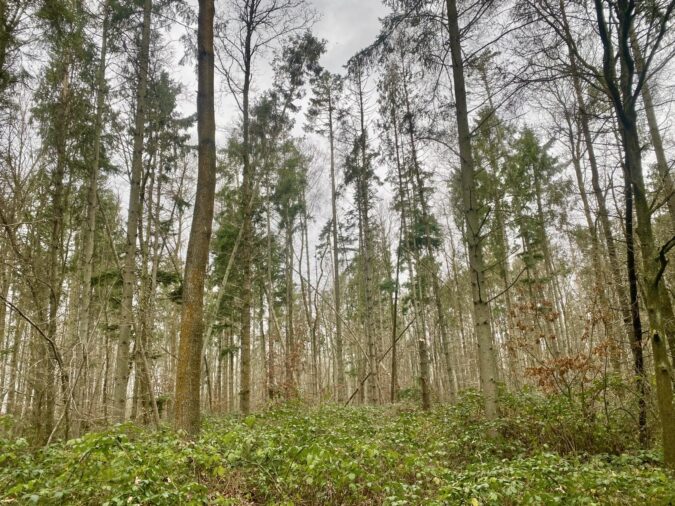
Plantations are generally monocultures of economically important tree species, trees that are valued for their timber and rapid growth.  Compared to natural woodland, biodiversity is lower in monocultures. They are less resilient to extreme climatic events, attack by pests and/or disease and offer fewer ecosystems services.  Adding different trees into the mix of species can result in an increase in biomass (timber) production and resilience. Since the 1930’s, a ‘nursing mixture’ of Pines and Sitka Spruce has been used to establish Sitka forest in nutrient-poor soils (without the use of fertilisers or herbicides).  Quite how the pines benefited the growth of the Spruce was not known. One possible ‘mechanism’ is plant soil feedback [PSF], where plants change the nutrient make-up and/or the  bacterial and fungal community of the soil.  These changes then benefit the subsequent growth of seedlings / saplings.  Important in this respect are the fungi that can establish symbiotic / mycorrhizal associations with plant roots.  Ectomycorrhizae (ECM) exist mainly as an external coating on the roots, with some of the hyphae penetrating into the root tissue. Ectomycorrhizae are often associated with woody tree species, particularly conifers. There are a number of parts to a mycorrhizal association with trees: The Hartig net, this is the fungal hyphae that penetrate the roots of the tree, and make contact with the root cells, allowing for the exchange of carbon compounds, mineral nutrients, and water. The Mantle is the sheath of hyphae that covers the tree roots.  It is a more substantive structure than the Hartig net.  The fungal sheath probably offers some protection to the delicate root tips from pathogens and pests.   The Extra-radical hyphae. These grow out from the mantle into the soil. They may spread a significant distance from the actual roots, increasing the surface area for the absorption of water and minerals.  The Fruiting bodies.  These are the reproductive structures of the fungus and are visible above ground. Now some evidence is accumulating about how nursery mixtures / species have their effect.  Last year, researchers at Manchester University looked at the nursing effect of pine and silver birch on Sitka Spruce.   They collected soil from Cannock Chase, where these tree species co-existed.  The soil was sieved and some sand added and then placed in pots. Four groups of pots were created Pots with pine seedlings Pots with Spruce seedlings Pots with silver birch seedlings Pots with all three types of seedlings Pot Treatment Species grown in the conditioned soil Pine conditioned soil  Pine Spruce Birch Spruce conditioned soil  Pine Spruce Birch Birch conditioned soil  Pine  Spruce Birch Pine, Spruce & Birch conditioned soil  Pine Spruce Birch All the pots were placed in a greenhouse and the seedlings allowed to grow on for 34 weeks.  This allowed the growing seedlings to ‘condition’ the soil.  At the end of this time, the seedlings were removed and soil sieved and placed in fresh pots.   The four ‘types’ of ‘conditioned’ soil were then used to grow on newly germinated seeds of the three tree species.   One seedling was grown per pot, and the pots grown on for 24 weeks in the greenhouse again.   At the end of the 24 weeks, the seedlings from each pot were harvested and carefully examined.  For each, many features were recorded Root length Branching intensity Root tissue density Total root length dry weight /mass recorded Ectomycorrhizal colonisation (microscopic analysis) Specific leaf area VIII.Leaf dry matter Photosynthetic rate The soil was also subjected to detailed analysis (e.g : pH, nitrates, microbial enzymes etc). The results showed that  The Spruce seedlings grew best in the soil that had been previously ‘conditioned’ with Pine growing in it. The Spruce fared less well in the previously Spruce ‘conditioned’ soil The increased growth was associated with greater root colonisation by mycorrhizae. Longer term increased growth in the silver birch ‘conditioned’ soil might be associated with increased availability of soil nitrates It would seem that Pines facilitate the growth of the Spruce through the enhanced establishment of symbiotic, mycorrhizal connections.  These connections allow saplings to access vital mineral nutrients such as phosphate.  This study therefore goes some way to explaining the nursing effect of mixed species planting. Full details of this work may be accessed here :  https://besjournals.onlinelibrary.wiley.com/doi/10.1111/1365-2664.14848