Woodlands.co.uk

Blog - natural regeneration

Ownership of SSSI Woodlands

Ownership of SSSI Woodlands

by Adrian Jowitt, 6 March, 2026, 1 comments

Sites of Special Scientific Interest (SSSIs) are some of England’s most remarkable natural places. With over 4,100 sites across the country, they showcase the very best of our wildlife, habitats, and geology - collectively covering around 1.1 million hectares (about 8% of England). Owning a SSSI woodland is a special opportunity. As a custodian of one of these nationally important areas, you play a meaningful part in protecting and enhancing our natural heritage for generations to come. Many owners find this a rewarding way to connect more deeply with their land and its wildlife.  Beyond their conservation value, SSSIs can also offer quiet places for recreation, provide opportunities for scientific study, and deliver wider benefits such as clean water, flood management, carbon storage, and pollination. Because of their importance, some activities on SSSIs need to be carefully managed. The Wildlife and Countryside Act 1981 sets out a list of operations that require consent from Natural England before going ahead—such as tree work, drainage changes, or certain types of recreational activity. Most owners find the process straightforward, and it helps ensure that any work supports the special features of the site. More guidance is available at Sites of special scientific interest: managing your land - GOV.UK When purchasing land, conveyancing checks will normally confirm whether it lies within a SSSI. You can also explore this yourself via the MAGIC map system, and further information about individual sites is available at designatedsites.naturalengland.org.uk. Natural England is there to help. Through good management advice, and tailored guidance, they work alongside landowners to support positive management and help sites deliver for nature recovery. Open communication is encouraged, as is collaboration with neighbouring landowners—particularly for larger-scale matters such as deer or squirrel management. Many traditional woodland practices, including coppicing, natural regeneration, and managing invasive species, fit well with SSSI conservation and are often recommended. Some protected features may be less visible, such as fungi or particular bird communities, but the focus is on looking after the habitats that support them. Although caring for a SSSI may feel like a responsibility at first, it can be hugely rewarding. Owners frequently enjoy the sense of purpose, connection to nature, and contribution to biodiversity. Support, advice, and in many cases grant or stewardship options are available—meaning even small woodland owners can make a real and lasting positive difference. Adrian Jowitt  Principal advisor on woodland policy, Natural England.
Deer in woodlands

Deer in woodlands

by The blog at woodlands.co.uk, 22 June, 2024, 3 comments

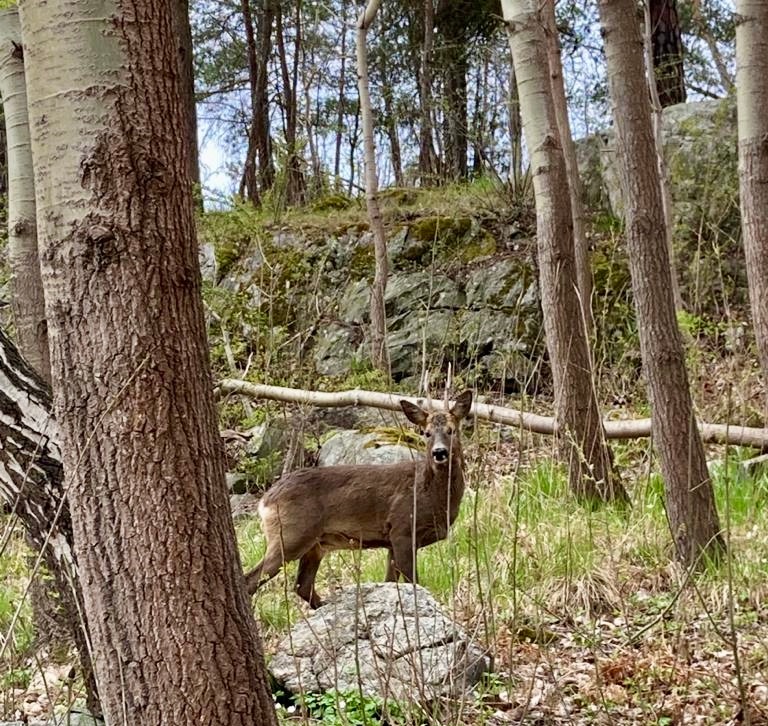
Woodland covers some 1,000 hectares of the Ashdown Forest, that is roughly 40% of its area. Much of the woodland is relatively young. However, the forest’s capacity for regeneration / renewal is being damaged by overgrazing.  Local deer populations have grown and now represent a problem. Deer browse / graze on vegetation, shoots, flower buds and foliage are stripped off plants.  Young saplings are damaged and bark is eaten, especially when food is scarce.  Consequently, tree and shrub regeneration is limited.  Other species are affected by the feeding of the deer, either through loss of niches or food.  Among those at risk are small mammals and certain butterfly species. [caption id="attachment_34368" align="aligncenter" width="650"] deer damage[/caption] Damage is found in woodlands in many parts of the country, as deer populations have increased in recent times. In the 1970s, the deer population was estimated to be around 450,000 as compared to today’s estimates of over 2 million.  The National Forest Inventory highlighted that "40 percent of British forests have ‘unfavourable’ levels herbivore damage, which limits the survival of young trees and threatens biodiversity".  Apart from deer damage, there is damage by the grey squirrel populations. Deer browsing can : Prevent natural regeneration Affect biodiversity Affect woodland resilience Reduce food availability to the herd which can lead to starvation / loss of condition Deer are also hosts to ticks.  The ticks may be infected with Borrelia burgdorferi  bacteria and transmit them to humans, resulting in Lyme disease. Deer  also contribute to collisions with motor vehicles; more than 450 deer were hit by vehicles on Hampshire roads last year .  In Scotland,  government agency figures indicate that deer vehicle collisions  [DVCs] have almost doubled between 2008 and 2020.   Sadly, people are injured or killed in DVCs, and the repair cost to vehicles runs into millions. The solution to the ‘problem’ is not clear cut. Culling [the selective killing of animals] to control deer populations is one way in which numbers can be reduced, and the damage to woodland mitigated.  However, this approach has been met with opposition by many, including animal rights organisations.  There is the argument that whilst a reduction in deer numbers might fix some problems in the short term, the subsequent increase in plant growth and food availability might lead to increased breeding by the remaining deer and numbers would then increase again.  Also, unsuccessful or inaccurate shooting leads to animal suffering, mutilation and / or a lingering death.   Some might advocate rewilding and the introduction of apex predators (such as the wolf, lynx, wild cats*) as a means of reducing numbers but that might raise other problems! Deer have been 'part and parcel' of woodlands since mediaeval times, when the forests were used for hunting. In the Ashdown Forest, the number of red deer declined during the C17th,  and poaching was a factor in their decline. Fallow deer numbers also declined. [Fallow deer were introduced to England by the Normans around 1100 AD.]  The deer population roaming the forest has increased significantly in the recent decades, and now there are the relatively recently introduced species, muntjac and sika deer.   There are six species of deer in UK woodlands – the two native species, the red deer and roe deer and fallow, muntjac, sika and chinese water deer make up the four non-native species. The problem of over grazing is not unique to the Ashdown forest. For example, deer numbers in Scotland have doubled in recent years to almost a million since 1990.   Finding sustainable (and humane) solutions to the large numbers of deer is difficult. * Wildcats were once widespread in Britain, but by the end of the 18th century, they were to be found only in the northern regions. [caption id="attachment_34415" align="aligncenter" width="700"] Remnants of birch woodland near Loch Muick are subject to browsing by red deer (especially in the winter), so temporary fences have been put in place to allow for regeneration.[/caption]
Winter Poplars

Re-populating poplars.

by The blog at woodlands.co.uk, 24 February, 2023, 4 comments

Poplars belong to the same family as the willows. Like willows, they have a 'preference' for wet soil. There are a number of poplar species – white, grey and black poplar and the western balsam poplar,   A poplar that is common is the Lombardy Poplar, it is a variant of the Black Poplar and probably the most recognizable poplar,  as its branches grow almost parallel to the main stem.   It is a tall, thin tree. The leaves of black poplar (Populus nigra) are arranged along the stems in an alternate fashion. The leaf has a long, slender leaf stalk – which is slightly flattened. The leaf is sometimes described as ‘triangular’ or ‘diamond shaped’. When first formed, the leaves may have a bronze tinge and the young shoots, leaves and stalks have fine, tiny hairs.   The upper leaf surface is a dark green, whereas the lower surface is not such a deep green. In Autumn, the leaves may turn a vibrant 'banana' yellow. The bark of the Black Poplar is grey / brown and deeply fissured with age. The tree may grow to a height of 100 feet, but is usually smaller than this.  The species is dioecious, that is, there are separate male and female trees. In some parts of the country, like Cheshire, the number of Black Poplars is falling, due to changes in land management, a reduced need for particular timbers and an ageing population of trees.  The natural regeneration of black poplars is limited because : male and female trees need to be near each other the fertilised seeds are only viable for a short period  and the seeds need to fall on damp ground   Added to this, there is the risk of hybridisation with other forms of Poplar. So, The Canal and River Trust in conjunction with Chester Zoo have initiated a program to plant black poplar trees in Cheshire’s Weaver Valley.  They have taken cuttings from native Cheshire trees and raised over 1,000 new trees, which have been planted in sites across Cheshire since 1995. For example, male and female trees have been planted by the River Weaver (Hartford) to encourage future natural propagation. Such black poplars can help promote biodiversity, providing homes for moths, bees, birds and butterflies.   Should you have a portion of woodland that has damp soil, and are considering planting some black poplar, there is company that seems to specialise in Poplars : http://www.poplartree.co.uk/poplartree/.  It lists some of the uses / benefits of poplars.