Woodlands.co.uk

Blog - Norway Spruce

Plants for Christmas.

Plants for Christmas.

by The blog at woodlands.co.uk, 23 December, 2025, 0 comments

At this time of year, certain plants play an important  part in Christmas celebrations.  One is the Christmas Tree itself - which became established in Victorian times after Prince Albert introduced one in the Royal Household.  A Christmas tree is invariably a conifer but any of the following species may be used : Norway Spruce Picea abies Silver Fir Abies alba  Nordmann Fir Abies normanniana Scots Pine Pinus sylvestris and in North America Douglas Fir Pseudotuga menziesii  and Balsam Fir Abies balsamea. There is also the artificial Christmas tree. These originated in Germany in the late 1800s, and were typically made from dyed goose feathers attached to a central pole / wire frame.  Later in the 1930s, the Addis company used the machinery for making their toilet brushes to create ”trees’ .  Animal bristles, dyed green, were used to form the needles of the ‘trees’.  Nowadays, most of the artificial Christmas trees come from China. Apart from the Christmas tree, there is also Holly, Ivy and Mistletoe. All are evergreen plants.  Bringing greenery is an age old tradition associated with the coming of, or ‘rebirth’ of Spring.  The holly tree is either male or female, and also not a conifer. The leaves have spines and a thick, protective and waxy cuticle. Its leaves (as a garland around the door) were thought provide protection for the home, warding off evil spirits.  It was also used in the ancient Celtic Festival of Beltane to welcome in summer. It is certainly the case that in the past, the distribution of holly was far more widespread. The Needwood Forest in Staffordshire was a significant and ancient midlands forest but after the Enclosure Act of 1803, large numbers of its trees were felled.  In his ‘Plant Book’, Professor David Mabberley notes that some 150,000 holly trees were taken from this forest to provide bobbins for the cotton mills of Lancashire.  Bagot’s Wood is said to be the largest existing piece of this ancient woodland). Holly was also an important species in hunting estates and deer parks. Sometimes it was planted around saplings of other more valuable trees to deter browsing by deer. The  leaves of Holly are palatable to livestock, despite their spines.  It is the only evergreen tree (found in deciduous forest or woodland) that does not contain chemicals that are toxic to sheep or cattle. For many centuries, it was common practice to provide holly as fodder for livestock, during the winter months when other foodstuff such as hay or grains were in short supply.  Without the provision of the holly, livestock might have to be slaughtered.  The practice of using holly as fodder was more common in areas like Cumbria, the Welsh Borders and the Pennines*. Again in the past, Holly was also for hedging as it was virtually impenetrable, though the downside of using holly was its relatively slow growth. The berries of holly are attractive food to some birds, especially redwings and fieldfares. Holly and Ivy are often used to make festive wreaths and garlands. Common ivy (Hedera helix) may be found growing in woodlands, hedgerows or on walls. Sometimes it is a climber; sometimes it forms a layer at ground level.  It is a woody, evergreen perennial that is distributed throughout much of the British Isles, and many parts of Europe. It can grow in a variety of soil types, and when mature is resistant to many harsh conditions, being particularly tolerant of shade. Last of the Christmas plants is the mistletoe. Mistletoe is well known for the custom of “kissing underneath the mistletoe”. It is an unusual plant in that it is a hemiparasite that grows on trees such as apple, lime, poplar and hawthorn.  It forms large balls that are suspended  from the branches and and more obvious in the winter months (see featured image), when the host has lost its leaves.  Whilst it can make sugars and other complex organic compounds, it relies on its host plant for water and mineral salts.  It does this by forming ‘clamp-like’ connections (known as haustoria) with the water conduction tissue (xylem tissue) of the host plant.Mistletoe is an important species on woodlands. Some species are directly dependent upon it, or example the mistletoe marble moth and the 'kiss me slow weevil', and the berries provide food for number of different birds.    When mistletoe is removed from woodlands,  the number of woodland birds tends to decline as does biodiversity.  
Prospecting for gold?

Prospecting for gold?

by The blog at woodlands.co.uk, 31 October, 2025, 0 comments

Mineral deposits (such as those containing copper.or tin) slowly release ions into the surrounding soils.  This release of ions occurs through chemical processes such as oxidation or through the activity of microbes.  Because of these processes, it is often the case that metals such as lead, cadmium, nickel and mercury can be found in plants.  Indeed, some are referred to as hyper accumulators. Such plants might be used in phytomining.  This would involve growing hyper-accumulator plants on a metal-rich soil, harvesting the plants and then burning the plant biomass down to an ash  from which the metal might be reclaimed.   This would make sense economically where the metals were rare or of high intrinsic value.  In Finland, two species of willow trees (Salix schwerini and Salix viminalis) have been studied as agents of phytoremediation.  These trees can grow in acidic soils and can cope with with copper, zinc, nickel, chromium or lead contamination.  Initial research indicates that willows can help reduce zinc levels withinin six years under favourable conditions, though nickel, copper and chromium take much longer. New research at the Finnish University of Oulu has indicated that even gold may move into certain plants.  The research team were studying Norway Spruce trees that were growing in the mineral deposit above a gold mine.  They took samples from a number of trees and analysed the leaves, and found that some had gold nanoparticles within the leaves. These minute particles were surrounded by bacterial films. It would seem that certain spruce associated bacteria can help transform soluble gold from the soil into solid particles within the leaves.   The ‘soluble gold’ enters from the soil and is transported up to the needle-like leaves, where it is precipitated into solid form. The size of the particles is indeed microscopic, being only about a millionth of a millimetre in size.  Far too small to be extracted for commercial use.   The process of biomineralisation is poorly understood, but it seems that certain endophytic bacteria (those that live within the plant) play a role in the process.  
A tree at Christmas

A tree at Christmas

by The blog at woodlands.co.uk, 24 December, 2024, 0 comments

For many, the Christmas tree is an essential part of the celebrations.  Selecting your tree from a local garden centre or a woodland (that grows and sells trees by the thousand)  then decorating it and surrounding it with presents, is part and parcel of the festivities.  But when did these activities start ? Winter celebrations date back many centuries and many are associated with the winter solstice, which marks the shortest day and longest night (in northern latitudes).  It marked the time when the sun’s 'strength' would begin to return - as day length begins to increase. As part of such celebrations, people would bring greenery (usually evergreen material) indoors - symbolic of warmer times to come when crops could be grown.  Such celebrations were widespread across Northern Europe, and these traditions continued even as Christianity spread .   However, there were some who regarded the celebration of Christmas and its associated decorations as sacrilegious. In the UK, during the Commonwealth period under Oliver Cromwell, an outright ban on celebrating Christmas was issued in June 1647.  Parliament passed an ordinance banning Christmas, Easter and Whitsun festivities, services and celebrations. This included festivities at home, and there were fines for non-compliance.   In the United States, some States like Massachusetts, also fined people who celebrated Christmas.  However, many German people who migrated to “the New World” in the 18th century, carried their Christmas traditions with them, which included displaying and decorating Christmas trees. Christmas trees gradually gained in popularity.  In the UK, the adoption of the Christmas tree as part of the seasonal celebrations by Queen Victoria and her husband [Prince Albert of Saxe-Coburg and Gotha] was featured in the London Illustrated News.   This had an image of the Queen and her family decorating a Christmas tree.  The wealthier elements of Victorian society followed the example of the Royal Family. The Christmas tree is invariably an evergreen tree but it can take several forms.  A variety of conifers are sold as Christmas trees, for example, the Norway Spruce Picea abies Silver Fir Abies alba Nordmann  Fir Abies normanniana Scots Pine Pinus sylvestris and in North America, the Douglas Fir Pseudotuga menziesii  and Balsam Fir Abies balsamea. The Norway Spruce is one of the cheaper trees available.   It is a ‘typical’ conifer - being a woody, evergreen tree that produces it seeds in cones.  Like many conifers, the Spruce produces resin, which helps protect the tree from attack by fungi and bacteria. Many Christmas trees are now grown on “Christmas Tree Farms” as opposed to being felled from natural woodlands and forests. Many millions of trees brighten up our homes and offices across the country each Christmas.  Later, they can be recycled as many councils  / local authorities now collect Christmas trees in order to recycle them.  Many are turned into wood chippings / compost and used in local parks as mulch. Sadly, many millions of Christmas trees still end up in land fill each year, where the tree decomposes and produces methane gas, which is more potent than carbon dioxide as a greenhouse gas. Note : other evergreen plants used to decorate the home at this time of year, such Holly, Ivy and Mistletoe should be used with caution as they can contain toxins, which may harm pets etc.  For example, Mistletoe contains Phoratoxin and Viscotoxin, which are poisonous proteins when ingested.   
Tree Health Pilot Scheme, targeting pests and diseases.  Finding out about the THP and SPHNs

Tree Health Pilot Scheme, targeting pests and diseases.  Finding out about the THP and SPHNs

by Ruth, 26 July, 2023, 1 comments

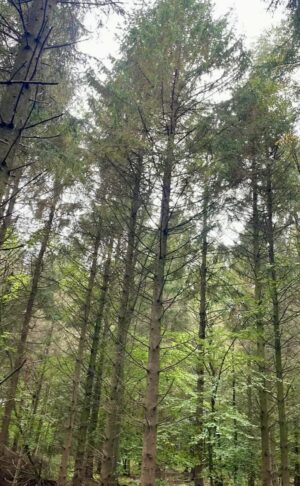
We first became aware of the tree health pilot (THP) scheme in 2021 when we received a Statutory Plant Health Notice (SPHN) for trees infected by one of the specified pests. The THP scheme has been designed to help slow the spread of pests and diseases affecting trees in England. There are grants available for larch trees with Phytophthora ramorum, spruce trees affected by Ips typographus, sweet chestnut trees with Phytophthora ramorum or sweet chestnut blight, oak trees with oak processionary moth (OPM) and ash trees with ash dieback. In our case, the Larger Eight-toothed Spruce Bark Beetle [Ips typographus] had been found in the Norway spruce and we were instructed to fell, move, process and destroy all spruce trees in the defined area of the wood. Strict but clear directions were given regarding the ‘how, when and where’ for the felling and processing. An initial site visit and ongoing support from the Forestry Commission and their Plant Health Forestry Team allowed us to follow the process of applying for a THP grant with ease. We submitted the application and received confirmation that the grant application was successful, at which point it was over to the team undertaking the felling. Once complete a final inspection from the Forestry Commission took place to ensure we adhered to the agreed method statement (as specified in the SPHN) and then we were able to submit the claim. This claim was processed and received – all within approx. 3 weeks. Fast forward to 2023. One of the woods we are managing in the southeast (which lies within the Ips typographus demarcated area) has a small stand of Norway spruce (approx. 0.5 hectare). Some of the trees are damaged, stressed or dead, and at risk of providing the right conditions for the eight-toothed spruce bark beetle. Advice from the Forestry Commission is: How does felling healthy spruce help the situation? This reduces the opportunity for colonisation [of the beetle] and may sometimes be required as a precaution to ensure that trees that could be potentially infested are removed. Removing spruce as a host from the demarcated area entirely will limit the possibility of populations of Ips typographus establishing and prevent spread to other areas. Predicted climate change means that what is currently healthy spruce may not remain so over future years, hence early felling could reduce the risk of these areas becoming future outbreak sites. We decided to investigate whether the THP scheme could support the proactive felling and extraction of the Norway spruce. We submitted an Expression of Interest for the THP scheme, the Forestry Commission undertook a site visit and were able to confirm there was no Ips found in the wood, and we were eligible to apply for the grant. We concurrently applied for a felling licence to clear fell the compartment of Norway spruce. It is worth noting, if an SPHN is served then normally there are no restocking conditions applied however restocking and maintenance grants are available to support restoring woodland In this case there are restocking conditions in line with the felling licence – an opportunity to plant and enable native broadleaves to thrive – that can also be grant-aided. An application for the THP scheme was submitted and we subsequently received a grant offer which was accepted. What next? A pre-felling survey was required in order to determine pest freedom for Ips typographus, and the authorisation for harvesting operations remains valid for 3 months. [caption id="attachment_40238" align="aligncenter" width="675"] Galleries formed by the beetles[/caption] An inspection for Ips typographus will need to take place before any felled timber can be taken off site – the advice is to fell and move the timber quickly rather than leaving stacks in the wood. The felling commences this week and should only take 5 days, and we plan to restock with native broadleaves over the winter. The Forestry Commission has produced a very useful guide Ips typographus: Guidance on the movement restrictions of spruce trees - Forestry Commission (blog.gov.uk) but throughout the whole process the Forestry Commission and Plant Health team have been really supportive and quick to answer queries about Ips, the THP grant scheme and the forestry operations. My advice if you have a stand of Spruce – is to speak to your Forestry Commission Woodland Officer about getting involved with the Tree Health Pilot scheme or visit their website to find out more: Tree health pilot scheme - GOV.UK (www.gov.uk) Last week we hosted a number of people from the Forestry Commission, the Plant Health Forestry team, Forest Research, and DEFRA. They are continually evolving the scheme to understand how best to provide this vital funding to woodland owners to enable and encourage management of spruce and Ips. We were pleased to say they have, however,  not found it in the wood!

Next Page »