Woodlands.co.uk

Blog - oak trees

Searching for Woodland Soundscapes 

Searching for Woodland Soundscapes 

by Sam Corbett, 26 September, 2026, 0 comments

Pink Floyd’s Grantchester Meadows features some unusual instrumentation: the rolling whistles of a skylark, a honking goose, a buzzing insect. Recordings of blackbirds feature prominently in Kate Bush’s Aerial Tal, not to mention, of course, in the Beatles’ Blackbird, and field recordings of farmyard animals, rushing rivers and harsh winds have been used by other musicians over the years. Now, however, soundscape artists are blurring the division between music and the natural world further, with many taking to Britain's woodlands in search of their natural notes and melodies. For some, it’s not only a meditative experience, but a way of enhancing their perception of the natural world. “Listening, if you give it time, can be transformative to one’s sense of place,” sound artist Jez Riley French told Sound UK. “You have to give up control in a way. At least give up the idea that you know what a forest sounds like.” The quantity and variety of different sounds to be discovered in even a small patch of British woodland can be almost endless for the committed listener. Here are some you might not have noticed before: Caterpillar Business You may, on a June day, notice the sound of raindrops pattering on the forest floor, then look up to discover there’s not a cloud in the sky. When large numbers of caterpillars feed on the canopies of oak trees during early summer, a sound not unlike rainfall can be heard. This is actually the sound of frass (caterpillar droppings) landing on the forest floor. The Inner Workings of Trees This one requires a bit of specialist kit, but is worth the effort. By attaching a contact microphone to the trunk of a tree, you can record the whispering movement of water through the tree’s xylem and the crackling sound of the sap rising up the trunk during spring, as well as the tiny pops and cracks of the growing and shifting wood fibres. Wasps Taking a Bite Did you know wasps have a penchant for wood? Carefully approach a dry log or a bit of old fencepost on a summer’s day and you may hear a social or paper wasp hard at work. These wasps scrape away wood fibres, chew them into a pulp, and take them back to their nests to build new walls. The sound is a faint scrabbling, like fingernails on a tabletop. Gorse Bombshells  Some compare it to gunshots, though the more temperate say the sound is closer to popcorn. As the sun heats the seed pods of a gorse plant during summer, the pressure inside them gradually builds and eventually, they burst, launching their seeds into the air, and letting off a loud pop. When dozens are going off at once on a hot day, the sounds combine into a satisfying crackle. How to Have a Go Though a clutch of soundscape artists have made their passion into a profession by creating albums of natural sound or providing accompaniment to exhibitions, most use field recording as a relaxing weekend hobby, and an excuse to spend time in the woods. The price and complexity of recording setups can range depending on the user’s commitment.  Hobbyists might want to invest in an omnidirectional microphone, such as a Lom mikroUsi, a Clippy EM272, or a Sennheiser MKH 8020, in order to capture the entire forest atmosphere at once. Contact microphones that capture those gurgling tree sounds, or hydrophones for recording activity below the surface of ponds and brooks, can also be worthy investments for the truly dedicated.  But for those just starting out, a basic plug-in microphone or even a phone recording can provide a fine place to start. Often it is the act of paying acute attention to the woodland around you, rather than the recording itself, which is most valuable. “The key is to be aware of your individual role in the collective quietness,” French explained. “Allow time for the sounds to take us beyond our usual, short attention spans.” Thanks to David Alty for the wasp image.
A place to live - leaves.

A place to live – leaves.

by The blog at woodlands.co.uk, 24 September, 2026, 0 comments

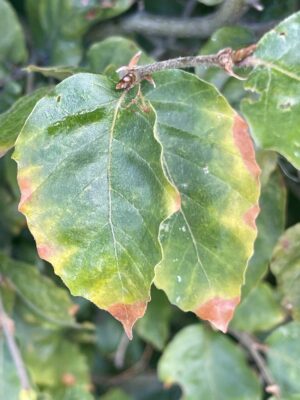
Generally speaking, leaves are quite small, but collectively they present a massive surface area to the environment.  The total surface of leaves is significantly greater than the surface area of the Earth.  Leaves are the organs of photosynthesis, not only do they make the basic chemicals for the plant, but they replenish the oxygen in the atmosphere. Generally speaking, a leaf has two surfaces.  One surface (the adaxial) is presented to the sun, the other (the abaxial surface) is shielded from the light to some extent.  Both surfaces are covered with a waxy layer (the cuticle), which helps restrict water loss. The underside of the leaf has many tiny pores, the stomates, which can open and close to allow the exchange of gases and water vapour.  The lower surface may be covered in minute 'hairs'.  These create an unstirred layer, so that air next to leaf has a high water content and thus water loss through the stomates is reduced.  The veins of a leaf contain xylem tissue which delivers water and mineral salts, and phloem which transports sugars and other organic compounds from the leaf. [caption id="attachment_43706" align="alignleft" width="300"] adaxial surface[/caption] [caption id="attachment_43705" align="alignright" width="300"] abaxial surface[/caption]   The upper  surface and lower surface  of a foxglove leaf.  Whilst the veins can be seen on the top surface, they are ridged and covered in hairs on the lower surface. [caption id="attachment_13486" align="alignleft" width="240"] galls on sycamore[/caption]   Once a leaf has grown then its size, shape and the veins remain constant, but during the course of the year other things can and will change.  For example, in autumn the coloured pigments in the leaf break down and many compounds are transported out of the leaf as it undergoes senescence. The leaf may be subjected to attack, caterpillars and leaf miners may eat its tissues.  Certain wasps may lay eggs within the leaf so that a gall develops.  Greenfly use their piercing mouthparts to access sugars and other compounds from the phloem.  Bacteria may infect the leaf either through wounds inflicted on the leaf, or by penetrating the stomates. To some micro-organisms, a leaf is ‘home’; it is a habitat.  Rather like it is now common to talk about our gut microbiome or  the microbiome of the skin, so each leaf has a microbiome. Recently, microbiologists from China and Germany have studied the microbiome of oak leaves.  Specifically, they examined the microbiome of the leaves of the pedunculate oak.  They examined how the organisms present changed during the course of a growing season.  They found that the upper and lower sides of the leaves had different communities of micro-organisms.  Both surfaces  shared the same sorts of bacteria, but they varied in the amounts / proportions of the bacteria on the two surfaces.  Furthermore the differences between the upper and lower surfaces changed as the seasons changed.  The diversity of organisms on the lower surface of the leaf fell as the year progressed.  Some of the bacterial DNA on the lower surface was that of bacteria which could be found on / in aphids and whitefly.  Some of the bacteria found were associated with fermentation of sugars.   The study did not investigate fungal species on the leaves, but it does indicate that there are complex microbial communities present on leaves, and that the two surfaces offer different ‘opportunities’ for micro-organisms.  Similarly, it has been established that there is a root microbiome. The root microbiome is a complex community of bacteria, fungi, archaea, and viruses living in and around plant roots. This microbiome helps the plant take in nutrients, fight diseases, and cope with environmental stress. [caption id="attachment_43724" align="alignright" width="350"] Hornbeam - abaxial surface[/caption]   [caption id="attachment_43723" align="alignleft" width="350"] Hornbeam - adaxial surface[/caption]
The times they are achanging

The times they are achanging

by The blog at woodlands.co.uk, 1 September, 2025, 4 comments

This morning,  the Today programme (Radio 4) featured an interview with Kevin Martin ( Head of Tree Collections at Kew) and Chris Packham (environmental compaigner).  They were explaining the ongoing effects of this summer’s hot and dry weather.  Mr Martin said that the trees at Kew were “ tired, they have had a stressful summer”.  The result is that many trees are entering their dormant stage, moving materials from aerial regions to the roots - much earlier than usual.  The colour changes in leaves and leaf drop do not usually occur until well into October but this year such changes are already  proceeding apace.  Kew has been able to put some mitigations in place, for example, the watering of young trees which have yet to establish extensive roots systems. This is not true for trees across the UK, where young saplings in particular may have been affected by the dry weather and successive heat waves, [plus increased browsing by the extensive deer population]. Chris Packham spoke of “climate breakdown” and “environmental chaos”, noting that an oak tree near him was ‘festooned with acorns’, but they were only the size of peas.  Normally acorns would fall later in the year as food for wood pigeons,jays, squirrels and badgers.  Jays help ‘plant’ oak trees by distributing acorns.  He said that whilst local hawthorns were red with berries, which would normally be food for winter thrushes later in the year, the berries would now be dried up / shrivelled when the birds arrived to search for them.  Though lots of hedgerow fruit [e.g. sloes, rose hips, blackberries] is being produced, it is being produced at the wrong time.  He also commented on the scarcity of mole hills as moles are forced to burrow deeper in the soil in search of earthworms etc. As the seasons change, some plants and animals adapt. For example,  blackcaps from Northern Germany fly to the UK rather than Spain to overwinter.  During a relatively short period, their wing length has changed, actually shortened - a case of evolution in action.  However, many species are struggling.   The  wet summer of 2024 was particularly difficult for butterflies, as evidenced by the data collected by the Big Butterfly Count. Nature's timings are now ‘out of sync’, plants and animals are further impacted by extreme weather events, flooding, high winds and extreme temperatures. [caption id="attachment_24651" align="aligncenter" width="600"] Sloes on Blackthorn.[/caption] https://www.metoffice.gov.uk/about-us/news-and-media/media-centre/weather-and-climate-news/2025/double-record-breaker-spring-2025-is-warmest-and-sunniest-on-uk-record  
Too hot, too dry - continued

Too hot, too dry – continued

by The blog at woodlands.co.uk, 21 August, 2022, 0 comments

Looking around the garden this morning one might be forgiven for thinking that autumn is already here.  Several trees seem to think the short days of autumn have arrived and are preparing to shed their leaves. Certainly the walnut and hazel are of this opinion.  However, other signs indicate that this is not the case, my twenty year old cedar has died, as have several Cryptomerias and other conifers - this despite assiduous trips with the water can.  In fact, the plants are responding to this summer’s weather, a long period without rain (or very little) plus the very hot weather that we have experienced; particularly in the South and South East.  The plants are not reacting to any changes in day length but to drought. Plants detect changes in the photoperiod they experience through their phytochrome system; under normal circumstances their biological clock will tell them when to prepare for winter.   Whilst many well established trees and plants with extensive root systems can withstand a period of drought, younger plants or those in poor or freely draining soil are likely to die.  Such plants simply cannot take up enough water to replace that lost through transpiration; that is, water evaporation through the stomates (pores) in the leaves.    The intensity of the heat this year coupled with the reduced rainfall has affected many plants and trees and it may be some time before we see the full effect of this summer’s weather.  Beech trees suffer more during periods of droughts because they have shallower roots, while oaks reach moisture deeper in the soil and continue to grow.  In the drought of 1976, many beech trees died and survivors often exhibited reduced growth some 40 years on*. Some plants respond to drought stress by bringing forward their reproductive process, so that fruits and seeds are produced early.  This is an attempt to ensure the survival of the species for when conditions are more favourable to growth.  The Woodland Trust, noted for its phenology records, recorded ripe blackberries in late July (lots of reports on its page on Facebook).  Hawthorn, Rowan, Holly and Elder have all been recorded as fruiting earlier this year.  This was true of the filbert in my garden this summer.  This earlier production of fruits and seeds may have ‘knock on’ effects on the wildlife that feed upon them.   Whilst the effects of the extreme weather are obvious in our parks, gardens etc, the effects on rivers and streams are dramatic.   Chalk streams, in particular, have been affected; they are unique habitats.  The River Ver is a chalk stream in Hertfordshire.  The summer has seen large sections of its upper reaches reduced by several kilometres due to the hot weather (and water abstraction).  The effects in and around such streams may be felt for many years as the water levels fall so the habitats for fish, amphibians and invertebrates (such as dragonflies / mayflies) are reduced or lost.  Recolonisation of such drought impacted systems can be slow and prolonged.   An accessible and detailed paper on Beech trees and drought is available here : research gate.net [caption id="attachment_22186" align="alignright" width="300"] Mature Beech on Box Hill, Surrey.[/caption] [caption id="attachment_10575" align="alignleft" width="300"] Mature beech[/caption]
Home to roost  : an owl box.

Home to roost : an owl box.

by Liz, 2 March, 2022, 1 comments

In late winter, it’s good to put up new nest boxes and clear out existing ones, in time for the breeding season.  In Ellekers Wood, as part of our management plan, we've been making lots of new boxes for birds and bats. Bats are currently having problems finding food to eat, plus many of their natural roosting places have disappeared. Building a bat box offers them :- somewhere safe to roost,   a place to raise their pups and  Sleeping quarters during the day.  Our biggest boxes are the two tawny owl ‘chimney boxes’.  Tawny (or brown) owls (Strix aluco) ‘own’ the classic owl hoot. They will nest in large gardens with trees, but woodlands are good for them. Their diet ranges from worms to rabbits.  Tawny owls like a north east facing entrance,  with a clear route.  Our boxes are made from 1" thick, rough sawn larch planks. We followed the RSPB design. Each box is approximately 800mm long (measurements / specifications available here).  Fortunately,  Dan has a head for heights and he has installed the boxes in mature oak trees at a height of approximately 6 metres.  The tawny owl typically makes its nest in a tree hole where it can protect its eggs and young against potential predators. They will occupy / nest in smaller cavities than barn owls and the design of the box reflects this. As tawny owl chicks start to explore their surroundings before fledging, it is important that the boxes are placed with easy access to nearby branches, so that they can climb over.  As with many species of birds, tawny owls are sensitive to disturbance when incubating their eggs, and should not be approached as they can be aggressive.  It is important that consideration is given to the siting of any box [embed]http://youtu.be/RfXIHXCyTNk[/embed]   Full details of RSPB nest boxes for various birds can be found here : https://www.rspb.org.uk/birds-and-wildlife/advice/how-you-can-help-birds/nestboxes/nestboxes-for-owls-and-kestrels/  
veteran tree

Veteran trees and veteranisation.

by The blog at woodlands.co.uk, 12 February, 2022, 0 comments

A thousand years ago, significant areas of the country were devoted to wood pasture, that was grazed by livestock.  As time passed, much of this became royal hunting forest - a mixture of woodland, coppice, open land and farms.  As the woodlands were managed (through traditional techniques such as coppicing and pollarding), many of the trees were able to grow to maturity.  They became veteran trees.  Trees such as beech reach maturity after some 200 years, oaks take 400 years and yew 900+.   Such veteran trees can be seen in areas like the Savernake (south of Marlborough) and Sherwood Forests. Saverrnake has veterans like the Big Belly Oak, and Sherwood has the Major Oak.  Sadly, since the nineteenth century many veteran trees and ancient woodlands have been lost due to the expansion of agriculture, housing development and road & rail creation.  Veterans have also been lost from hedgerows, many of which were grubbed out to enlarge fields to allow for increasing mechanisation. As oaks and beeches age so they change, they expand, trunks hollow, cracks and holes appear, heart rot develops and dead wood appears.  Each tree offers a myriad of micro-habitats.  Bracket fungi feed on the dead heart wood, as do stag beetle larvae.   Mosses and lichens live on the bark, attached to crevices that channel the rain down the trunk, bats, woodpeckers and nuthatches inhabit holes. Other birds (like redstarts) nest in the branches and twigs.  The decaying leaf litter beneath the tree offers sustenance to a variety of beetles, and fungi (e.g. oakbug milkcap).  English oaks are associated with more than two thousand species, and more than two hundred are directly dependent on the trees. The loss of so many veteran trees has resulted in an international project to determine if these trees can be ‘replaced’.  It involves a technique termed veteranisation. Younger trees are damaged in order to start the process of decay and ‘ageing’.  The process may include Creating woodpecker-like holes Creating nest boxes for birds / bats Breaking branches Damaging the bark / trunk - to simulate deer / animal damage Inoculation with fungi It is being trialed at some 20 different sites in Norway, Sweden and England.  The project started in 2012 and will run for some 25 years.  It is hoped that such ‘techniques’ could be used to accelerate the formation of veteran trees status with its associated biodiversity. Thanks to Angus for tree jpgs. For further information : https://naturebftb.co.uk/wp-content/uploads/2021/09/Introduction-to-Ancients-of-the-Future-Jamie-Robins.pdf https://www.gov.uk/countryside-stewardship-grants/creation-of-dead-wood-habitat-on-trees-te13 https://www.woodlandtrust.org.uk/media/1798/wood-wise-ancient-trees.pdf  (opens PDF)

Next Page »