Woodlands.co.uk

Blog - owls

My Experience of Using Mulch Mats,  around Young Trees

My Experience of Using Mulch Mats, around Young Trees

by Charlotte, 14 May, 2025, 2 comments

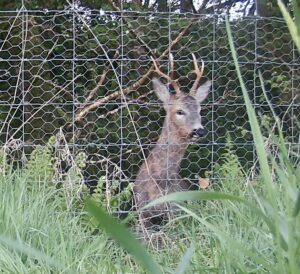
My husband and I bought Lighthouse Meadow in 2022 from woodlands.co.uk.   I’d always wanted to plant my own woodland and see the wildlife changes as the land evolved from grazed grassland to biodiverse woodland.  Our preference was to avoid using plastic tree guards due to the environmental waste. The site is also windy so we wanted to encourage wind-induced root development to have stronger, more wind resistant trees: tree guards can limit strong root development, resulting in weak, top-heavy trees which are more prone to damage in strong winds. The protect the young trees from predation by deer and rabbits, we installed a deer fence with rabbit mesh. Featured image is a male fallow deer peering through our fence wishing he could eat one of my hazel saplings.  We used mulch mats around the base of each young tree, held down with five bamboo pegs. Over two years we have planted 3000 trees using this method. I won’t lie, it is hard work! We used mulch mats made from jute, a 100% biodegradable natural fibre. Their purpose is to suppress the growth of grass around the young tree. They are permeable, allowing air, nutrients and water to pass through them which also helps in reducing moisture loss. In the above photo, Tim has secured a mulch mat around a hazel sapling using a bamboo peg at each corner and a fifth peg to fix the flap of the mulch mat in place. NB : we found that a rubber mallet was kinder on knuckles than a metal one! We are now 18 months on from planting our first trees so I’ve had a chance to assess how well the mulch mats have performed. Last year (2024) had a wet summer and the grass grew very tall. We found that many of the mulch mats had started to biodegrade around the one year point. Our field is steeply sloping which meant that tall grass at the top end of the mulch mats tended to flop over, swamping the shorter saplings like wild plum and oak. So we needed to do quite a bit of maintenance, uncovering some of the trees and trimming the grass. The mulch mats had worked very effectively to suppress the grass immediately around the sapling. The  photo below shows a hornbeam sapling we planted 18 months ago. I’ve pulled back the grass which had flopped over. Although the mulch mat has completely biodegraded, you can still clearly see the square shape where it once was and the grass growth immediately around the sapling continues to be suppressed. The tree is healthy and now tall enough to be above the grass. We planted our second lot of trees in November 2024. However, we have had to reaffix and replace some of the mulch mats we used then because they were damaged during Storm Darragh. We found that the extra strong storm winds were able to rip up some of the mulch mats, despite being pegged down with five bamboo pegs. However, we weren’t the only ones needing to do some maintenance following the storm. Our neighbour has been planting trees using tall plastic tree guards and stakes. His trees also suffered during the storm and he had to re-stake and re-affix many tree guards. So although we found ourselves doing a fair bit of extra work to reattach the mulch mats, other tree protection methods had also suffered and required maintenance. The above photo of a young oak we planted Autumn 2024 shows how the strong Storm Darragh winds have torn up the mulch mat. So, would I use mulch mats again in future? Yes, because after 18 months I can see that the impact of using mulch mats is still benefitting the trees, despite the mulch mat having degraded. However, we have learnt a lot in the last year and we’ve bought a petrol mower (with a ‘drive’ function) and have regularly mowed strips across the field trimming the grass along the top end of the mulch mats to reduce the risk of tall grass flopping over the saplings. We have also learnt that our field has a very substantial population of field voles and the mulch mats don’t protect the saplings from voles gnawing the bark. We have lost around 5% of the trees to vole damage. Tree guards also wouldn’t protect a sapling as the voles can still easily get up inside the tree guards. We are therefore adopting a nature-based solution and will be erecting tall perches for birds of prey. We wish to encourage tawny and barn owls, buzzards and other raptors to the field to feed on the voles. For more information on our use of mulch mats, we made a film for WoodlandsTV, Plastic Free Tree Planting. We are also going to follow the recent WoodlandsTV film by Jack D’Gama and George Hassall on Birds of Prey Perches: one way to reduce rodent damage to young trees as inspiration for our owl and buzzard perches to manage the vole population.
Blackbirds, climate change and disease.

Blackbirds, climate change and disease.

by The blog at woodlands.co.uk, 9 April, 2025, 0 comments

Climate change is introducing disease to new areas as it favours the spread of disease vectors, such as mosquitoes.  Usutu is a virus disease that originated in South Africa, it is spread by mosquitos and affects birds, particularly blackbirds and owls.  Whilst birds are the primary hosts to the virus, it can infect ‘incidental hosts’ such as bats and humans, through insect bites. The virus has been found in a number of mosquito species in Africa and Europe.  In the U.K,  and Europe the main vector is Culex pipiens - the common house mosquito or northern house mosquito.  The virus has probably spread through the movement of migratory birds between Africa and Europe, and is now present in many European countries. The virus was first detected in the London area in summer 2020 and was associated with a decline in Blackbird numbers. Blackbird numbers have declined by approximately 40% since 2018. The virus was then detected in Cambridgeshire in 2023.  It seems that most Usutu infections in humans do not cause disease and so the risk to human health is considered ‘low’.  There is no evidence to date that the consuming poultry poses a risk to our health.  However, the detection of Usutu in the UK marks the first time that a mosquito-borne virus capable of passing  from animal hosts to humans has emerged in this country.  Its speed and spread are being monitored as it may model how other mosquito borne disease arrive here. A virus that may be a particular cause for concern is the West Nile virus.  This virus spreads in a similar way to Usutu and needs similar climatic conditions.  West Nile virus, also transmitted through mosquito bite, can cause fever, vomiting and diarrhoea.  At present, there is no vaccine available.  West Nile virus was detected in the Netherlands in 2020, and there is concern that the changing climate could facilitate its spread in Europe.
Home to roost  : an owl box.

Home to roost : an owl box.

by Liz, 2 March, 2022, 1 comments

In late winter, it’s good to put up new nest boxes and clear out existing ones, in time for the breeding season.  In Ellekers Wood, as part of our management plan, we've been making lots of new boxes for birds and bats. Bats are currently having problems finding food to eat, plus many of their natural roosting places have disappeared. Building a bat box offers them :- somewhere safe to roost,   a place to raise their pups and  Sleeping quarters during the day.  Our biggest boxes are the two tawny owl ‘chimney boxes’.  Tawny (or brown) owls (Strix aluco) ‘own’ the classic owl hoot. They will nest in large gardens with trees, but woodlands are good for them. Their diet ranges from worms to rabbits.  Tawny owls like a north east facing entrance,  with a clear route.  Our boxes are made from 1" thick, rough sawn larch planks. We followed the RSPB design. Each box is approximately 800mm long (measurements / specifications available here).  Fortunately,  Dan has a head for heights and he has installed the boxes in mature oak trees at a height of approximately 6 metres.  The tawny owl typically makes its nest in a tree hole where it can protect its eggs and young against potential predators. They will occupy / nest in smaller cavities than barn owls and the design of the box reflects this. As tawny owl chicks start to explore their surroundings before fledging, it is important that the boxes are placed with easy access to nearby branches, so that they can climb over.  As with many species of birds, tawny owls are sensitive to disturbance when incubating their eggs, and should not be approached as they can be aggressive.  It is important that consideration is given to the siting of any box [embed]http://youtu.be/RfXIHXCyTNk[/embed]   Full details of RSPB nest boxes for various birds can be found here : https://www.rspb.org.uk/birds-and-wildlife/advice/how-you-can-help-birds/nestboxes/nestboxes-for-owls-and-kestrels/  
At last,  my own wood.

At last, my own wood.

by The blog at woodlands.co.uk, 23 January, 2022, 5 comments

So!  My story begins many, many years ago when I had a dream to own my very own woodland.  Of course I didn’t believe it would ever come true, however, a dream’s a dream and one day I decided to go for it.  I sold my house and downsized in a big way so that I had funds to realise my dream.  Then the search began, three years of searching. Everything I found was too far away, too expensive, too big, too small……!! Then, I fell on one for sale with Woodlands.co.uk, just five minutes from home and 6½ acres – perfect! I will never forget the day of completion.  I was soo excited and couldn’t wait to get the key to my gate so I could officially walk through my very own woodland.  As I struggled through the bracken and brambles, which in themselves were a delight…. Little birds popping out, discovering little plants, blackberries, raspberries, self-set holly bushes, oak trees… It was just wonderful.  The majestic Silver Birch trees towering over me giving sneak previews of the sky above.  The smell was just amazing…. Was it my imagination or was the air so pure with subtle scents of the tree and plant species. I was truly in my element. My intention was to spend as much time there as possible so setting up camp was a priority, along with a pathway so as not to disturb any wildlife/budding growths when clambering through the dense overgrowth. I cleared an area for the ‘camp’ which was soon to consist of a fire pit, stumps from the larger fallen trees for seats, a frame from cut off trees to throw a sheet of tarpaulin over - should the rain come. This little secret area became a huge part of the early days at the woodland. There’s nothing quite like boiling a kettle on an open fire, cooking lunch using the branches collected.  The smell, the warmth not to mention the smoke to keep the unwelcome little bug visitors away!!! Imagine my excitement when 7 deer came strolling past for the first time which gave me the idea to have an area to encourage them to visit so that we could hopefully see them regularly. Over the next few months, pathways were developed so that all areas of the woodland could be accessed with various areas of interest including a sensory garden, allotment, orchard, natural pond, various picnic areas, deer watch area, an ‘observatory’ to shelter us in the evening / night where we hide out and watched the night wildlife (deer, rabbits, owls), and our very own 'Hartley Hare' !!!).  On clear nights, watching the stars through the telescope is just amazing… there’s no light pollution so the sights are just amazing. Then there’s the memorial garden, inspired by my sister who I lost to Covid in March 2020. And, who could have a woodland without a bit of Winnie the Pooh – a tribute to Hundred Acre Wood!!! I have put bird boxes up to encourage varieties including Tree Creeper, Blue tits, Great Tits, Sparrows,, Nuthatches, Owls and baskets for Sparrow hawks, Hobbits and Buzzards. The original disappointment as squirrels moved into the Barn Owl box and Pigeons into the Tawny Owl box soon became delight as the babies arrived. It was so lovely watching the busy parents rearing their young. Then, the following season, guess what….. yes!!…. A Barn owl nested!! Friends and family just love to visit the woodland to enjoy the magical relaxing atmosphere; to explore the pathways leading to the various little nooks and crannies to search for plants, insects and just to sit quietly, listening to the birds and the rustle of the leaves. To anyone who has never thought of owning a woodland before, just imaging the freedom, the space, the never ending discoveries of plant life, tree life, wildlife and with imagination, you can make more than one dream come true.  To anyone who is thinking of owning a woodland…. Do it!  You will have nothing but pleasure and peace, and experience an immediate shift in your mental wellbeing and, if like me you have physical disabilities, the change of pace, the air, the green will have a positive impact on your aches and pains!!!           Thanks to Lesley for the above enthusiastic account of her woodland adventure.
Next Page »
