Woodlands.co.uk

Blog - pesticides

Moths - secret pollinators?

Moths – secret pollinators?

by The blog at woodlands.co.uk, 24 November, 2025, 0 comments

Honeybees, bumblebees and butterflies are always cited as being important for flower pollination. Indeed, without them many of our food crops would ‘fail’.  But what about moths?  Well, recent research has found that they too are efficient pollinators.  A recent study compared the role of nocturnal and day time pollinators.  Much scientific research has focused on daytime pollinators, like honey bees and bumblebees, but little is known about the night time pollinators.  So a study was devised, which focused on the day and night visitors to bramble flowers. Bramble may be a bit prickly to us but for bees and other insects it is important source of nectar and pollen, from early spring through to autumn.  The study was carried out out in the summer moths (when night is only one third of the daily cycle).  Trail cameras were used to record visitors to the bramble flowers over three days, also special bags were used to cover the flowers for different times in order to determine the effectiveness of the different pollinators on pollination and fruit formation.  One group of the bramble flowers was covered up for the three days.  A second group was bagged up for the day time.   The final set was covered only at night.  The number of pollinator visits was recorded as was the resulting pollination and fruit formation.   At night, moths were the only insect visitors of the pale pink / white flowers of the bramble, and they also proved to be very effective pollinators. It is not clear why moths were more effective, perhaps the time they spend visiting a flower is a critical factor.  They do spend more time rummaging in a flower than day time insects [hoverflies, butterflies, bees etc].     There are only some sixty species of butterfly in the UK but over two thousand species of moth.  But like butterflies, moths are vulnerable with many of our larger moths in decline.  The challenges that they face as the same as those that threaten many insects namely: Pesticides Habitat loss Climate change But moths face an additional challenge - artificial light at night. This interferes with the feeding behaviour of their larvae / caterpillars, it also affects the feeding and breeding of the adults.   Thus, moths are not only important pollinators but a vital component to the biodiversity of an ecosystem.  They also are a food source bats and birds. Moths can be helped by: By allowing a patch of brambles and / or wild flowers in your garden Persuading the council to allow wild flowers to grow and flourish on roadside verges, ‘spare’ plots of land etc. Asking the local council to reduce night time lighting where it safe to do so.   At home, limiting the use of outdoor lights at night, draw curtains and blinds to limit light spill to the exterior. As insects are in decline generally, (see the  woodlands.co.uk splatometer blog) it is important to help our pollinators - ensuring that they still ‘have a home’ at the end of the day.  
A problem with pollinators?

A problem with pollinators?

by The blog at woodlands.co.uk, 20 June, 2025, 0 comments

Bee:wild [https://beewild.rewild.org] is a new science-led, global campaign, which aims to help and save pollinators - particularly bees.  The woodlands blog has reported on the decline in many insect populations in recent times - referring to the ‘insect apocalypse’, the ‘windscreen test’,  and the ‘splatometer’. The causes for insect loss are many but critically important are : Habitat loss and fragmentation The extensive use of pesticides, herbicides & fungicides. These may be coupled with other issues such as climate change, and pollution from fertilisers into rivers and streams.  However, in recent times, we may now need “to add to the mix” - Wars and conflict.  These can result in changing patterns of agriculture so that the range of crops grown is reduced, which means there are less foraging opportunities for pollinators. The ubiquity of plastics. Specifically microplastics and nano plastics.  Microplastics come in part from larger plastic pieces that degrade into smaller pieces, but also from microbeads.  Microbeads are very small pieces of polyethylene plastic that are added to health and beauty products, such as certain skin cleansers and toothpastes. Now microplastics are to be found everywhere from the deep oceans, to Arctic snow and Antarctic ice. They are also found in the hives of honey bees.  Quite what their effect is on bees or indeed many other organisms (including us) is not yet clear. Artificial light.  Much of our world is illlluminated 24/7.  Towns and cities rarely experience total darkness, even the countryside is lit up by the lighting on roads and motorways.  This artificial light is not without effect.  Areas ‘bathed’ in light may Deter nocturnal moths from visiting flowers, reducing pollination and egg laying. Make the night flying moths ‘easier targets’ for predators (such as bats). Affect the feeding habits of moth caterpillars. Air and water pollution.  Both air and water are increasingly filled with a ‘cocktail’ of chemicals, some derived from the extensive use of pesticides (insecticides, herbicides, fungicides, some come from use of fertilisers).  Particulates released from car tyres and brake pads contribute to the ‘chemical smorgasbord’.  Whilst the effect of any given chemical may be sub-lethal, small, or non existent the combined effect of the mixture may be significant, even deadly.   Wild fires.  Add into this anthropogenic concoction mentioned above, the chemicals released from wild fires - such as those seen recently in Canada, Siberia, Australia and the United States.  These fires not only release a complex mixture of particulates and chemicals, they also destroy habitats for pollinators.  The sheer scale of these fires makes the recovery of ecosystems that much harder. Bee:wild [https://beewild.rewild.org] suggests a number of measures to help pollinators : A swifter move to electric cars to reduce levels of atmospheric pollution Production of crops with enhanced nectar and pollen production to benefit pollinators Creation of more flower-rich areas, for example, within solar farms Use of RNAi therapy to specifically target pests and not beneficial insects.  RNA interference is a technique that uses natural cellular processes to silence or reduce the expression of particular genes in a particular organism.  Thus, it might render a pest sterile. Introduction of measures to reduce the use of ‘our’ chemicals, used to enhance the growth of crop or animals. Such measures when coupled with the creation of urban rich flower gardens, rewilding and the protection of remaining areas of natural habitats will help pollinators, and insects in general.
Bees, agrochemicals and the microbiome

Bees, agrochemicals and the microbiome

by The blog at woodlands.co.uk, 23 October, 2023, 0 comments

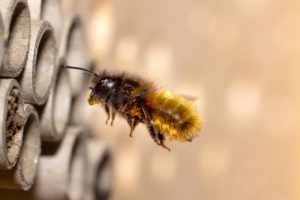
Mason bees and agrochemicals The blog has reported many times on the threats to bees - money bees, bumblebees and ‘wild bees, such as mason bees / solitary bees.  The threat to bees from neonicotinoids has been well documented, now there is a report that suggests that certain other agrochemicals may be harmful to bees. Researchers at the Julius Maximilians University at Würburg have been investigation the effect of a fungicide (Fenbuconazole) on the reproductive behaviour of horned mason bees (Osmia cornuta).  A number of Osmia species are used to improve pollination in fruit and nut crops.    They are efficient pollinators having a special pollen collecting / carrying structure called a scopa.  Mason bees are solitary bees.  Each female is fertile and makes her own nest and no worker bees for these species exist. In the Spring, male and female bees emerge from a nest.  The males generally exit first and remain near the nest, ready to mate with the females.  A female bee selects a mate on their ‘smell’ / odour and the ‘quality’ of their thoracic vibrations (achieved through muscle contractions).  After mating the males soon die.  The females search for and select a nest site, visiting flowers to collect pollen and nectar for their nests.  Once a certain amount of food has been collected within the nest, the females lay their eggs on top of this material (in a series of cells) and then seal off the nest.  The eggs hatch to form larvae which feed upon the food and within weeks forms a cocoon, in which it continues to develop to an adult. Though the fungicide (Fenbuconazole) is considered to be of low toxicity and the bees were exposed to a sub-lethal dose, nevertheless the Fenbuconazole had significant effects on the bees.  Pesticide exposed males were more likely to rejected by the females, compared to ‘control’ bees that were not exposed to the fungicide.  The thoracic vibrations of the exposed males were less powerful / noticeable and the composition of their odour or smell was different. The smell of the bees is dependent on particular hydrocarbon compounds in their cuticle  - their exoskeleton.  It is possible, therefore, that the mating behaviour and reproductive success of these bees is being affected by agrochemicals. Carpenter bees. The microbiome refers to the collection of micro-organisms that lives on or in us, particularly within within the gut. Whilst these micro-organisms are small, they contribute to our health and ‘well being’. They offer protection against pathogens, help our immune system develop, and enable us to digest.  Just as we have a microbiome so do bees.  Scientists as York University (Canada) have been investigating the microbiome of three species of carpenter bees (from North America, Asia and Australia). The term "carpenter bee" comes from their nesting behaviour,  most species burrow into plant material such as dead wood or stems, though a few create tunnels in soil.   Social bees (like honeybees and bumblebees) acquire their microbiome by interacting with their hive or nest ‘mates’. Solitary bees, like the carpenter bees, get their microbiome from the environment as they forage for food.   The researchers found that: The bees’ microbiome contained Lactobacilli, which are important for good gut health, helping protect against fungal pathogens and facilitating nutrient uptake. They also discovered crop pathogens in the microbiomes of the carpenter bees which were previously only found in honeybees. Whilst these pathogens are not necessarily harmful, it is possible that the wild bees could be vectors for spreading disease.  With thanks to Pixabay  (Umsiedlungen and Sabinem34) for the above images of bees Finding flowers. Research at the University of Exeter has shown that bees can distinguish between various flowers through a combination of colour and pattern.  This selectivity is achieved despite the ‘acuity’ of a bee’s vision being quite low (about a 100 times lower than ours) - this means they can only see the pattern of a flower when they are quite close (a matter of centimetres).  The researchers analysed a significant amount of data on plants and visiting bee behaviour, and they used experiments involving artificial shapes and colours.  One particular finding was the importance of the contrast between the outside of the flower and the plant’s foliage.  This seemed to help beesfind their way to the flowers quickly .    
Professor Goulson on allotments, gardens and bees.

Professor Goulson on allotments, gardens and bees.

by Angus, 21 June, 2023, 3 comments

I recently attended the National Allotment Society AGM, where the keynote speaker was Professor David Goulson.  His main academic studies focus on the threats to bees, bumblebees and other insects. He is based at Sussex University.  Back in 2006, he founded the Bumblebee Conservation Trust; a charity which has grown to some 12,000 members.  In his talk at the meeting, he made the following points : He loves allotments because they capture carbon and are rich in biodiversity.  They produce a lot of food.  Typically producing some 10 tonnes / hectare whereas farming productivity is about 3 tonnes per hectare.  The record on a 1m2 in an allotment is 10 kg, which is the equivalent of 100 tonnes / hectare.  Allotments not only produce good food for healthy eating, but people get good exercise through their gardening activities.  A study shows the ‘over-60s’ with allotments have longer life expectancies [controlling for other variables]. [caption id="attachment_40124" align="aligncenter" width="675"] A bee at risk of extinction.[/caption] There are over 300,000 allotment plots in the UK and some 90,000 people on waiting lists.  More allotments could help counter poor health and cut NHS costs. We should turn our cities, towns and villages into a network of nature reserves - essentially a form of urban rewilding. Gardens are a vital part of this, as there are some 400,000 hectares of them in Britain.   Prof Goulson is really keen on less mowing, more ponds and no pesticides. Interestingly, France banned pesticide use in public and urban areas, such as parks, back in 2014 - it is an example that we should follow. Even pet flea treatment is damaging to insect life.  The strength of the doses used means that the chemicals can pass into the environment - to grass, rivers, canals and pools.  Sadly, now 8% of gardens have some plastic lawns, and plastic hedges (and Wisteria !).  Plastic makes him despair.Plant diversity in pavements should be celebrated. Wild flowers / weeds are sources of pollen & nectar for pollinators.  Verges should be nature reserves.  A Scottish "On the Verge" group stopped councils mowing 8x a year and planted a seed mix to transform verges in their area.  Councils should mow less.  Some people may object, so people should strengthen their Council’s hands by writing to them and praising them for no-mow-May-type efforts.  The Buzz Club - has been set up, this is a citizen science project to see what works best for insects. There are lots of short films on his youtube channel . Bees and other pollinators need help.  He suggested lots of ways to help them, for example,  drilling holes in logs for bug hotels.  You can follow Prof Goulson on Twitter or Facebook. [caption id="attachment_40132" align="aligncenter" width="675"] Bumblebees 'enjoing' a small clump of poppies[/caption] [caption id="attachment_40129" align="aligncenter" width="428"] urban herbicide use[/caption]  
Problems for bees and bumblebees.

Problems for bees and bumblebees.

by The blog at woodlands.co.uk, 18 November, 2022, 3 comments

The decline in many insect populations across the globe is worrying, threatening economies and ecosystems.  A German study in 2017 indicated that the mass of flying insects (in various natural areas) had fallen by some 70%+.  The decline in insect populations has been associated with habitat fragmentation, the spread of agriculture and the use of pesticides, with the neonicotinoids being particularly associated with damage to bee and bumblebee populations. Recent work at the University of Konstanz suggests that when bumblebee colonies are exposed to limited resources of nectar and exposure to the herbicide - glyphosate,  then their colonies may fail.  Bumblebee colonies need a good supply of nectar as a ‘fuel’ in order to maintain a constant brood temperature (of approximately 32oC).  Only at this sort of temperature does the eggs & larvae develop quickly from egg to adult, and the colony grow from a single queen to several hundred bees.  If the temperature is not maintained, then the brood develops slowly or not at all.  The loss of wild flowers (and their nectar) plus the use of the herbicide (in agricultural areas) looks to be a problem for the bumblebees. Just as bumblebees are facing problems, so are honey bees.  The bees have faced infections with a variety of viruses, such as the deformed wing virus.  This virus affects wing development so that the wings are 'stubby' and useless, plus they may be deformities of the abdomen and leg paralysis;  the insect cannot function and dies.  The virus is transmitted by the Varroa mite - a parasite (that also feeds on the bees’ tissues).  The virus was originally identified in Japan in 1980’s and is referred to as DWV-A.  However, a new form of the virus (DWV-B) was identified in the Netherlands in 2001 and it is spreading across Europe, and to other continents.  Sadly, this variant of the virus kills bees faster and is more easily transmitted (according to research at the Martin Luther University).
Pollinator preferences

Pollinator preferences

by The blog at woodlands.co.uk, 4 April, 2022, 0 comments

It would seem that pollinators have ‘favourite plants’.  Research centred on the National Botanic Garden of Wales has looked in some detail at the foraging habits of bees, bumblebees, hover flies and solitary bees - our most important pollinators. Dr Abigail Lowe identified the plants that the insects were visiting by analysing the DNA from pollen grains on their bodies (a process known as DNA barcoding). It is clear that the ‘preferences’ of the insects change with the seasons and indeed the availability of particular flowers.  In Spring, nearly all the pollinators frequent buttercups, lesser celandines and dandelions (all brightly coloured yellow flowers).  Come the summer, honey bees and bumblebees tend to favour thistles, knapweeds and brambles, whilst hover flies may be seen on hogweeds and angelica plus thistles and knapweeds.  In autumn, the bumblebees can be see visiting asters (Daisy family flowers) and brambles. Full details of her work can be found here : https://botanicgarden.wales/press/plants-for-pollinators-new-dna-research-reveals-fascinating-insights-into-the-plants-used-by-bees-and-hoverflies/ There are also suggestions on how to help pollinators in your garden, such as encourage buttercups and dandelions by reducing mowing (in the Spring) plant late flowering daisy type flowers encourage some bramble (you might get some blackberries, in return) reduce the use of chemicals (especially pesticides and herbicides) hoverflies can be encouraged by damp, wet areas and rotting wood and these suggestions would also work in a woodland.   [caption id="attachment_38320" align="aligncenter" width="700"] Marmalade hover fly[/caption]
Pollinator problems

Pollinator problems

by The blog at woodlands.co.uk, 27 October, 2021, 0 comments

In a previous woodlands.co.uk blog, Professor  Dave Goulson (University of Sussex) has written about the problems that bees and bumblebees face.  Recently, he joined with Clipper teas (who produce organic tea products) to again emphasise the problems that bees and other pollinators face, and to explain how our lives would be affected if they were to be lost.  Bee, bumblebee and other pollinator populations are at risk or in decline.  Professor Goulson estimates that there are some 6,000 different species of pollinating insects in the U.K alone, but they face risks as a result of Habitat loss Pollution Climate change Use of pesticides (insecticides, herbicides, fungicides) [caption id="attachment_36158" align="aligncenter" width="650"] Hoverfly foraging[/caption] Whilst it is true that insecticides such as neonicotinoids are directly toxic to bees and bumblebees, many other compounds used as herbicides and fungicides are also harmful to these insects.  Obviously herbicides get rid of weeds, but weeds or wild flowers are a food source for these pollinators.  Pesticides can have what are termed  ‘sub-lethal effects’, so that the learning ability of the insects is reduced.  Bees and bumblebees can learn which flowers are best as food sources, they can navigate to and from their nests / hives through open countryside.  Also these compounds can affect their resistance to disease, and their fertility / reproduction. It is a concern that that bees’ honey stores may contain a cocktail of several pesticides that the bees have encountered during their foraging.  In collecting pollen and nectar, a single bee may visit / pollinate four thousands flowers in a day. Not only are many thousands of  wild flowers species dependent on bees for pollination but some three quarters of our food crops also need bees and other insects.  Without them, the range and availability fo fruit and vegetables in our supermarkets would be substantially reduced. Whilst going organic and reducing reliance on the many forms of pesticide agriculturally is great help to pollinators, there is also good news in that small growers and even domestic gardeners can have a positive impact on the numbers of bees and others pollinators, such as : Planting a range bee-friendly plants in their gardens Creating a wild flower area in the garden or Allowing the lawn to grow up to form a small meadow like area Reducing the use of all pesticides - insecticides, herbicides, fungicides etc.
Woodland web updates 6.

Woodland web updates 6.

by The blog at woodlands.co.uk, 17 September, 2021, 0 comments

Pesticides problems. The effect of pesticides on bees and bumble bees is now well documented.  However, the combined effect of different pesticides is less well known.  If pesticide A is known to kill 10% of the bees in an area that has been treated, and pesticide B kills another 10% then it might be reasonable to assume that 20% of the bees would be killed - IF the effects are additive.  However, evidence is beginning to indicate that the effects of the pesticides is more than the sum of the parts - the pesticides work together / synergistically. Pesticide formulations that are sold to farmers are often ready mixed ‘cocktails’ so exposure to more than one pesticide is often the norm,  so it is important that these co-operative effects are understood and known. Honey bees have been affected by not only pesticides but also varroa.  Varroa is a mite, which lives and feeds on honeybees and their larvae.  Fortunately, bees have complex hygienic behaviours, for example, removing dead larvae or pupae.   Research indicates that honey bees are modifying this behaviour to deal with varroa mites. Helping pollinators Researchers at the University of Freiburg have recently published work establishing the importance of semi-natural habitat regions next to orchards and other agricultural landscapes for pollinators.  Such areas (ditches, banks, overgrown fences etc) help ensure that flowers (and therefore nectar and pollen) are available over a significant period of time.  This is important for pollinators such as hover flies, solitary bees, bumblebees etc. as nectar / pollen provided by crops is only available for a short and limited period.  Such areas are also important for overwintering, nesting sites, providing food for larval stages etc).  Their work focused on orchards near Lake Constance in Southern Germany. Soil remediation with lupins. There are many sites around the world where the soil is contaminated with metals (such as arsenic) as a result of past mining / industrial activities.  Such arsenic contaminated soil might be ‘revived’ by using the natural mechanisms that some plants have evolved to deal with certain contaminants.   The white lupin (Lupinus alba) is an arsenic-tolerant plant that might be a candidate for phytoremediation of soil.  The tolerance of the white lupin to arsenic is thought to be due to the release of chemicals by the roots into the soil.  Staff at the University de Montréal placed nylon pouches close to the roots to capture the molecule released.  The chemicals were then analysed to see which could bind to the arsenic (phytochelatins).  Phytochelatins are known to be used within plants to deal with metals but here they seem to be used externally.  Quite how they work is yet to be determined.

Next Page »