Woodlands.co.uk

Blog - pine marten

A case of the pink squirrel ?

A case of the pink squirrel ?

by The blog at woodlands.co.uk, 27 February, 2026, 4 comments

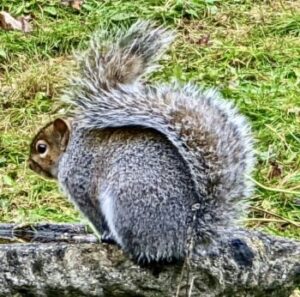
Researchers at the Animal and Plant Health Authority (APHA) has been working of an oral contraceptive that will hopefully offer a way to reduce grey squirrel populations in a humane and effective manner.  The contraceptive targets a mammalian hormone known as GnRH [Gonadotropic Releasing Hormone].  This hormone stimulates squirrels to ovulate or produce testosterone.  The contraceptive stimulates the production of antibodies against the GnRH so that the animals are rendered sterile.  However, there are problems with the contraceptive. It affects other species, such voles, wood mice, and dormice if they feed in the ‘traps’. Ensuring its effective means of delivery to grey squirrels alone. To address these issues, APHA has be experimenting with different designs of baited ‘traps / feeders’ to deliver the contraceptive so that only grey squirrels can enter.  The bait for these ‘traps / feeders’ is hazelnut butter mixed with rhodamine B.  The rhodamine B is added as it causes the fur of grey animals that have taken the bait to fluoresce under UV light, it may also colour the fur of the squirrel to PINK. Red squirrels cannot reach the bait as they are not heavy enough to trigger the internal mechanism of the trap / feeder.  A recent test of the mechanism revealed 19,000 visits by grey squirrels but only 9 by mice, so it does effectively distinguish between different woodland species.  There is now a plan to test the traps / feeders on a much larger scale in Cumbria, Northumberland, South Scotland and Lancashire.  Perhaps technology may be used to follow the behaviour of the animals at the 'traps' - e.g. trail cameras / infra red photography. Modelling by APHA of the contraceptive and modified traps suggests that grey populations might drop by half within six years.  Other methods to reduce the grey squirrel numbers include: The introduction of Pine Martens in suitable areas, which predate more successfully on grey squirrels, as the red ones are somewhat nimbler. Incentives for landowners to create more woodland.   Further information : https://aphascience.blog.gov.uk/2018/10/09/red-squirrel/
Wildlife in Scotland

Wildlife in Scotland

by The blog at woodlands.co.uk, 18 January, 2024, 0 comments

NaturScot is Scotland’s nature agency.  It monitors and reports on all aspects of the natural environment.  It has published a report on its terrestrial bird breeding species and it is a somewhat mixed report. Some of the most ‘famous’ species associated with Scotland, such as the black grouse have declined significantly during the period of study (1994 - 2019).  The grouse population has halved, and the kestrel, greenfinch and lapwing populations are also in decline.  Woodland populations of Capercaillie have also fallen.  The largest grouse in the world, the capercaillie was once widespread but suffered local extinction in the eighteenth century and was reintroduced in the C19th. It is now only found in old pine forests and mainly in the Cairngorms National Park. The Capercaillie are now red-listed and protected in the UK. [The Pine Marten which feeds in part on the eggs of game birds was almost lost in the nineteenth century, due to farmers and gamekeepers trapping them.] The fall in bird numbers has been associated with changes in climate, notably warmer and wetter weather coupled with extreme events (such as flooding and heat waves).  Whilst some species have suffered as a result of the changing weather, others seem to have prospered, including some that do not ‘traditonally’ make their way to Scotland.  The great spotted woodpecker is one such species, its numbers have increase by 500%, bullfinch and red numbers have also increased.  Gold finches and magpies are now more common on farmlands in Scotland. various measures could help offset some of these declines,.such as  the diversification of woodland (more tree species) restoration of peatlands Creation of habitats on farmland legal predator control deer exclusion to allow regeneration removal of deer fencing, (where feasible) as capercaillie and black grouse are known to fly into this and injured as a result. One example of the benefits of deer fencing is to be seen in the Glen Lyone woodlands.  Historically, this area was part of the royal hunting grounds of Cluanie and was home to capercaillies, wildcats and lynx.    Nineteenth century maps show a significant area of woodland, but by the 1990’s less than a hundred of the ancient pines were left.  The oldest pine in the area dates back to the C14th century, and many others are several centuries old.  However, the area was heavily grazed by deer, which reduces regeneration as young seedlings / saplings get eaten.  Now “Trees for Life” have erected new deer fencing, which hopefully will allow natural regeneration of pine forest in the area.  Calendonian Forest once covered much of the Highlands but now less than 2% of it survives.  Full details of this project (and a video) may be found here ; https://treesforlife.org.uk/scotlands-oldest-wild-pine-saved/
capercaillie

woodlands web updates : 28

by The blog at woodlands.co.uk, 30 November, 2023, 0 comments

On the Red List! The capercaillie is threatened.  Its numbers in Scotland have roughly halved (between 2010 and 2020).  It was once widespread, but now it is found in the pine forests of the Highlands - notably the Cairngorms National Park.  It is a red listed species. The decline in numbers is associated with poor breeding success, poor weather in early summer when the chicks are developing, another problem is predation by species such as the pine marten, foxes and crows.  The Game and Wildlife Conservation Centre (GWCT) has identified another issue that these birds face - namely collisions with deer fences.     These fences are created to keep deer out of particular areas.  However, when the capercaillie (and black grouse) impact on these fences, they are injured or killed.  Marking these fences, reduces the number of collisions but does not stop them.  Unmarked fences are still killing adult birds.  Marking of these fences or their removal would help with the survival of the capercaillie, though removal would  mean trees and shrubs would be unprotected from deer. Mosquitoes! There are some 36 different species of mosquitoes to be found in the UK, which  are generally harmless (though they bite).  But that may change.  With longer and warmer summers, the UK may become a venue for other species such as the tiger mosquito.   This insect has been found in ‘traps’ (monitored by the UK Health Security Agency) at ports and rail terminals.  This insect is known to transmit various diseases, such as dengue fever.  The mosquito was found in Italy in 1990 and it is spreading on the continent. A species of Culex has also been found in some areas of the Thames estuary - which can spread the West Nile Virus. This virus can result in flu-like symptoms.  Outbreaks have been been mainly in the warmer areas of the Mediterranean, but with climate change and the potential for very hot summers here - vigilance will be needed. Floral defences. Many flowers release a distinctive scent.  The scent serves to attract pollinators like bees and butterflies, or  it may ward off pests that would feed upon the plant.. Many of the chemicals that contribute to scents are terpenes.  Recent research has investigated how these chemicals can affect the growth and development of butterflies - using painted lady butterflies.  These butterflies feed on a wide range of plants and hence are exposed to a variety of scents / terpenes. For these experiments, the researcher (at the University of Centra Florida) used four common floral terpenes  Limonene :  which has a fresh, citrus like smell Linalool. : has a floral scent, reminiscent of lavender Cineole : has a camphor-like smell, slightly medicinal contributes to eucalyptus oil. β caryophyllene : this has a spicy / woody fragrance. Different amounts of these terpenes were fed to caterpillars of the painted lady butterfly, and the subsequent development of the caterpillars was monitored and the size of the adults recorded.  The experiment was also conducted at different temperatures.  Temperature affects scent release by flowers. Higher levels of terpenes has significant affects on the survival of the caterpillars, especially when combined with the higher temperatures.  The caterpillars took longer to enter into pupation when given high levels of terpenes, though the size of the adults that emerged from pupation was unaffected.  If longer and warmer summers become more common, the combined effects of terpenes and heat could become important determinants of development. `