Woodlands.co.uk

Blog - pines

The air that we breathe.

The air that we breathe.

by The blog at woodlands.co.uk, 24 April, 2026, 0 comments

When you step into your garden during the Spring or Summer months, you might be aware of the scent of honeysuckle, lavender or indeed an old fashioned rose.  Similarly, in a woodland the scent of pine or other conifers may permeate the air.  These various scents often involve a group of compounds known as the terpenes.  The resin that exudes from pine bark is rich in terpenes. Terpenes are used in the building of many complex organic molecules and contribute to the make-up of volatile, organic compounds [VOCs] - produced by many plants.  The scents released from nectaries or other parts of flowering plants are often associated with attracting pollinating insects, but they can serve other functions.  For example, some VOCs released by a plant may warn surrounding plants of attack by insects. However, as you walk down the street, the air is rarely filled with these pleasant, natural scents. Instead the fumes of traffic, factories and industry assail us.  They are the exhaust emissions from cars, lorries, buses etc, plus the various bits and pieces [particulates] that are released from the ‘rubber’ of car tyres, brake pads etc.  The damaging effects of particulates are now well documented.  The effects include lung disease such as chronic obstructive pulmonary disease (COPD) and reduced lung function.   Particulates help create the concoction of substances that we inhale; sadly our air is often polluted with many different compounds. Scientists from Oxford University and Kew recently investigated air quality in different locations around Oxford.  The locations varied from the centre of the town, where the Botanic Garden is found, out to the University’s Wytham Woods.  Wytham is one of the most intensively studied woodland areas in the world.  The wood ‘holds’ 500 plus plant species and 800 or more butterfly and moth species. Records of bird populations go back some sixty or more years (largely due to the work of David Lack and others).   The air samples that the scientists collected were subjected to detailed chemical analysis using the technique of gas chromatography-mass spectrometry. Some 245 different compounds were identified in the various air samples, with each of the six different sites haveing their own signature collection of chemicals.  Sites near to busy roads contained high levels of benzene and toluene, which are traffic-related chemicals.  The tree rich areas naturally showed a greater presence of plant chemicals (VOCs).  Unsurprisingly, when they sampled the air in the Botanic Garden (over the course of a year), they found the highest levels of these plant compounds.  Warmer weather increased the levels of these VOCs / plant derived chemicals, which have been associated with improved mood and stress reduction. Full details of the Oxford study here : https://nph.onlinelibrary.wiley.com/doi/10.1002/ppp3.70191
Reaching for the sky

Reaching for the sky

by The blog at woodlands.co.uk, 21 May, 2025, 0 comments

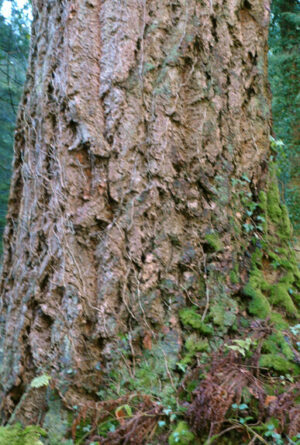
The tallest tree in England, a Douglas fir, is found on Exmoor.  The Douglas Fir was introduced into cultivation in 1827 by David Douglas.  Douglas was a gardener and botanist, who spent his early career in Scotland including time at the Botanical Gardens of Glasgow University.  He was recommended to the Royal Horticultural Society by William J Hooker, the first director of Kew Gardens.  Douglas made three trips to North America and was ultimately responsible for the introduction of many different species.  Some of the plants introduced during Victorian times include Sitka Spruce, Sugar Pine, Western White Pine, Ponderosa Pine, Lodgepole Pine, and Monterey Pine. These have transformed our landscape and the timber industry. Sadly, David Douglas died at an early age on an expedition to Hawaii, in suspicious circumstances. The Douglas Fir, despite its other common names, Douglas Spruce, Oregon Pine - is not a true fir , spruce, or pine. It is also not a hemlock. Its genus name is Pseudotsuga, means false hemlock.  The trees can grow to heights of nearly 100 metres, especially in their native coastal regions and may have a life span of 500 years. The Exmoor tree, planted 150 years ago, has reached a height of 63 metres (over 200 feet). However, as a relative youngster it still has some way to go — and it has competition. A recent survey* revealed there are a half million redwood trees in the UK.  Three species exist: the coastal redwood (Sequoia sempervirens ), the giant sequoia / redwood (Sequoiadendron giganteum), and the dawn redwood (Metasequoia glyptostroboides) They are among the largest trees on earth.  The coastal redwoods are the tallest of the three species.  The largest was measured to have a height of some 379 feet (115.5M).   Not only are these trees large but they are also impressive because of their longevity, living for a thousand years is not unusual.  Dendrochronology has aged one specimen at over 2500 years.   The coastal and the giant redwoods are found naturally on the pacific coast of California and Oregon.  Many of the UK redwoods, like the Douglas Fir, were introduced in Victorian times.  They were often planted on the estates of the wealthy and landed gentry. There are now probably more redwoods in the UK than in their native Pacific Coast range. Recent hot and dry weather has stressed the American trees, exposing them to intense wildfires. A recent study of some 5000 redwoods investigated how well the trees were ‘performing’ when compared to their American counterparts.  The tree were scanned with lasers  [a non invasive technique] to determine their height and volume (= biomass),  They were found to be growing just as well as those in the Sierra Nevada, this is probably due to our relatively mild but wet climate. The tallest redwood tree in the UK stands at 58 metres at Longleat, so somewhat behind the Douglas fir. However, whilst the Douglas Fir may have a life span of 500 years, a redwood can survive for 2000+ years, giving it time to catch up and overtake. * see  https://www.bbc.co.uk/news/science-environment-68518623 and https://royalsocietypublishing.org/doi/10.1098/rsos.230603
Trees - come in all shapes and sizes

Trees – come in all shapes and sizes

by The blog at woodlands.co.uk, 10 November, 2023, 0 comments

Trees come in many shapes and sizes.  Some are tall and thin, like Poplars, others have a ‘rounded’ canopy, like oak and horse chestnut.  Sometimes we ‘persuade’ trees to assume a particular shape or form, perhaps through pollarding or coppicing - or something more extreme - like topiary or bonsai.  However, sometimes nature itself has unusual or dramatic effects on trees.  Wind can leave trees on cliff tops or exposed places distorted and growing almost horizontally along the direction of the prevailing wind. Occasionally, something very strange is seen.  For example, at Gryfino in Western Poland, there is a forest with some very weird looking trees. There are about 400 trees that are bent at the base.  At first, the trunk lies more or less parallel with the ground, then it bends upwards and the stem is erect.  Consequently each trunk of these pines trees has a pronounced bend in it (see photo below).  The rest of the trees in this forest are quite normal, growing upright and straight - like most pines.It is thought that the pines were planted back in the 1930’s though the local town was forsaken by the residents during the second world war (and only repopulated in relatively recent times). The trees are sometime referred to as the Crooked Forest. There has been much speculation as to how the trees came to be so mis-shapen.  The theories run from The landing of alien space craft! This crushed / flattened the trees when young and tender The trees were damaged  by German tanks during the war (but why only a select number of trees?) Genetic mutation(s) which resulted in abnormal growth Fungal infection(s) which resulted in abnormal growth The young trees were flattened by a heavy fall of snow, which perhaps persisted for some time.  The trees were able to right themselves in the Spring, through a normal geotropic response. The trees were part of plantation / forest, in which some were deliberately cut at a young / sapling stage.  The area was a tree farm, where some of the pines were cut / bent for later use in furniture or frames. By bending a young tree down to the ground in this manner (for some time), compression wood is formed. Such wood has higher lignin and lower cellulose content and it is stronger than wood that is bent after a straight tree is felled (for example, by a steaming process).  Indeed, English ‘hedgerow oak’ was known to be the best for the curved timbers needed to internally strengthen a sailing ship.  Trees were even deliberately bent in certain ways so as to " grow" a required set of curved timbers.  Such curved timbers were known as “compass timbers”.  In Gryfino, it is likely that the war interrupted the activities of local foresters / woodworkers, they left and these trees were left to grow on in their rather unusual form. Thanks to Kalasancjusz at Pixabay for the image of the crooked forest.

Next Page »