Woodlands.co.uk

Blog - predators

Facts about badgers, a Woodlands TV film

Facts about badgers, a Woodlands TV film

by The blog at woodlands.co.uk, 15 October, 2024, 0 comments

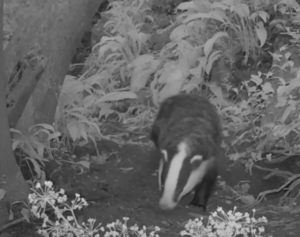
The badger (strictly speaking the european badger) arrived in this country,  like everything else, as the ice retreated some thousands of years ago.  It is our largest land predator, others such as the wolf are no longer with us - though some would support their reintroduction as part of rewilding programs. Whilst badgers are predators, they are, in fact, omnivores - eating both plant and animal material.  Much of their diet is earthworms, though they are not averse to small mammals such as mice, rats and hedgehogs!  Whilst badgers tend to make their home (setts) in woodlands, they will travel to open fields and pastures in search of food, digging for grubs [for example, chafer larvae]. A badger sett is a complex, extensive engineering feat accomplished by using their powerful front limbs and claws.  They dig down and then drag the earth out of the tunnels by moving backwards with the soil under their chin and then deposit it in a ‘spoil heap’.   The presence of a spoil heap is a good indication of a badger sett in your woodland.   If a colony is well established there will be a main sett, but also an ‘annex sett', and possibly even smaller setts away from the main sett.  Recently Woodland TV filmed Adrian Coward from the Somerset Badger Group, who explains in details the nature and relationship of these setts and how badgers recognise their ‘family members’ and how they mark their territory.  They move around their territory along well defined paths. [embed]https://youtu.be/vv3CK1hVM2o?si=_TmpkcXhKoxqy24A[/embed] Whilst we know a lot about how badgers move through their home territories, little was known about any long distance movements. To investigate such movements, scientists set up a study in County Kilkenny (Ireland).  It was one of the largest badger studies of its type,  The study spanned a large area and some four years ,and 'followed' some 900+ badgers.  They found that whilst most badgers only moved 2 to 3 kilometres from their sett, some travelled 7.5 km and the longest distance travelled by a badger was 22 km.  If animals can move around and meet with other populations, this can promote outbreeding. Learning about these 'lengthier' movements may be a useful contribution in the discussion of badgers and bovine tuberculosis - which is also discussed in the Woodlands TV film ‘Facts about badgers’, and the topic has featured in other woodland blogs. Curious fact : The French call a wet shaving brush blaireau or “badger", because quality brushes use badger hair. Apart from viewing Woodlands TV on this site, it may also be viewed on YouTube : www.youtube.com/@WOODLANDSTV 82K subscribers 482 videos 15,896,142 views Joined 9 Jul 2008 United Kingdom
The Hazel Dormouse : a woodlands TV film (Conservation and Monitoring of Hazel Dormice).

The Hazel Dormouse : a woodlands TV film (Conservation and Monitoring of Hazel Dormice).

by The blog at woodlands.co.uk, 3 October, 2024, 0 comments

The hazel dormouse is an arboreal species, that is to say, it spends a large part of the year up in the trees.  It is also largely nocturnal in habit. Its favourite foods are hazelnuts, berries and insects.  Their active period is between Spring and Autumn, and during this time they build a ‘nest’.  These nests tends to made from ‘local materials’ usually found within a few metres of the nest.  Bracken, hazel, beech leaves and grasses are frequently used, though honeysuckle and other species may be incorporated.  The nests are found in trees in deciduous woodlands, thick scrub, and hedgerows, feeding on local available materials depending on the time of year.  They tend not to move great distances, generally having a range of up to a hectare. With the approach of colder weather and limited food supplies, the dormouse tends to move down to the ground and build another nest ready for hibernation.  The winter nest is similar to that built in the canopy with an outer layer of leaves and core of some ‘woven’ material.  Hibernation is a dangerous time for a dormouse.  If the dormouse has not accumulated enough fat reserves then it will simply run out of energy during the cold weather.  It has been estimated that a dormouse loses about 0.5% of its body weight every day during hibernation.  Whilst ‘asleep’, the dormouse is easy prey for a predator and could also die as a result of trampling by a large animal [the nests are inconspicuous], or indeed woodland management activities. [caption id="attachment_41621" align="aligncenter" width="650"] Dormouse in a state of torpor.[/caption] Interestingly, during the dormouse’s active period of Spring and Summer, the dormouse can enter into a state of torpor when food is scarce.   This allows them to save energy through dropping body temperature and heart rate.  So hazel dormice can spend a lot of the year ‘asleep’ in one form or another. Woodlands TV has just produced their first film about the hazel dormouse - which can be viewed below. This film was made in collaboration with the People’s Trust for Endangered Species (PTES). More information on the PTES’ monitoring and conservation of hazel dormice can be accessed by clicking here, Note that a licence is required for handling these special animals, details in this link :- https://www.gov.uk/government/publications/hazel-dormice-survey-or-research-licence-level-1. [embed]https://youtu.be/COUh5ZluEew?si=f697mPkVLoI8dceU[/embed] Interesting fact : Though Ireland has no native dormouse, the hazel dormouse was found in County Kildare in 2010. Further films by Woodland TV can be found here : -https://www.youtube.com/@WOODLANDSTV    

Next Page »