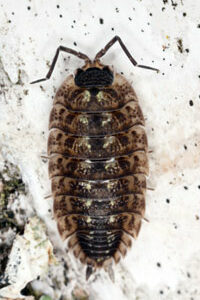
woodlice – nature’s recyclers
by The blog at woodlands.co.uk, 6 January, 2023, 2 comments
The soil and the litter layer in a woodland is teeming with many different forms of animal life, particularly invertebrates that include many types of insects (beetles, springtails), arachnids, spiders and mites (arachnids), centipedes and millipedes (Myriapods), roundworms (Annelids) such as earthworms. One group of animals that is often forgotten is the woodlice, they are terrestrial crustaceans belonging to the same group as crabs and lobsters. Their ancestors were probably amongst the first animals to make the transition from sea to land (millions of years ago).
Indeed, they are still confined to a moist / damp environment as they breathe through ‘gill-like’ structures on their back legs (pleopods) and their body surfaces are susceptible to water loss. Consequently, they are usually found in damp, dark places, under rocks and in decaying logs / wood; they tend to be more active at night (which again reduces the risk of dehydration). To protect their offspring, their fertilised eggs are placed inside a fluid filled pouch (carried between the female’s legs, and they are provided with water and nutrients). The young go through a series of moults before reaching maturity.
Woodlice are detritivores, feeding mostly on dead plant and animal matter in the soil and leaf litter. Once, they have ingested and digested this material, what remains passes out of their bodies and micro-organisms will continue its breakdown (forming part of what is termed the detrital food chain). They excrete ammonia through their exoskeleton, so they have a ‘distinctive smell’. The ‘blood’ or haemolymph of crustaceans contains an oxygen carrying pigment that is blue when oxygenated. It is based around a copper atom, our red haemoglobin is based around an iron atom.
There are five woodlice species that are common in the U.K. The "famous five species”, they are
Oniscus asellus (the common shiny woodlouse),
Porcellio scaber (the common rough woodlouse),
Philoscia muscorum (the common striped woodlouse),
Trichoniscus pusillus (the common pygmy woodlouse) and
Armadillidium vulgare (the common pill bug).
Common names for woodlice vary throughout the country. Several of the names refer to the fact that some species can roll up into a ball (armadillo bug, roly-poly, roll bug). Apparently, the collective noun for woodlice is a quabble.