Woodlands.co.uk

Blog - ragwort

The common ragwort

The common ragwort

by The blog at woodlands.co.uk, 7 July, 2024, 4 comments

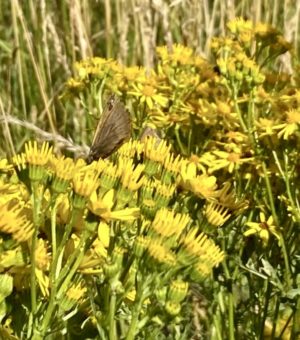
Ragworts are a group of daisy-like flowers.  The flowers are actually composites, that is, they are made up of many smaller flowers held together in a structure called a capitulum.  The family of daisy-like flowers is known as the Asteraceae (previously called the Compositae).  There are several different species of ragworts, for example : Common Ragwort (Jacobaea vulgaris, previously Senecio jacobaea) Oxford Ragwort (Senecio squalidus)  Hoary Ragwort (Senecio erucifolis) Marsh Ragwort (Senecio aquaticus) Silver Ragwort (Senecio cineraria) Perhaps, the Common Ragwort and the Oxford Ragwort have attracted the most attention in recent times.  The story of the Oxford Ragwort is interesting. The plant is actually native to Sicily, growing on volcanic ash and scree.  It was grown in the Oxford Botanic garden around 1690.   After some years, it ‘escaped’ and could be seen growing around Oxford.  Later, with the advent of the railways, it was able to spread along the railway tracks and then across the country. The genetics of this plant and related species have been the subject of various research projects in recent years, and has resulted in the ‘reclassification’ of some ragwort species. However, it is the Common Ragwort (Jacobaea vulgaris, previously Senecio jacobaea) that has been the focus of much attention.  This is a native, biennial plant, but can be perennial. Its seeds are spread by wind and a single plant can produce thousands. Consequently, it can become a problem on waste land or other uncultivated areas. Ragwort may be seen in coppiced woodland,  particularly in the years immediately after cutting the coppice when there is lots of light and the ground flora 'comes alive'. The plant is a good food source for a wide range of insects and it is much 'loved' by pollinators.  Over a hundred insect species feed on its nectar  (bees, flies, moths and butterflies).  Not only is it a good source of nectar, it also provides a home and / or a food source for many invertebrate species.  Some insects feed on the ragwort exclusively.  [caption id="attachment_40185" align="alignleft" width="300"] Cinnabar moth caterpillar[/caption] One species that is particularly associated with this plant is the cinnabar moth, whose status is described as ‘common and widespread, but rapidly declining”.  The caterpillars are distinctive with yellow and black stripes. They feed on the ragwort absorbing its alkaloids, which make the caterpillars distasteful to predators.   Alkaloids are organic compounds produced by plants and many of them have potent medical uses - such as quinine (for malaria) or morphine (pain relief).  Most alkaloids have a bitter taste.  Many alkaloids are toxic (for example, atropine from the nightshade family of plants).  The alkaloids present in ragwort can make it a problem when present in fields / areas grazed by horses or cattle, though it is not usually a problem in gardens.  Horses do not normally eat ragwort due to its bitter tasting alkaloids but if consumed in any quantity then the alkaloids can cause liver damage (a form of cirrhosis). [caption id="attachment_40489" align="alignleft" width="300"] Tweet from Prof Goulson[/caption] Ragwort poisoning is relatively uncommon and may arise through feeding with hay that contains dried ragwort.  In U.K., the common ragwort is classed as an injurious weed under the provisions of the Weeds Act 1959, and there is the Ragwort Control Act 2003.  The latter provides for a code of practice relating to ragwort.  Removing common ragwort from an area is not without its problems.  Sometimes, other species are ‘identified’ as ragwort and sprayed with weedkiller.       Friends of the Earth have produced a ‘briefing’, which notes that Ragwort has been blamed for animal deaths which are unproven Scare stories have been based on poor or irrelevant statistics, and biased surveys Ragwort has been falsely labelled as a threat to human health / the countryside As a result, unnecessary measures have been used to control ragwort (in nature reserves or areas like the New Forest, and indeed roadside verges). The briefing, entitled  “Ragwort: problem plant or scapegoat?” which can be accessed here offers a number of solutions to the ‘ragwort problem’ Further information about controlling ragwort is available on WoodlandsTV - see below: [embed]https://youtu.be/esfLW0nIvNo?si=DQ2Uokq7U1pAJYMZ[/embed]
dandelion

Wild flower pollen and bees

by The blog at woodlands.co.uk, 20 April, 2024, 1 comments

The period since WW2 has seen urban areas and, indeed farms, expand across the UK. The number of places where wildlife can thrive has been eroded.  Gardens and lawns have been changed to provide parking for cars, lawns are mowed and ‘weed-killered’, or worst still replaced with artificial grass so there is not a weed in sight.  Fortunately there are now initiatives like No Mow May that promote the growing of wild flowers in lawns and public spaces, like roadsides and verges.  Many common weeds are simply wildflowers by another name. Wild flowers / weeds (like dandelions, ragworts, clovers) are a lifeline for bees and bumblebees - who are facing so many threats [pesticides, habitat loss, invasive species] so adequate food is important. The flowers of these wild flowers / weeds offer food for a wide range of endangered bees, and at times when other resources are limited.  Dandelions, for example, offer an abundant source of nectar and pollen for bees & bumblebees when other options are limited - especially in urban settings. They produce their flowers (and therefore nectar and pollen) from early Spring right through to the onset of Winter. Recent studies have shown that the diet of bees has changed over the years.   In the past, the bees were able to forage and collect pollen and nectar from a wide variety of plants but with the loss of ‘natural’ wild areas their diet is now often dominated by brambles, clover and dandelions.  In the case of dandelions, their simple, open flowers makes for ease of collection.  They are visited by honey bees, bumblebees and carder bees.   Some studies have indicated that dandelion pollen, whilst it is rich in the amino acid proline,  has low levels or lacks certain amino acids (such as valine and isoleucine).  Bees need the same ten essential amino acids as us.  Without a supply of these particular amino acids, the development and growth of bees is impaired, as is their disease resistance and ability to raise the brood.  So, it is important to find ways to offer our pollinators a range of plants / pollen to provide all their essential nutrients. interesting related papers Food for Pollinators: Quantifying the Nectar and Pollen Resources of Urban Flower Meadows: https://journals.plos.org/plosone/article?id=10.1371/journal.pone.0158117 Shifts in honeybee foraging reveal historical changes in floral resources: https://www.nature.com/articles/s42003-020-01562-4
woodlands web updates 16

woodlands web updates 16

by The blog at woodlands.co.uk, 30 April, 2022, 1 comments

LASI is the Laboratory of Apiculture and Social Insects at the University of Sussex. It is particularly noted for its research work on bees. Recently, Dr Balfour and Professor Ratnieks have published a study on the rôle of certain 'injurious weeds'.   Five of our native wildflowers fall into this category : Ragwort (Jacobaea vulgaris), Creeping or Field Thistle (Cirsium arvense), Spear or Common Thistle (Cirsium vulgar), Curly Dock (Rumex crispus), and Broadleaved or Common Dock (Rumex obtusifolius).  They compared the ragwort and the thistles with plants like red clover and wild marjoram (often encouraged / sown on field edges etc).. They found that the 'injurious weeds' were particularly 'effective' at attracting pollinators, not only did they they attract greater numbers of pollinators than clover etc, but also a greater range of pollinator species.  This was ascribed to the open nature of their flowers and their generous nectar production.  This brings into question the control of species like the ragwort, as it is clearly important to pollinators (as are some 'botanical thugs' - like brambles).  Ragwort contains chemicals that are toxic to livestock, causing liver damage; it has been blamed for the deaths of horses and other animals. At the Smithsonian, Kress and Krupnick have analysed the features of some 80,000+ species of plants to see how they might fare in the Earth's changing climate (the Anthropocene).  This may seem like a large number of different plants, but represents approximately only 30% of the known species of vascular plants.  There is not enough information of the remaining species to make a reasonable guess as to how they might react to climate change;  a reflection on how little we actually known about our 'botanical resources'.  Sadly, they conclude that more plants will lose out than win.  Particularly at risk of extinction are the Cypress family (which includes the redwoods and junipers) and  the Cycads, whereas black cherry might be a winner. As was reported previously in the woodlands blog, there is a difference between the leaves of the redwoods found at the top of the tree and those lower down.  Those at the top are small, thick, and fused to the vertical stem axis; this fusion of leaf and stem creates a relatively large volume of tissue and intercellular space that can store water. The leaves in the lower part of the crown by comparison are large, flat and horizontal to the stem axis.   Now scientists as the University of California (Davis) have further investigated the role of these leaves.  They now believe that the different leaf forms help explain how the exceptionally tall trees are able to survive in both wet and dry parts of their range in California.  In the rainy and wet North Coast, the water absorbing leaves are found on the lower branches of the trees.  In the Southern part of the redwoods range, the water collecting leaves are found at a higher level to take advantage of the fog (and rain, which occurs less often).
