Woodlands.co.uk

Blog - red squirrel

Diet and Digestion in Grey squirrels & Red squirrels.

Diet and Digestion in Grey squirrels & Red squirrels.

by The blog at woodlands.co.uk, 6 February, 2026, 0 comments

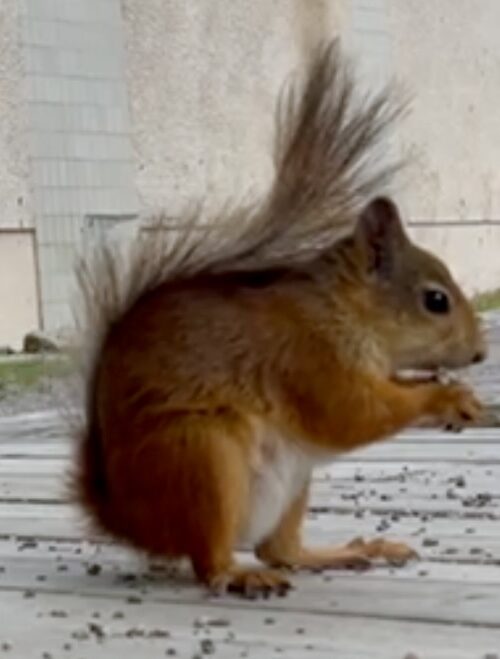
Whilst it can be amusing to watch the antics of a grey squirrel hopping about in your garden, they are generally seen as a pest.  In your garden, you might find some of your bulbs have disappeared or in the fruit season, some of your soft fruits might be ‘missing’.  However, in woodland and forests they are adept at stripping bark from trees, which obviously wounds the trees, distorts growth and may allow for the entry of pathogens.  Grey squirrel damage to trees in England and Wales has been estimated to cost £37m a year in lost timber value and reduced carbon capture. The squirrels tend to select vigorous trees as they have a bark with a rich sap content, such as  sycamore, beech, birch and oak.  It has been suggested that they targeted such trees for their sugar content, as much bark stripping activity occurs in May to July, a period when the tree would be actively photosynthesising and transporting sugars around the tree in the phloem tissue (bast).  However, recent work suggests that they may be after micro-nutrients, such as calcium.   [caption id="attachment_41889" align="alignleft" width="300"] squirrel[/caption] Scientists from Bangor University have investigated and compared the microbiome of grey and red squirrels.  The microbiome refers to the make-up on the bacteria and other microbes present in the gut.  They help in the breaking down of food materials, and the production of vitamins.  They found the intestinal (caecum*) microbiome or microbiota of grey squirrels is more diverse than that of red squirrels, and where there were bacterial species in common then the amounts differed. These findings might help explain why grey squirrels can, for example,  digest acorns readily despite their tannin content, whereas red struggle to make full use of this plentiful food supply.   The grey squirrel gut also has a bacterium - Oxalobacter.  This bacterium can change the insoluble calcium from tree bark into a more digestible form.  Calcium levels in trees tend to rise in late spring / early summer when squirrels indulge in bark stripping.  Red squirrels strip bark less frequently than greys, this may be due to their somewhat more limited, less diverse microbiome.  The microbial diversity of grey squirrels may enable them to use a greater range of materials than the red squirrels, perhaps explaining in part their spread and the displacement of the red squirrel. Another factor leading to the displacement of the red squirrel has been the spread of the squirrel pox virus into the red squirrel population.  This virus has little effect on grey squirrels but leads to sickness and often death in red squirrels.  The grey squirrel also harbours another threat to red squirrels - the adenovirus.  Again grey squirrels seem unaffected by this, but red squirrels develop severe intestinal damage.  This difference may again be related to the difference in the microbiome of the two types of squirrel. Note : the caecum is a pouch within the gut, between the small and large intestine where the digestion of cellulose etc takes place, it is 'rich' in bacteria. More detail on grey squirrels in the links below :  https://www.microbiologyresearch.org/content/journal/jmm/10.1099/jmm.0.001793 https://pubmed.ncbi.nlm.nih.gov/38354038/ https://www.bangor.ac.uk/news/2024-02-21-gut-bacteria-may-explain-why-grey-squirrels-outcompete-reds-new-research and https://rfs.org.uk/insights-publications/rfs-reports/report-overview-the-cost-of-grey-squirrel-damage-to-woodland-in-england-and-wales/
Vikings and squirrels.

Vikings and squirrels.

by The blog at woodlands.co.uk, 14 July, 2025, 0 comments

JAcross Europe, the red squirrel is recognised as an endangered species.  The U.K populations are at risk due due to :- Habitat loss Competition with Grey Squirrels The effects of the squirrel pox virus The last two are a result of the introduction of the grey squirrel from America in the 19th century. Red squirrels are at home in all types of woodland and may even be seen in parks and gardens, but they 'like' mixed conifer forests best.  Scotland is home to many of the U.K's red squirrels. The number of squirrels is quite small – estimates of their number vary, perhaps there are less than 300,000* across the whole of Britain.   The status of red squirrel populations is a matter of considerable interest. [caption id="attachment_42416" align="alignleft" width="300"] Screenshot[/caption]  In 2014, it was noticed that some members of the Scottish red squirrel populations had abnormal growths on their ears, snout and limbs. Further investigations found that the squirrels were suffering from leprosy.  Leprosy  is a bacterial infection,  caused by two different species of mycobacteria: Mycobacterium leprae and Mycobacterium lepromatosis.   The two types of  bacteria have slightly different distributions in the squirrel populations of the U.K.  Whilst leprosy in squirrels was first reported in 2014,  it is likely that the disease has been around in squirrel populations for much, much longer, probably hundreds of years. Profesor Verena Schünemann,  Christian Urban et al have studied bacterial DNA extracted from human skeletons, dating from 400 CE to 1400 CE with deformities associated with leprosy.   They 'reconstructed' the genetic makeup of mediaeval forms of the bacterium.  Leprosy was not uncommon across Europe in mediaeval times - indeed up to the sixteenth century.   Disease, in its many forms , was a common part of life -  dysentery, diphtheria, typhoid, smallpox, and plague meant that life expectancy was limited. The last indigenous case of leprosy in the UK dates back to 1798.  In humans, leprosy causes muscle and nerve damage, which lead to deformity, blindness and disability.   Interestingly, research by Dr. Sarah Inskip has revealed that a pre-Norman skull [found in Hoxne in Suffolk] had a leprosy strain related to a form known to affect squirrels.  The same strain has also been found in medieval scandinavian skeletons.  It is possible that the  trade in squirrel pelts (and meat) could have contributed to the spread of the disease. Strong trade connections with Denmark and Sweden were in full flow in the medieval period.  Squirrel fur was also used as a lining for fine clothes and squirrels were kept as pets by some. The historical spread of leprosy is not fully understood.  The disease may have passed from squirrels to humans or vice versa in historical times.  Further study of the microbes that cause this disease (and that in squirrels) will help determine how the disease is acquired and transmitted.    The risk to human health is low. (Even so, good hygiene should be followed during any contact with wild animals). Professor Anna Meredith  (University of Edinburgh) is researching into this disease in squirrels.   Further reading / articles: https://www.newscientist.com/article/mg14819991-200-virus-blamed-on-invading-squirrels/ https://www.science.org/doi/10.1126/science.aah3783 https://www.theguardian.com/science/2017/oct/25/medieval-love-of-squirrel-fur-may-have-helped-spread-leprosy-study-reveals https://www.sciencedaily.com/releases/2017/10/171025103109.htm
