Woodlands.co.uk

Blog - redwoods

Changing times?

Changing times?

by The blog at woodlands.co.uk, 9 November, 2025, 0 comments

The Earth has experienced many glacial and interglacial periods over hundreds of thousands of years.  Since the last ice age, the Earth has warmed (the average global temperature has rising by some 4 to 5oC) but the temperature rise was about 0.1oC per century.  Today's warmer climate took 5,000–8,000 years to ‘evolve’, during which time the average global temperature rose at a rate of around 0.1oC every century.   This gradual change allowed trees to adapt to the changing climate.  In the last century, ‘we’ have driven a 1.3oC rise just in the last century - this is some ten times faster than the change post ice age.  [caption id="attachment_35526" align="alignleft" width="300"] drought[/caption] Not only has the climate warmed, it has become increasingly unpredictable with heat waves, drought and torrential rain.  These can have dramatic effects on our trees and heathlands.  For example, the heatwave in 2022 resulted in Kew Gardens losing some 460 of its trees.  This last summer saw 4 periods of heatwave conditions.   So, it is not surprising that some of our most familiar trees are struggling with these changed conditions.  They are stressed, and it would seem that the climate is not likely to moderate in the immediate future.  In recognition of the changing climate, Forestry England has produced a 'species for the future' list.  The trees in the list are those which might thrive in a warmer climate. Whilst it includes familiar species like oak, birch, and alder, other species such as the coast redwood and Corsican pine are included,  which hopefully will create more resilient woodlands.  The trees are listed below Aspen (Populus tremula) Beech (Fagus sylvatica) Coast redwood (Sequoia sempervirens) Common alder (Alnus glutinosa) Corsican pine (Pinus nigra subsp. laricio) Douglas fir (Pseudotsuga menziesii) Downy birch (Betula pubescens) European silver fir (Abies alba) Field maple (Acer campestre) Grand fir (Abies grandis) Grey alder (Alnus incana) Hornbeam (Carpinus betulus) Japanese red cedar (Cryptomeria japonica) Lodgepole pine (Pinus contorta var. latifolia) Macedonian pine (Pinus peuce) Maritime pine (Pinus pinaster) Norway spruce (Picea abies) Pedunculate oak (Quercus robur) Red oak (Quercus rubra) Rowan (Sorbus aucuparia) Scots pine (Pinus sylvestris) Sessile oak (Quercus petraea) Silver birch (Betula pendula) Sitka spruce (Picea sitchensis) Sweet chestnut (Castanea sativa) Sycamore (Acer pseudoplatanus) Western hemlock (Tsuga heterophylla) Western red cedar (Thuja plicata) Wild cherry (Prunus avium) Wild service tree (Sorbus torminalis) The list contains both native and non-native species, the aim is to create through planting stronger and more biodiverse woodlands that can tolerate our changing climate over the coming decades.  The rate of climate change is the main issue. Whilst some of the trees already grow here, others come come from warmer / drier areas, such as the Mediterranean or  North America.  There are already many redwoods in the UK.  They were introduced in victorian times, when they were planted on the estates of the wealthy and landed gentry. There are now probably more redwoods in the UK than in their native Pacific Coast range,  there intense heat and dry weather has exposed them to intense forest fires. Another possibility to promote resilience is to use seed produced by trees such as Oak that has been ‘produced’ by trees growing in warmer regions. The inclusion of trees that might be suited to our changing climate is often referred to as assisted migration.  However, the introduction of non-native species is not without its problems, for example the introduced species could become of invasive or add to the burden of pathogens that our trees are exposed too.
Reaching for the sky

Reaching for the sky

by The blog at woodlands.co.uk, 21 May, 2025, 0 comments

The tallest tree in England, a Douglas fir, is found on Exmoor.  The Douglas Fir was introduced into cultivation in 1827 by David Douglas.  Douglas was a gardener and botanist, who spent his early career in Scotland including time at the Botanical Gardens of Glasgow University.  He was recommended to the Royal Horticultural Society by William J Hooker, the first director of Kew Gardens.  Douglas made three trips to North America and was ultimately responsible for the introduction of many different species.  Some of the plants introduced during Victorian times include Sitka Spruce, Sugar Pine, Western White Pine, Ponderosa Pine, Lodgepole Pine, and Monterey Pine. These have transformed our landscape and the timber industry. Sadly, David Douglas died at an early age on an expedition to Hawaii, in suspicious circumstances. The Douglas Fir, despite its other common names, Douglas Spruce, Oregon Pine - is not a true fir , spruce, or pine. It is also not a hemlock. Its genus name is Pseudotsuga, means false hemlock.  The trees can grow to heights of nearly 100 metres, especially in their native coastal regions and may have a life span of 500 years. The Exmoor tree, planted 150 years ago, has reached a height of 63 metres (over 200 feet). However, as a relative youngster it still has some way to go — and it has competition. A recent survey* revealed there are a half million redwood trees in the UK.  Three species exist: the coastal redwood (Sequoia sempervirens ), the giant sequoia / redwood (Sequoiadendron giganteum), and the dawn redwood (Metasequoia glyptostroboides) They are among the largest trees on earth.  The coastal redwoods are the tallest of the three species.  The largest was measured to have a height of some 379 feet (115.5M).   Not only are these trees large but they are also impressive because of their longevity, living for a thousand years is not unusual.  Dendrochronology has aged one specimen at over 2500 years.   The coastal and the giant redwoods are found naturally on the pacific coast of California and Oregon.  Many of the UK redwoods, like the Douglas Fir, were introduced in Victorian times.  They were often planted on the estates of the wealthy and landed gentry. There are now probably more redwoods in the UK than in their native Pacific Coast range. Recent hot and dry weather has stressed the American trees, exposing them to intense wildfires. A recent study of some 5000 redwoods investigated how well the trees were ‘performing’ when compared to their American counterparts.  The tree were scanned with lasers  [a non invasive technique] to determine their height and volume (= biomass),  They were found to be growing just as well as those in the Sierra Nevada, this is probably due to our relatively mild but wet climate. The tallest redwood tree in the UK stands at 58 metres at Longleat, so somewhat behind the Douglas fir. However, whilst the Douglas Fir may have a life span of 500 years, a redwood can survive for 2000+ years, giving it time to catch up and overtake. * see  https://www.bbc.co.uk/news/science-environment-68518623 and https://royalsocietypublishing.org/doi/10.1098/rsos.230603
Burrs or Burls?

Burrs or Burls?

by The blog at woodlands.co.uk, 18 February, 2025, 0 comments

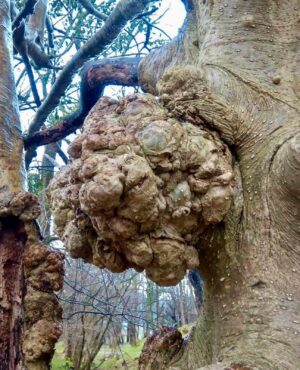
Burrs or Burls? What’s in a name. What are they?  They are woody outgrowths found on stems, branches, and often on roots.  They are  typically rounded, somewhat bulbous in form.  Burrs develop as a result of rapid and uncontrolled growth,  leading to a dense and irregular wood grain beneath the external bark of the structure. The uncontrolled and abnormal growth may result from various stressors, such as :- Physical damage eg. wounds, where branches are lost in high winds, injuries as the result of boring insects, or damage from squirrels or deer. Infections caused by bacteria, viruses, or fungi may trigger burr formation  These infections can induce  hormonal changes that affect cell division. Environmental factors such as extreme weather events or pollution can influence tree physiology and growth, as can somatic mutations. In most cases, a burr does not harm a tree, indeed they may persist for decades.  If the burr formed due to injury to the tree, then it could even be considered protective.  However, If a burr develops on a branch then it may become so heavy that the branch breaks. Burrs may be seen on a variety of trees, but some species are more prone to developing them, notably oaks, maples, walnut, and birch.  Coastal redwoods are known to produce burrs of considerable size, sometimes reaching several metres in width and even encircling the trunk of the massive trees..  Although burrs may not be visually appealing from the outside, internally the complex grain pattern means makes them highly valued for woodworking.  They are used to create bowls, furniture, musical instruments and sculptures.  It is generally unwise to cut a burr from a living tree; instead they are typically harvested from fallen or dead trees. Thanks to Steve Sangster for Burr images.
woodlands web updates 16

woodlands web updates 16

by The blog at woodlands.co.uk, 30 April, 2022, 1 comments

LASI is the Laboratory of Apiculture and Social Insects at the University of Sussex. It is particularly noted for its research work on bees. Recently, Dr Balfour and Professor Ratnieks have published a study on the rôle of certain 'injurious weeds'.   Five of our native wildflowers fall into this category : Ragwort (Jacobaea vulgaris), Creeping or Field Thistle (Cirsium arvense), Spear or Common Thistle (Cirsium vulgar), Curly Dock (Rumex crispus), and Broadleaved or Common Dock (Rumex obtusifolius).  They compared the ragwort and the thistles with plants like red clover and wild marjoram (often encouraged / sown on field edges etc).. They found that the 'injurious weeds' were particularly 'effective' at attracting pollinators, not only did they they attract greater numbers of pollinators than clover etc, but also a greater range of pollinator species.  This was ascribed to the open nature of their flowers and their generous nectar production.  This brings into question the control of species like the ragwort, as it is clearly important to pollinators (as are some 'botanical thugs' - like brambles).  Ragwort contains chemicals that are toxic to livestock, causing liver damage; it has been blamed for the deaths of horses and other animals. At the Smithsonian, Kress and Krupnick have analysed the features of some 80,000+ species of plants to see how they might fare in the Earth's changing climate (the Anthropocene).  This may seem like a large number of different plants, but represents approximately only 30% of the known species of vascular plants.  There is not enough information of the remaining species to make a reasonable guess as to how they might react to climate change;  a reflection on how little we actually known about our 'botanical resources'.  Sadly, they conclude that more plants will lose out than win.  Particularly at risk of extinction are the Cypress family (which includes the redwoods and junipers) and  the Cycads, whereas black cherry might be a winner. As was reported previously in the woodlands blog, there is a difference between the leaves of the redwoods found at the top of the tree and those lower down.  Those at the top are small, thick, and fused to the vertical stem axis; this fusion of leaf and stem creates a relatively large volume of tissue and intercellular space that can store water. The leaves in the lower part of the crown by comparison are large, flat and horizontal to the stem axis.   Now scientists as the University of California (Davis) have further investigated the role of these leaves.  They now believe that the different leaf forms help explain how the exceptionally tall trees are able to survive in both wet and dry parts of their range in California.  In the rainy and wet North Coast, the water absorbing leaves are found on the lower branches of the trees.  In the Southern part of the redwoods range, the water collecting leaves are found at a higher level to take advantage of the fog (and rain, which occurs less often).
Woodlands web updates : 13

Woodlands web updates : 13

by The blog at woodlands.co.uk, 2 February, 2022, 0 comments

Wetlands. In the past, many areas of wetlands have been drained and ‘dried out’.  Now it is recognised that this is counter-productive in terms of carbon storage / sequestration and biodiversity, so there are now measures to restore wetlands. The hope has been that restoration of wetlands will do much to restore the variety of plants and animals (and help carbon storage).  However, research by the University of Copenhagen suggests that such projects might be ‘struggling’. The study examined ten wetlands (near the River Odense) that were restored between 2001 and 2011.  The restoration involved the removal of drains and ditches, and allowed streams to meander again instead of flowing in ‘straight channels’.  The aim of the project was primarily to reduce the leaching of nitrogen and phosphorus from adjacent farmlands, and hope to see greater diversity of plants (e.g. marsh orchids, globeflower, tussock-sedge and ragged-robin).   The ‘restored’ wetlands were botanically poor (whether restored in 2001 or 2011), they had only a quarter of the plant species compared to natural wetlands.  This may be due to  the continued input of nutrients (from agriculture), which encourages species that are ‘nutrient hungry’ at the expense of others. the ‘difficulty’ of wetland species to disperse from one area to another. It may be that future restoration programs will need to include planting / seeding of additional wetland species. It has been suggested  that it could take the best part of a hundred years for the restored wetlands to resemble natural wetlands. Redwoods and relatives. Previous posts have talked about the special features of the giant redwoods (their height, age etc).  Over the last 150 years, they have ben subject to the pressures of commercial logging, clear felling and more recently high intensity fires.  Indeed, the fires have been of such an intensity that seed banks in the soil have been destroyed. Now they have been subject to genomic analysis, that is their DNA has been analysed and sequenced.  The first conifer genome to be sequenced was that of Norway Spruce, then that of loblolly pine.  These suggested that conifer genomes are large (3 to 10 times larger than the human genome), with repetitive sequences.  Coast Redwoods are hexaploid, that is, they ave six copies of each chromosome (we are diploid, that is, have only two copies of each chromosome).   The DNA of a coast redwood has  27 billion base pairs of DNA, the giant sequoia has 8 billion; by contrast we have circa 3 billion.   It is hoped that the Redwood Genome project will see the restoration of areas of coast redwood and giant sequoia that have been lost over the years. The genomic analysis will help inform and guide management strategies, ensuring genetic diversity in the newly planted tree seedlings. Such a strategy will (hopefully) enable newly planted areas to survive and thrive — in the Anthropocene. More on chromosomes Just as it has recently been shown that Coast redwoods are polyploids (i.e. have extra sets of chromosomes), so recent research in the Czech Republic has shown that the common nettle [Urtica dioica] has different ecological ‘preferences’ depending on its chromosomal status.  Nettles can be diploid (2n = 26) or tetraploid (2n = 52).  The tetraploid nettles seemingly have a broader ecological tolerance and a wide geographical distribution, whilst the diploid nettles occur in a narrower range of ecological conditions. Details of this research can be accessed here (note link opens a PDF) and Plants for a future has lots of information on nettles.    

Next Page »