Woodlands.co.uk

Blog - regeneration

Tree planting vs Natural Regeneration? And a film

Tree planting vs Natural Regeneration? And a film

by The blog at woodlands.co.uk, 13 January, 2025, 1 comments

Woodlands TV has just released another film, which discusses the pros and cons of tree planting in an area, as opposed to allowing natural regeneration.  Many years ago, Kenneth Mellanby [Director of a Research Station near Huntingdon] thought that it would be interesting to watch what happened to a barley field if it was left to its own devices.  The 4 acre field was ploughed for a final time in 1961 and then ‘abandoned’. The field sat next to an area of ancient woodland - Monks Wood. The changes in the field were monitored in succeeding years and eventually becoming known as the Monks Wood Wilderness Project.   In the first 10 to 15 years, a thorny scrubland developed with hawthorn and bramble.  Birds were attracted by their fruits and berries.  The birds dispersed the seeds of the fruits across the plot, and also brought in seeds from other areas (such as the adjacent woodland).  The bramble and hawthorn scrub afforded protection from the wind and herbivores [rabbits, deer etc] for young, delicate tree seedlings.  Wind blown seeds arrived in the area, such as ash and field maple.  Other tree seeds were deposited by birds, Oak began to grow.  Acorns were probably carried in by Jays, who bury them as a winter food store.  An acorn is a rich food source - containing fat, carbohydrates, proteins and micronutrients.  A single jay can scatter many hundreds of acorns each year.  They store more than they need, so some will germinate and grow on to saplings.  Whilst many different birds spread tree and shrub seeds, jays have been known to carry acorns significant distances and probably contributed to the northward spread of the Oak as the glaciers of the last Ice Age retreated. A mature oak tree can provide food and / or a home for many species of animals, plants and fungi. The former barley field has been monitored over the decades, and by 2014 it had become an oak woodland.  This despite the usual depredations of Rabbits, Hares, Muntjac Deer and Roe Deer which have been present at various times over the years.  So given time, former agricultural land can revert (rewind) to mixed deciduous woodland with a diverse collection of plants and animals.  For further details of Monks Wood - visit https://www.naturewalkswithcarol.com/monks-wood-nature-reserve.html The woodlands TV film features ecologist Connor McKinnie who highlights key factors to consider when planning woodland creation, such as tree protection methods, planting pattern, and species. This is the second film with Connor, exploring aspects of rewilding.  The first film is presented below : [embed]https://youtu.be/HZNX9hTzQaU?si=-Ivv4aziPzi4a3cA[/embed] The latest film may be viewed on YouTube by following this link : https://youtu.be/Qx7uiOlGjFY
Deer in woodlands

Deer in woodlands

by The blog at woodlands.co.uk, 22 June, 2024, 3 comments

Woodland covers some 1,000 hectares of the Ashdown Forest, that is roughly 40% of its area. Much of the woodland is relatively young. However, the forest’s capacity for regeneration / renewal is being damaged by overgrazing.  Local deer populations have grown and now represent a problem. Deer browse / graze on vegetation, shoots, flower buds and foliage are stripped off plants.  Young saplings are damaged and bark is eaten, especially when food is scarce.  Consequently, tree and shrub regeneration is limited.  Other species are affected by the feeding of the deer, either through loss of niches or food.  Among those at risk are small mammals and certain butterfly species. [caption id="attachment_34368" align="aligncenter" width="650"] deer damage[/caption] Damage is found in woodlands in many parts of the country, as deer populations have increased in recent times. In the 1970s, the deer population was estimated to be around 450,000 as compared to today’s estimates of over 2 million.  The National Forest Inventory highlighted that "40 percent of British forests have ‘unfavourable’ levels herbivore damage, which limits the survival of young trees and threatens biodiversity".  Apart from deer damage, there is damage by the grey squirrel populations. Deer browsing can : Prevent natural regeneration Affect biodiversity Affect woodland resilience Reduce food availability to the herd which can lead to starvation / loss of condition Deer are also hosts to ticks.  The ticks may be infected with Borrelia burgdorferi  bacteria and transmit them to humans, resulting in Lyme disease. Deer  also contribute to collisions with motor vehicles; more than 450 deer were hit by vehicles on Hampshire roads last year .  In Scotland,  government agency figures indicate that deer vehicle collisions  [DVCs] have almost doubled between 2008 and 2020.   Sadly, people are injured or killed in DVCs, and the repair cost to vehicles runs into millions. The solution to the ‘problem’ is not clear cut. Culling [the selective killing of animals] to control deer populations is one way in which numbers can be reduced, and the damage to woodland mitigated.  However, this approach has been met with opposition by many, including animal rights organisations.  There is the argument that whilst a reduction in deer numbers might fix some problems in the short term, the subsequent increase in plant growth and food availability might lead to increased breeding by the remaining deer and numbers would then increase again.  Also, unsuccessful or inaccurate shooting leads to animal suffering, mutilation and / or a lingering death.   Some might advocate rewilding and the introduction of apex predators (such as the wolf, lynx, wild cats*) as a means of reducing numbers but that might raise other problems! Deer have been 'part and parcel' of woodlands since mediaeval times, when the forests were used for hunting. In the Ashdown Forest, the number of red deer declined during the C17th,  and poaching was a factor in their decline. Fallow deer numbers also declined. [Fallow deer were introduced to England by the Normans around 1100 AD.]  The deer population roaming the forest has increased significantly in the recent decades, and now there are the relatively recently introduced species, muntjac and sika deer.   There are six species of deer in UK woodlands – the two native species, the red deer and roe deer and fallow, muntjac, sika and chinese water deer make up the four non-native species. The problem of over grazing is not unique to the Ashdown forest. For example, deer numbers in Scotland have doubled in recent years to almost a million since 1990.   Finding sustainable (and humane) solutions to the large numbers of deer is difficult. * Wildcats were once widespread in Britain, but by the end of the 18th century, they were to be found only in the northern regions. [caption id="attachment_34415" align="aligncenter" width="700"] Remnants of birch woodland near Loch Muick are subject to browsing by red deer (especially in the winter), so temporary fences have been put in place to allow for regeneration.[/caption]
Knox Wood - first impressions

Knox Wood – first impressions

by Alan, 19 February, 2024, 0 comments

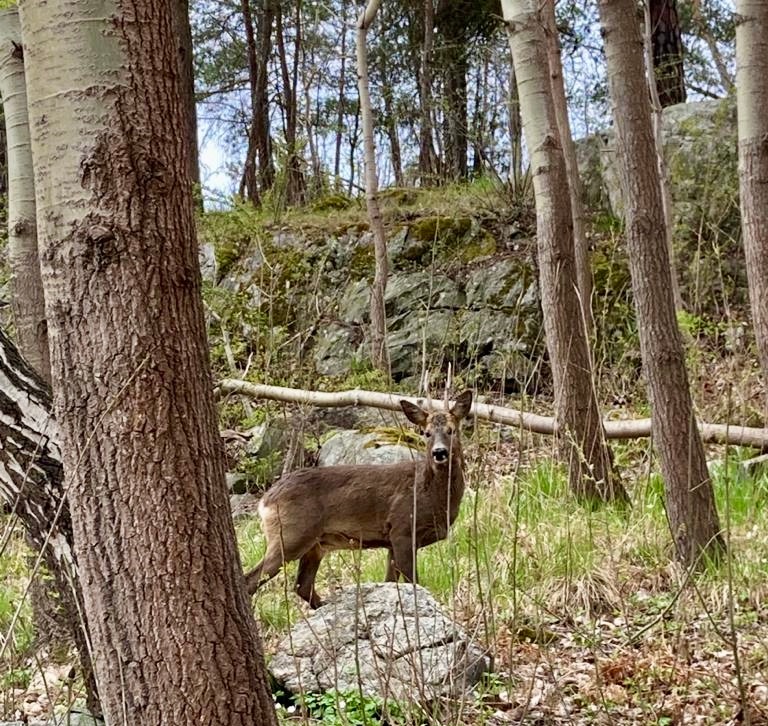
We purchased Knox Wood in August 2023, part of Boltonmuir Wood, an old woodland site on fairly boggy ground in East Lothian. Our five acres are split 50% almost pure birch (Silver and Downy) regenerating [about 20 years old] and 50% mature Scots Pine that is well thinned over mixed natural regeneration.  All of the site has previously been used for commercial forestry so there is plenty of natural regeneration from Sitka Spruce, Douglas Fir, Western Hemlock, Silver Fir and Larch. Some oak, rowan, hawthorn and beech regeneration is also present. Roe deer use the site but are not having much impact on the trees, just ticks to be aware of.   Plenty of mosses, ferns and bracken that indicate acidic soil conditions. Our plan is to improve the site for biodiversity and use some birch for green wood working.  So far we have been taking out non-native conifer regen, leaving a few that are suitable for bird nesting and to provide a bit of evergreen shelter. A few Rhododendrons to eliminate as well, easy enough using the lever and mulch technique. We will create some standing deadwood and add to the fairly good level of deadwood from previous birch thinning that is now well rotten.  We will add a few native species, such as Aspen and maybe more Willows for weaving.   Also hoping to grow some edible fungi on site, there are wild mushrooms and I am sure plenty of people already roam around there collecting them.  As Alien Spoons, I teach green wood working so will thin out the birch for spoon carving, shrink pots, bowls and other treen.  Maybe make some besoms and other products with it as well.    [caption id="attachment_41045" align="aligncenter" width="675"] Birch regenerating[/caption]  
Wildlife in Scotland

Wildlife in Scotland

by The blog at woodlands.co.uk, 18 January, 2024, 0 comments

NaturScot is Scotland’s nature agency.  It monitors and reports on all aspects of the natural environment.  It has published a report on its terrestrial bird breeding species and it is a somewhat mixed report. Some of the most ‘famous’ species associated with Scotland, such as the black grouse have declined significantly during the period of study (1994 - 2019).  The grouse population has halved, and the kestrel, greenfinch and lapwing populations are also in decline.  Woodland populations of Capercaillie have also fallen.  The largest grouse in the world, the capercaillie was once widespread but suffered local extinction in the eighteenth century and was reintroduced in the C19th. It is now only found in old pine forests and mainly in the Cairngorms National Park. The Capercaillie are now red-listed and protected in the UK. [The Pine Marten which feeds in part on the eggs of game birds was almost lost in the nineteenth century, due to farmers and gamekeepers trapping them.] The fall in bird numbers has been associated with changes in climate, notably warmer and wetter weather coupled with extreme events (such as flooding and heat waves).  Whilst some species have suffered as a result of the changing weather, others seem to have prospered, including some that do not ‘traditonally’ make their way to Scotland.  The great spotted woodpecker is one such species, its numbers have increase by 500%, bullfinch and red numbers have also increased.  Gold finches and magpies are now more common on farmlands in Scotland. various measures could help offset some of these declines,.such as  the diversification of woodland (more tree species) restoration of peatlands Creation of habitats on farmland legal predator control deer exclusion to allow regeneration removal of deer fencing, (where feasible) as capercaillie and black grouse are known to fly into this and injured as a result. One example of the benefits of deer fencing is to be seen in the Glen Lyone woodlands.  Historically, this area was part of the royal hunting grounds of Cluanie and was home to capercaillies, wildcats and lynx.    Nineteenth century maps show a significant area of woodland, but by the 1990’s less than a hundred of the ancient pines were left.  The oldest pine in the area dates back to the C14th century, and many others are several centuries old.  However, the area was heavily grazed by deer, which reduces regeneration as young seedlings / saplings get eaten.  Now “Trees for Life” have erected new deer fencing, which hopefully will allow natural regeneration of pine forest in the area.  Calendonian Forest once covered much of the Highlands but now less than 2% of it survives.  Full details of this project (and a video) may be found here ; https://treesforlife.org.uk/scotlands-oldest-wild-pine-saved/
Changing forests and woodlands.

Changing forests and woodlands.

by The blog at woodlands.co.uk, 18 March, 2022, 2 comments

For millions of years, forests and woodlands have been changing - as a result of natural regeneration, storms, fires and climate change.  However, with the expansion of human populations, woodlands and forests have been cut down to make way for towns, cities and the infra-structure of ‘modern’ life.  Sadly forests, and woodlands such as those in the path of HS2,  are still disappearing. ‘Untouched’ rain / tropical forest is being cut down to make way for cash crops; plus vast wooded areas have been destroyed by fire in Australia, Sweden and on the West Coast of the United States in recent years. Clearfell of any forested area for timber or agriculture involves the removal of all trees / vegetation and is sometimes followed by burning of the remaining debris. Clearfell can also have unintended consequences (beyond the loss of entire animal communities.  An Australian study has shown that it lowers soil nutrient levels - notably nitrate and phosphate.  Furthermore, the use of heavy machinery in clearfelling can compact the soil and its consequent exposure to the elements can lead to erosion (rain runoff).   When an area is subject to intense fire, there is a drop in the organic carbon content of the soil and structural damage to the soil; it can take many years for such fire-damaged soil to ‘recover’. Forests and woodlands support the vast majority of land-based species. However,  the species that we see today on a woodland walk may be different to those our ancestors might have seen five hundred or a thousand years ago.  Certain species only survive in relatively undisturbed (and ancient) forests / woodlands.  There are species that can ‘deal’ with disturbance and are adaptable, indeed opportunitistic,  such as red deer and fox.  The same can be said for certain plants species, which can become invasive.   Changes in species make-up and biodiversity do not always immediately follow loss of forest or woodland.  Generally speaking, the longer the life span of a species then the longer for the effects of forest loss to become apparent.  It may be that the effects ‘span’ generations, raptors / birds of prey may manage to raise their young in the immediate period following loss of forest or woodland. But their offspring may struggle to survive in a depleted environment. It might be that with limited resources an animal might simply not reproduce for years, if ever again.  Consequently, the impact of forest destruction / loss that species depletion might not be apparent for many years. The loss of forests and woodlands has lead to many local, national and inter-national initiatives to offset these losses: for example, New Zealand’s ‘One Billion Trees” project and the Nature Conservancy’s “plant a billion trees’ campaign.  Broadly speaking, reforestation involves the planting of native trees in an area, whereas planting with new (non-native) species is afforestation. Recent research suggests that whilst non-native plants often grow faster than native species, they also have less dense tissues (think: oak versus larch) and decompose more readily, which can contribute to more rapid cycling of carbon.  This will not help to mitigate climate change. It is also important to consider which trees might prosper and offer resilience in the light of climate change. Our climate is changing and will be different in the future, with summer temperatures being higher.  We have already seen more extreme weather events (leading to flooding and wild fires).  Forestry England has a number of tools to help plan which tree species will be suited to a site, now and in future.   There is ESC4 which offers a means to help forest managers and planners select tree species that are ecologically suited to particular sites; and there is also the climate matching tool.  As Forestry England says this is “so that we can see which places in the world currently experience the climate we are projected to have in future. We can compare these different places to help us plan which tree species will be suited to a site, now and in future”.  One strategy is to create woodlands that are more diverse, as it thought that diversity helps woods more resilient to climate change. This can be through encouraging a range of different, but carefully selected trees to grow, and being aware of the provenance of seeds or saplings.

Next Page »