Woodlands.co.uk

Blog - rewilding

Woodland updates

Woodland updates

by The blog at woodlands.co.uk, 26 April, 2026, 0 comments

Lighting up the trees. When there is thunder and lightning, there is sometimes a phenomenon known as St Elmo’s Fire.  It appears as an eerie ‘violet / blue ’ light on the masts of ships’ or church spires and it may be accompanied a slight buzzing sound. Sometimes it can be seen on the horns or antlers of animals  and in the right conditions may light up forest canopies with a faint, flickering eerie glow.   This has now been investigated by Patrick McFarland (and colleagues) - a meteorologist at Pennysylvania University. He has produced photographs / videos of coronae (electrical discharges) on the very tips of trees during thunderstorms.  Back on campus, the phenomenon was reproduced by exposing a branch from a spruce tree to a strong electrical field created between charged metal plates.  The waxy tips of the spruce needles glowed with a purple light; an  artificial St Elmo’s Fire was produced . (Further details to be found in the New York Times or at Wikipedia : https://en.wikipedia.org/wiki/St._Elmo's_fire ). Interesting fact : In 1751, Benjamin Franklin hypothesized that a pointed iron rod would light up at the tip during a lightning storm, similar in appearance to St. Elmo's fire.   A ray of hope ? A survey of land holdings in Scotland, where nature restoration / rewilding has been encouraged, has indicated that bird and insect pollinators are flourishing.  The study involved the Northwoods rewilding network; this includes some 100 farms, crofts and woodland sites - which are quite widely dispersed but covering more than 30,000 plus acres.  The survey compared areas of the rewilded land with neighbouring areas that were managed more conservatively / traditionally.  Bird populations were assessed at five of the sites and butterflies and bumblebees at six.   The birds doing well in such areas included the spotted flycatcher, cuckoos and woodcocks.  Butterflies that were recorded were the painted lady, green veined white, red admiral, scotch argus butterfly and the peacock. Bees included the buff-tailed bumblebee, the common carder, early and tree bumblebees.   Further details in The Scotsman [Katharine Hay, Friday 6 March 2026] or Apple News : https://apple.news/ AWyx1qpa9SbeOg-2HGmMtXw [caption id="attachment_38081" align="aligncenter" width="675"] Bumblebee visiting foxglove[/caption]
Sarah on the tractor

Woodland web updates 34.

by The blog at woodlands.co.uk, 24 March, 2026, 0 comments

Biodiversity after the Black Death. The plague or black death swept across Europe and the UK (from 1347 - 1353, resulting in millions of deaths.  Some studies suggest that it killed between a third and half of the population.  As a result, there was a much reduced workforce, villages were deserted, farmland was abandoned, traditional land and woodland management fell by the wayside.  It was suggested that all of this lead to a significant rewilding event and an increase in biodiversity - both plant and animal. However, an analysis at York University of fossil pollen studies across Europe suggests a 'different story’.  Plant diversity did not increase after the plague, in fact it fell. Plant diversity fell for the next 150 years.  This suggests that some plant species depend on the human disturbance within the various ecosystems (farming, grazing, woodland management, all help seed dispersal etc).  However, mediaeval practices were far gentler than today’s mechanised, industrial scale farming and the clear cut felling of woodlands. Ploughs were pulled by oxen or hand, woodlands were managed by coppicing etc.  So reducing human activity does not always lead to a 'rebound of nature’. The contribution of small woodlands. Over the centuries, our woodlands and forests have been ‘decimated’.  Our woodland / forest cover has been reduced to a small percentage of what it was by farming, felling, building of transport networks and the expansion of towns and cities.  Consequently, there now exist many small patches of woodland in an an agricultural landscape. These ‘islands’ differ in size, degree of isolation, and age. It would be easy to dismiss such ‘islands’ are being of no importance.  However, recent studies suggest that they can make a significant contribution to the biodiversity of the landscape, partly through the ‘edge effect’. The edges of woodlands are exposed to the surrounding environment. Consequently, they receive more sunlight and often nutrients from the surrounding agricultural land.  They are generally richer in species like brambles, hawthorn, willow, offering food for deer, butterflies and other species.  They may also store more carbon in the topsoil than older woodlands - acting as carbon sinks.  As the edges of these woodlands tend to be drier and hotter than woodland itself, there is a lower risk of tick borne disease as fewer tick larvae survive under such conditions.  They are therefore making a significant contribution to diversity and ecosystem services in an agricultural landscape. Such small and often isolated woodlands need to be managed. so they do not become overrun by ivy and bracken if they are to contribute to the diversity of the landscape. A singular advantage of owning a woodland with an edge is that it may offer a good view of the surrounding landscape, which one might sit and enjoy. [caption id="attachment_43124" align="aligncenter" width="675"] View from a scottish woodland[/caption] For further information about the edge effect see  Julian Evans' video on woodlandTV at YouTube : [embed]https://youtu.be/D2buIXiz1sk?si=zhsUiter2pjvyZAv[/embed]
Deer in woodlands

Deer in woodlands

by The blog at woodlands.co.uk, 22 June, 2024, 3 comments

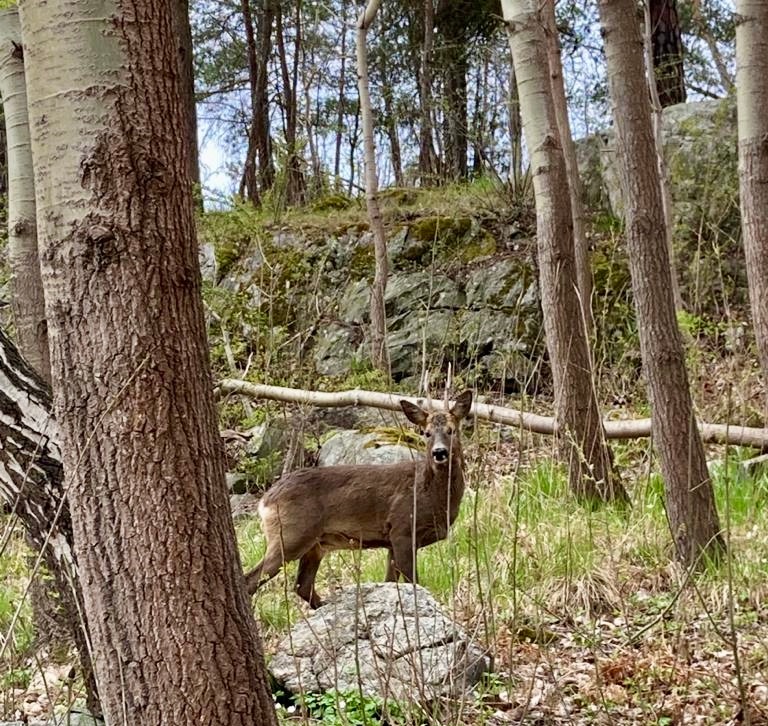
Woodland covers some 1,000 hectares of the Ashdown Forest, that is roughly 40% of its area. Much of the woodland is relatively young. However, the forest’s capacity for regeneration / renewal is being damaged by overgrazing.  Local deer populations have grown and now represent a problem. Deer browse / graze on vegetation, shoots, flower buds and foliage are stripped off plants.  Young saplings are damaged and bark is eaten, especially when food is scarce.  Consequently, tree and shrub regeneration is limited.  Other species are affected by the feeding of the deer, either through loss of niches or food.  Among those at risk are small mammals and certain butterfly species. [caption id="attachment_34368" align="aligncenter" width="650"] deer damage[/caption] Damage is found in woodlands in many parts of the country, as deer populations have increased in recent times. In the 1970s, the deer population was estimated to be around 450,000 as compared to today’s estimates of over 2 million.  The National Forest Inventory highlighted that "40 percent of British forests have ‘unfavourable’ levels herbivore damage, which limits the survival of young trees and threatens biodiversity".  Apart from deer damage, there is damage by the grey squirrel populations. Deer browsing can : Prevent natural regeneration Affect biodiversity Affect woodland resilience Reduce food availability to the herd which can lead to starvation / loss of condition Deer are also hosts to ticks.  The ticks may be infected with Borrelia burgdorferi  bacteria and transmit them to humans, resulting in Lyme disease. Deer  also contribute to collisions with motor vehicles; more than 450 deer were hit by vehicles on Hampshire roads last year .  In Scotland,  government agency figures indicate that deer vehicle collisions  [DVCs] have almost doubled between 2008 and 2020.   Sadly, people are injured or killed in DVCs, and the repair cost to vehicles runs into millions. The solution to the ‘problem’ is not clear cut. Culling [the selective killing of animals] to control deer populations is one way in which numbers can be reduced, and the damage to woodland mitigated.  However, this approach has been met with opposition by many, including animal rights organisations.  There is the argument that whilst a reduction in deer numbers might fix some problems in the short term, the subsequent increase in plant growth and food availability might lead to increased breeding by the remaining deer and numbers would then increase again.  Also, unsuccessful or inaccurate shooting leads to animal suffering, mutilation and / or a lingering death.   Some might advocate rewilding and the introduction of apex predators (such as the wolf, lynx, wild cats*) as a means of reducing numbers but that might raise other problems! Deer have been 'part and parcel' of woodlands since mediaeval times, when the forests were used for hunting. In the Ashdown Forest, the number of red deer declined during the C17th,  and poaching was a factor in their decline. Fallow deer numbers also declined. [Fallow deer were introduced to England by the Normans around 1100 AD.]  The deer population roaming the forest has increased significantly in the recent decades, and now there are the relatively recently introduced species, muntjac and sika deer.   There are six species of deer in UK woodlands – the two native species, the red deer and roe deer and fallow, muntjac, sika and chinese water deer make up the four non-native species. The problem of over grazing is not unique to the Ashdown forest. For example, deer numbers in Scotland have doubled in recent years to almost a million since 1990.   Finding sustainable (and humane) solutions to the large numbers of deer is difficult. * Wildcats were once widespread in Britain, but by the end of the 18th century, they were to be found only in the northern regions. [caption id="attachment_34415" align="aligncenter" width="700"] Remnants of birch woodland near Loch Muick are subject to browsing by red deer (especially in the winter), so temporary fences have been put in place to allow for regeneration.[/caption]
Rethinking the British countryside - more trees, fewer sheep?

Rethinking the British countryside – more trees, fewer sheep?

by Angus, 25 July, 2022, 0 comments

Perhaps it all started with a "No-shave November" (or "Movember") when men realised that they could go for a month without shaving and no one would mind.  It may also have been good for them as they thought more about men's health and they let nature take its course.  A few years later people started wondering about other habitual cutting, such as mowing their lawns religiously.  "No Mow May" was invented in 2019 by Plantlife with the idea that less cutting of grass would allow wildflowers to flourish.  The official reason for this concession to conservation was to allow the wild flowers and pollinators to thrive, but it may also have become popular because it allows maintenance teams to work a bit less hard during May.  In any event it's now so popular that about 36% of lawn owners now join in every year.  But it's spilled over well beyond just the month of May - many owners of lawns have questioned whether they really want so much short grass when alternatives are more interesting - and better for wildlife.  Even at the 2022 Chelsea Flower show there were several gardens demonstrating rewilding. So rethinking the scorched earth policy has now spread from men's chins to gardens and parks - but will it spread further?  What about our hillsides? For eighty years we have been intensively grazing these with sheep and cattle as if our lives depended on it - which maybe they did in 1942, when war-time convoys of food from the US were being torpedoed.  Even after grazing ceased to be a necessity sheep continued to dominate our hillsides with grants to sheep farmers making it profitable to use their four-legged lawnmowers at scale.  Farmers even grubbed out hedges in the 1970s, described by Oliver Rackham as the locust years, which made the countryside look even neater and tidier.  According to DEFRA there are currently about 32 million sheep in the UK, a third of them in Wales.  Land used for rough grazing and grassland makes up about 50% of the UK's total land area.  So for several generations now the UK has used half of its land to raise animals for eating, but times are changing rapidly.  Whereas those with meat-free diets used to be a tiny minority their numbers are growing rapidly - already at least 14% of the population is meat-free and for those of university age (18-23) the number is up to 25%, and rising. The combination of reduced demand for meat and increasing awareness that we can happily stop cutting the grass is prompting a rethink of how we use the British countryside.  Much of the grazing land is not suitable for growing agricultural crops so that leaves owners wondering what to do with their land.  Some are choosing rewilding in various ways but usually with far fewer grazing animals, longer grass and more wildflowers. [caption id="attachment_38426" align="aligncenter" width="600"] 'rewilding' of roadsides and verges[/caption] Others are planting trees and creating new woodlands.  Where the land is sold it's often to people who want to plant trees or simply to fence out sheep and allow "natural regeneration" allowing trees to self-select and grow on their own.  It's an appealing project for many families to take on 5 acres of grazing land, plant trees and convert it into a wood of their own. This re-evaluation of how grazing land is used is happening right across the world as plant based diets become more popular and there is potential to re-establish wilder habitats.  It's good for carbon emissions - not only because woodland fixes carbon but also because rewilding cuts the number of grazing animals releasing methane: belching by sheep and cattle creates a third of the total emissions of UK agriculture. Despite this, there may be resistance from the powerful National Union of Farmers which mostly represents bigger farmers and which promotes farming as an industry.  Farmers already complain about reductions in headcounts of livestock - since the peak in 1992, sheep headcount is down by about a third.  But it's also about the way the grant system is structured - millions of sheep only exist because of the farm payments, financed by taxpayers, and the condition of receiving these annual grants is that "unwanted" vegetation and wild plants have to be removed.  So even if the sheep don't chomp up biodiversity the farmers have to do it to get their grants. [caption id="attachment_21282" align="aligncenter" width="600"] Sheep grazing around solar array[/caption] Even beyond this suppression of diversity, sheep and cattle are damaging in many other ways such as compacting the soil which contributes to flooding and droughts. Meanwhile the number of men keeping their beards after no-shave November has increased and there are more gardens and parks with wild meadows so maybe the much bigger revolution in rural land use might follow. Governments have had it within their power for decades to reform the grant system but real change may be driven by people's behaviour - eating less meat and planting up their own woodlands.