Woodlands.co.uk

Blog - rhododendron ponticum

Changing times?

Changing times?

by The blog at woodlands.co.uk, 15 January, 2026, 0 comments

Researchers from the Open University have studied how ancient woodland habitats have changed in recent times.  Of the 43 woodlands studied; some were near to urban areas, whereas others were sited in rural locations.  The change in the nature of these woodlands was ‘measured’ by comparing historical records, herbarium specimens and surveys of the woodlands with present day surveys and analysis.   The study was particularly interested in ‘indicator species’ (eg bluebells, yellow archangel) associated with ancient woodland. Ancient woodland indicators are generally slow to colonise, but may be ‘stress tolerant’ and can persist after woodland disturbance or indeed, tree removal.  The study looked at how they fared with the spread of non-native species, such as the Spanish Bluebell, Rhododendron ponticum, swamp stonecrop (Crassula helmsii), Buddleja davidii, and Japanese knotweed (Fallopia japonica). These can outcompete native species, leading to local extinctions.  Woodlands near urban areas might be expected to be affected by the spread of such plants from gardens, parks etc. Pollution, which degrades air quality and also affects nutrient availability.  This may be due to fertiliser run-off from agricultural land or particulates and heavy metals from roads / industry.  Rural woodlands are perhaps more likely to experience fertiliser run-off than urban ones, this can increase nitrate and phosphate levels in the soil.  However, the drainage of particulates and various pollutants from roads and motorways has recently been recognised as problematic. The research indicated that the presence of native species in both urban and rural areas was relatively unaffected over the last thirty years.  However, the number of non-native or alien species in urban woodlands has risen significantly, affecting their species make-up. Thus, the study identified a large number of alien species recorded in ancient woodlands near to urban settings but these are largely absent from rural sites.   Biotic homogenisation can occur as non-woodland and alien species start to move into our ancient woodlands, leading to changes in the native plant communities.  A significant  proportion of ancient woodland in England is near to urban sites.  Clearly, there is a need for improved and careful monitoring of ancient woodlands near urban areas. 
Unwelcome 'guests'.

Unwelcome ‘guests’.

by The blog at woodlands.co.uk, 3 April, 2025, 0 comments

A plant growing in the wrong place is sometimes described as a weed, but it can be more than just an inconvenience.  Plants in the wrong place can have a devastating effect on ecosystems, dramatically reducing biodiversity.  The same is true for certain animals - those that have 'traveled' from their natural habitats to 'foreign areas’ where they have no natural predators to keep their numbers in check.  Foreign or alien species are sometimes introduced to an area in the belief that they will solve local problems with pests or over-population of a native species.   A classic example of this is the cane toad.  Native to  parts of central and South America, the cane toad is preyed upon by a variety of animals such as caimans, snakes, eels and some fish species.  It was introduced into sugar plantations in various parts of the world to control beetles that were damaging sugar cane crops. Since this was a successful strategy in Puerto Rico, the toad was introduced elsewhere, notably Australia.  Just over a hundred toads were released in Queensland in 1935, with more released in 1937.  Unfortunately the toad did not effectively control the grey-backed cane beetles (the intended target), and they found other things to eat.  Their numbers grew exponentially and they spread into other areas, such as the Northern Territory and New South Wales.  These poisonous toads have significantly reduced biodiversity particularly affecting native amphibians and reptiles. Sometimes foreign species are introduced as ornamental plants or 'exotics'. During the Victorian period many plant species were brought to the UK for country estates.  Rhododendrons that were collected across Asia and the Himalayas became popular in parks and gardens.  However, Rhododendron ponticum, a species native to the southwestern Iberian Peninsula (parts of Portugal and Spain) and the southern Black Sea Basin (parts of Bulgaria & Turkey)  has been less well received.   It was introduced in the eighteenth century by Conrad Loddiges.  Loddiges grew seed and sold on young plants as an ornamental flowering shrubs for gardens, parks and estates. On country estates and heathland areas, it was planted as cover for game birds as its dense growth offered shelter and protection. It has since spread aggressively and is now considered to be an invasive species. An invasive species is a non-native species that spreads and damages its new environment. R. ponticum poses a threat to key woodland ecosystems, such as Atlantic Oak Woodland.  When this shrub ‘invades’, it comes to dominate the area.  It creates deep shade so the woodland floor becomes a dark and ‘barren’ place. Many ground flora species are lost so that only shade tolerant mosses and liverworts remain.  These plants form a ‘dense mat’ of vegetation that is a barrier to seed germination.  Additionally, there is evidence that as R. ponticum grows, it produces chemicals which inhibit the growth of other species.  This phenomenon is known as allelopathy.  Even when the Rhododendron is removed, it is difficult to reestablish the original flora.  Clearing an area of this plant is difficult and expensive. One effective method involves drilling the stems and injecting herbicide directly into the plant, a targeted approach that uses a lot less herbicide than spraying.  Mabberley’s Plant-book notes that the cost of eradicating the plant from Snowdonia was £30M and that was in 1988. Another Victorian introduction was the grey squirrel. Native to North America, grey squirrels were first released in the UK in the latter part of the 19th century.   One person associated with their spread was the 11th Duke of Bedford  (Herbrand Russell).   He was involved in various animal conservation projects, but he released and 'gifted' many grey squirrels from the estate at Woburn.  The populations of grey squirrels in Regent's Park, London are thought to have come from there. Humans may still be helping the spread of the grey squirrel, albeit unintentionally.  One squirrel was captured on the Isle of Skye (in 2010), it had traveled from Glasgow, as revealed by its genetic profile.  It had probably made the journey as stowaway under a car bonnet. It is important that we are aware of how 'easy' it is for these animals to travel with us.  Their introduction has been disastrous for the native red squirrel populations, due to competition and the spread of the squirrel pox virus.  It is vital that grey squirrels do not colonise areas where the red squirrel still survives. . More recent introductions have arrived due to increased global trade.  Parasites and pests can ‘hitch a ride’ with people, materials or goods as they move across the world.   Climate change is also altering the range and distribution of many plant and animal species.  There is an alert for the Asian or Yellow Legged hornet (Vespa velutina nigrithorax), an invasive, non-native species from Asia.  This hornet preys upon honeybees and other beneficial insects such as hover flies and bumblebees. It hovers outside bee hives, waiting to catch and then kill returning honeybees. The effect on bee colonies can be devastating. The Asian Hornet arrived in France in 2004 (through an import of Chinese pottery) and has spread rapidly. Now it is found in Italy, Spain, Portugal, Switzerland, Belgium and Germany.  Preventing its establishment in the UK is critical.  Any sighting needs to be reported, this can be done through the Asian Hornet Watch. This link downloads a PDF, which gives more information about the Asian Hornet, and contains images comparing the  appearance of the asian hornet, the european hornet, the wasp and honey bee. Other invasive species that are a cause for concern include : Himalayan Balsam Harlequin ladybirds, Signal Crayfish, Eight-toothed bark beetle Citrus long horned beetle Giant Hogweed Thanks to Anton for images.
Deer and Scotland’s temperate rain forest.

Deer and Scotland’s temperate rain forest.

by The blog at woodlands.co.uk, 6 July, 2023, 1 comments

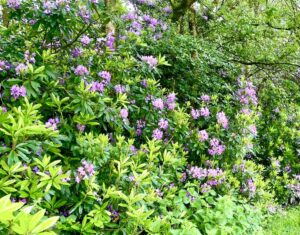
Scotland’s west coast has a number of temperate rain woodlands / forests. They are quite rare. The remnants of oak, birch, ash, native pine and hazel woodlands are small and isolated from each other. They are noteworthy for the diversity and richness of the bryophytes (mosses and liverworts) and lichens; found in abundance on the trees, rocks and on the ground.   Sadly, such woodlands have been in decline for some time. In the past, this woodland covered large areas of the west coast of Scotland, but much has been lost over the last two thousand years.  These woodlands / forests now cover a small area, just under 5% of the land. Factors that have contributed to the decline and loss of this woodland include:- mismanagement,  overgrazing by sheep and  invasion by non-native species [such as Rhododendron ponticum]. According to recent study by Scottish Environment LINK, deer now represent a considerable threat to the woodlands.  Whilst deer are part of woodland ecosystems, when their numbers increase beyond a certain point then they become a significant problem.  Deer numbers are now at historic highs in Scotland/  Money has been made available to manage surging deer populations, for example, through the provision of deer fencing.  However, the report considers that such fencing is “both expensive and often ultimately ineffective”.  More needs to be done if deer damage is to be reduced and allow regeneration of the woodlands. Developing a community approach to deer stalking and management will be important, combined with the use of technologies such as thermal and drone surveying. A greater focus on the management of roe and sika deer, combined with the removal of Rhododendron ponticum will be needed if the woodlands are to flourish and expand. see also : https://www.thescottishfarmer.co.uk/news/23637346.soaring-deer-numbers-see-new-powers-land-managers/   [caption id="attachment_39688" align="aligncenter" width="675"] Rhododendron ponticum, these plants were growing near the River Tay.[/caption] visit https://www.instagram.com/woodlands.co.uk/?hl=en  
Rhododendron ponticum revisited

Rhododendron ponticum revisited

by The blog at woodlands.co.uk, 30 March, 2023, 0 comments

In the eighteenth and nineteenth century, many explorers / adventurers brought ‘exotic’ plants back to the United Kingdom. These ‘exotics’ were planted in arboreta, botanic gardens, and some in gardens.  One bush that was introduced was Rhododendron ponticum. The plant is native to the eastern and western Mediterranean, and the Pontic Mountains, hence its name). It was introduced into Britain in the late eighteenth century, by Conrad Loddiges.  It was planted in Victorian hunting estates, also on heathland areas to provide shelter for game species. Its rootstock has been used for grafting of less hardy, more colourful types.  Many Rhododendron species are a delight and an adornment to our parks and gardens, indeed many hundreds of species of Rhododendron are known (many in China and the Himalayas)*.   Rhododendron ponticum has proved to be invasive.  It is a threat to key parts of our woodland ecosystems, such as Atlantic Oak Woodland.  Atlantic oak woodland is sometimes referred to as Celtic Rainforest.  It is characterised by lichen covered trees, growing amongst a rich moss and liverwort flora.  This woodland environment is damp and humid, to which streams and waterfalls contribute. These woodlands have evolved under the influence of the Gulf Stream,  which helps keeps warm and wet the area.  In some parts of the country, the woodlands have remained in their 'ancient state', since the last ice age.  However, these woodlands were more extensive but now exist as much smaller ‘pockets’ - damaged by grazing, pollution, and ‘exotics or aliens’ like R. ponticum. When this shrub ‘invades’, it 'takes over' and the woodland floor becomes a dark and barren place. A deep shade results from the thickets of the Rhododendron.  This results in the loss of much of the ground flora so that only some shade tolerant mosses and liverworts remain.  They form a ‘mat’ of dense vegetation that is a barrier to seed germination.  Even when the Rhododendron thicket is removed, the re-establishment of the original flora is compromised.  There is also evidence that as it grows this shrub produces chemicals which inhibit the growth of other species;  this is known as allelopathy. R.ponticum has spread in many areas, mainly to the West of the country. Each flower can produce several thousand seeds, so that a large bush can produce several million seeds in year. These seeds are tiny and wind dispersed; and though not all the seeds will germinate and grow, many will and colonise an area. Even when bushes have been removed from an area and the litter layer cleared, the seeds may persist in the seed bank of the soil - allowing the species to recolonise. In consequence, follow up over a five year period is really important. Recent figures suggests that some 37,000 hectares are affected in the UK.  Though the government does make a grant available for the removal of Rhododendron, progress with its removal has been slow. In Wales, there is a project called the Celtic Rainforests Project  (YouTube video link here) that focuses on invasive species and their attempted eradication in Atlantic Oak Woodlands in Wales.  With the agreement of the landowner, the project will organise surveys to identify the scale of the problem, and then contractors to carry out the work over the period of a management agreement, at no cost to the landowner [woodlands.co.uk has groups of buyers who have agreed for their various woods to be covered by such management agreements]. Clearing an area of this plant is difficult and expensive. An  effective first treatment to eliminate R. ponticum is to drill the stems, and inject herbicide directly into the plant.  This uses a lot less herbicide than spraying, and is a selective approach.  Mabberley’s Plant-book notes that the cost of eradicating the plant from Snowdonia was £30 M and that was in 1988.  Further information about the work in the welsh oak woodlands here. The plant is also a problem in Ireland. Indeed, referring to the Killarney National Park a politician has said “nothing short of calling in the army is going to put it right.” [caption id="attachment_39688" align="aligncenter" width="675"] Rhododendron ponticum growing near to the River Tay.[/caption] Forest Research has a number of publications about the management and control of R. ponticum. * Details of the genus may be found in Mabberley's Plant-Book. With thanks to Chris Colley