woodlands web update – 22
by The blog at woodlands.co.uk, 11 February, 2023, 0 comments
Back to one’s roots?
Some of the effects of agriculture are very obvious, such as the vast areas of land now covered by monocultures of wheat or oil seed rape. The expansion of mechanised agriculture has resulted in significant reductions in biodiversity, for example, through the loss of hedgerows and ponds (see the post on ghost ponds in Norfolk).
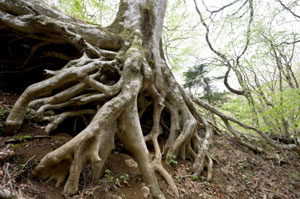
However, agriculture has others effects that are not quite so obvious. Soils are ‘filled’ with roots, and roots help engineer landscapes. They help:
break up bedrock,
improve permeability of the soil to water
stabilise the soil,
store carbon
transport water and minerals to the plants.
They have been doing this for millions of years since the colonisation of land by plants.
Now, research by scientists in the United States, has shown that the roots of agricultural crops are significantly less deep than those of the natural vegetation in an area. Indeed, the root depth may be shallower by some 60 cm, compared to the natural root systems of an area. If the soil is less root material then there is
decreased carbon storage,
reduced nutrient recycling and
possibly reduced soil stability.
Whilst there are some areas where “woody encroachment” is occurring (for example, shrubland taking over in some grasslands and forest advance into regions of tundra so root depth is increasing) - the onward march of agriculture is dominant.
Full details of this analysis / research : https://agupubs.onlinelibrary.wiley.com/doi/10.1029/2022EF002897
Shrinking in winter
Recent research has shown that some small mammals (like moles and shrews) shrink in size during periods of cold temperature. This shrinking is thought to be a response to cold temperature rather than lack of resources.
This change in form has been known for some 70 years and is referred to as Dehnel’s phenomenon. Professor Dehnel observed this change in form in shrews [in Poland in 1949]. However, shrews have a short lifespan so an extended studied of this phenomenon with these animals was not / is not possible.
Recent studies by German researchers have focused on moles, who can survive harsh winters by becoming smaller.
It is thought that this reduction in size enables energy savings. According to Dr Dina Dechmann this reduction in size comes at a cost, as the animals’ cognitive behaviour is affected.
Further information here :
https://royalsocietypublishing.org/doi/10.1098/rsos.220652
Farming and sustainability
With the expansion of farming, less and less of the land is available for our native plants and animals, Hedgerows and ponds have been lost / removed, natural habitats have been reduced. The government has produced new guidance on environmental land management schemes (ELMs). That is subsidies that will be paid to farmers if they help promote and protect nature and improve the environment (e.g. using less insecticide and reducing pollution).
There would be payment /subsidies for some 280 measures, for example :
Creating fenland from lowland peat
Maintaining sphagnum moss
Creating land that could produce organic fruit
Establishing a skylark plot
Adding organic matter to the soil
Creating green cover over winter (on 70% of the land)
Welcome as these measures might be, there is criticism that they favour big arable farmers and do not really help those working on more marginal land (such as upland and moorland regions).
Further information available here.
Trees - From Root to Leaf
For those who like their trees, here is a new book about them. Written by Paul Smith -who was head of the Millennium Seed Bank of the Royal Botanic Garden, Kew. Not read or seen a copy but the Sunday Times comment "'Stunningly illustrated and detailed ... a celebration of all things arboreal, from the seeds, leaves, flowers and fruit to the diversity of trees and how they have influenced art, culture and science' suggests that it might interest.
See "https://press.uchicago.edu/ucp/books/book/chicago/T/bo186012850.html"